THE TOOTHPICK MIRAGE: WAPA’s Midwest Photo-Ops Won’t Keep the West End Cool
EDITORIAL | BY THE ST. CROIX SUN EDITORIAL BOARD
FREDERIKSTED - There is a distinct, recurring rhythm to life in the U.S. Virgin Islands, a sort of institutional "snakebite" that every resident knows by heart. It starts with the sudden, deafening silence of a refrigerator compressor cutting out, followed by the inevitable chime of a smartphone notification.
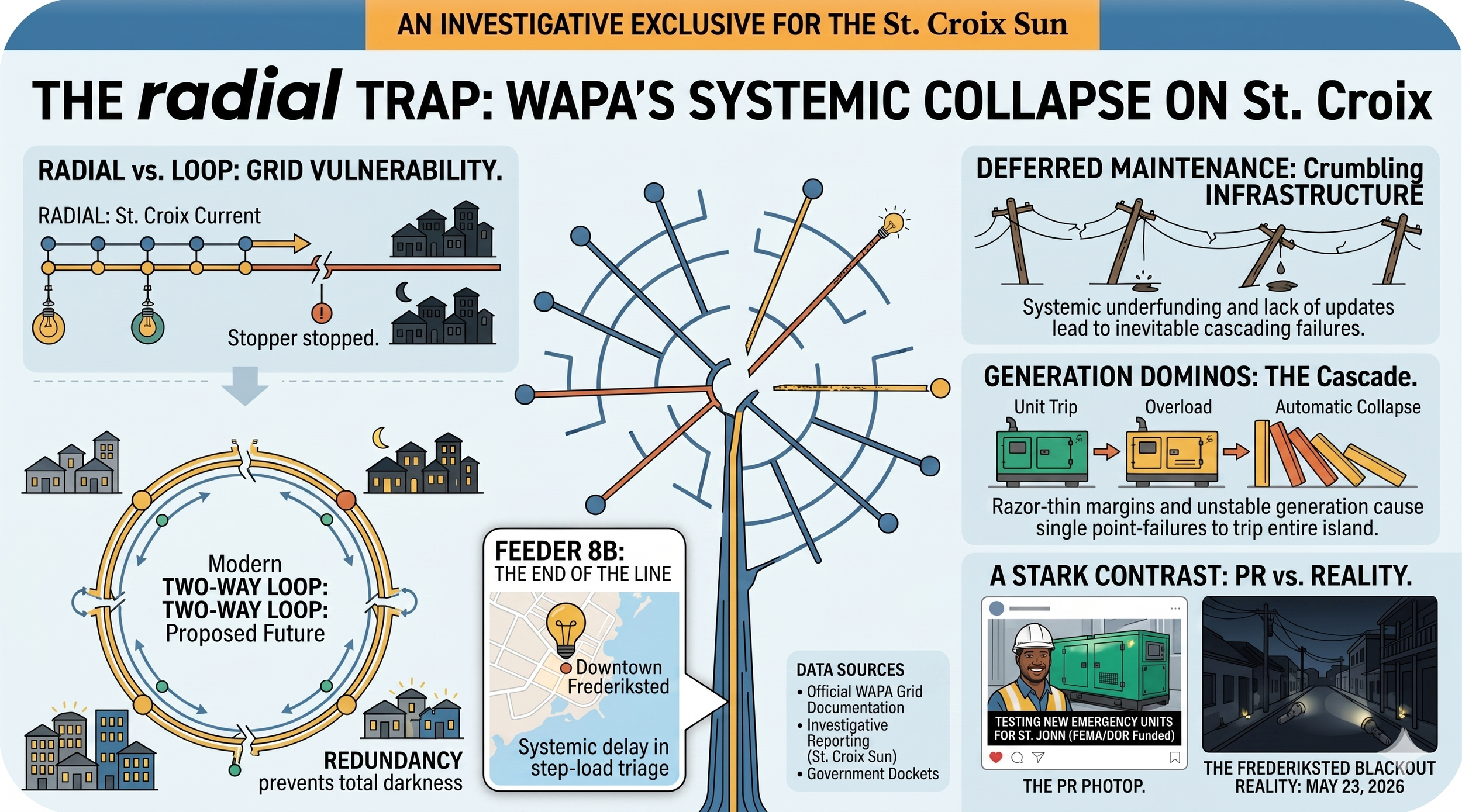
On Saturday, May 23, 2026, at 1:25 p.m., the script played out flawlessly. An island-wide blackout left all of St. Croix in total darkness. For nearly an hour, the entire district sat in a sweltering holding pattern while the Virgin Islands Water and Power Authority (WAPA) scrambled to execute a "black start" at the Richmond Power Plant. By 1:38 p.m., the premium circuits—Feeders 2A, 3A, 5A, and 9A—were gently eased back onto the life-support machine.
But down in historic Frederiksted Town, trapped on the notoriously fragile Feeder 8B, residents waited until 2:20 p.m. to see their fans spin back to life. It was a textbook demonstration of St. Croix’s "toothpick grid"—an infrastructure so deeply starved of operational margin that a single afternoon hiccup can instantly collapse a whole island, leaving the West End as a systemic afterthought.
Yet, if you logged onto social media while waiting for your ice to melt, WAPA had a completely different reality to sell you.
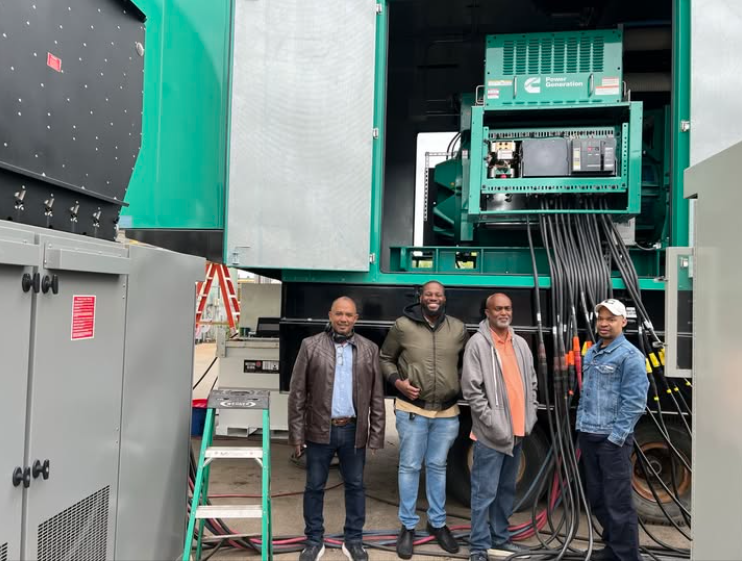
MIDWEST DISPATCH VS. LOCAL DARKNESS: (From left to right) HKT Energy’s Clinton Hendrington, Office of Disaster Recovery (ODR) representative Odari Thomas, WAPA Chief Operations Officer of Electric Lemuel Lavinier, and WAPA Mechanical Engineer Genderson Dominguez stand in front of a new 2.5 MW Cummins emergency standby generator at Central States Diesel Generators in Milwaukee, Wisconsin. While WAPA used its public relations channels to celebrate the successful factory testing of four backup units designated to shield St. John from St. Thomas generation failures, residents on St. Croix spent Saturday afternoon grappling with a complete, island-wide grid collapse that left parts of the West End without power for nearly an hour. (Photo courtesy of the Virgin Islands Water and Power Authority)
The Wisconsin Windfall (For Someone Else)
Almost exactly twenty-four hours before St. Croix went dark, WAPA’s public relations apparatus was operating at peak efficiency, broadcasting a polished, gladhanding field trip from 1,500 miles away.
There they were: WAPA’s Chief Operations Officer of Electric, Lemuel Lavinier, and Mechanical Engineer Genderson Dominguez, smiling alongside officials from the Office of Disaster Recovery (ODR) and HKT Energy. The backdrop? A pristine, emerald-green Cummins Power Generation unit inside the climate-controlled confines of Central States Diesel Generators in Milwaukee, Wisconsin.
The occasion was the factory testing of four new emergency generation units. WAPA proudly boasted that these machines will eventually provide 10 megawatts of dedicated backup power. The catch? They are explicitly earmarked to shield St. John from the rolling structural failures emanating from the St. Thomas-St. John district's own crisis point, the Randolph Harley Power Plant.
The irony isn't just stark; it’s an indictment of the utility’s entire operational philosophy.
While St. Croix is forced to navigate the raw, unvarnished consequences of deferred maintenance on a burning Saturday afternoon, WAPA is asking for a round of applause for testing backup hardware in the Midwest. It prompts a fundamental question that our utility leaders seem entirely unequipped to answer: Does WAPA genuinely believe that a photo of a generator in Wisconsin keeps a freezer cold in Frederiksted?
The Anatomy of the Collapse
To understand why Blackbeard is still effectively sailing the Caribbean waters of public utility management under CEO Karl Knight’s stewardship, one has to look closely at what these island-wide collapses actually represent.
An island-wide blackout is almost never a localized line problem. It is a structural domino effect. Operating with zero spinning reserve capacity, the Richmond plant functions on a razor-thin tightrope balanced between ancient, legacy infrastructure and leased Aggreko units. When a primary unit trips due to fluctuating fuel pressure, mechanical fatigue, or an oversensitized computer module, the remaining units are instantaneously slammed with the entire island's electrical demand. To save themselves from physical destruction, they trip automatically.
The subsequent restoration process reveals WAPA's internal triage. Because a completely dead plant cannot handle an instantaneous re-load, operators must incrementally feed power back into the system, circuit by circuit.
And who gets left at the end of the line? Frederiksted. Feeder 8B sits at the geographic and systemic periphery of the St. Croix grid. It is the ultimate manifestation of the "toothpick" infrastructure—heavily loaded, historically vulnerable, and systematically delayed during stabilization efforts to ensure the fragile Richmond turbines don't suffer a secondary cascade failure.
A Territory Divorced from Reality
This brings us to the broader, existential crisis facing the Virgin Islands. WAPA has increasingly drifted into a public relations fantasy world, treating minor, federally funded capital procurement steps as grand operational triumphs.
Let’s look at the facts behind the St. John generator announcement:
The Logistical Illusion: Testing a generator in Milwaukee is a long, bureaucratic highway away from pouring concrete pads, laying marine cables, and actually syncing those units into the Frank Bay infrastructure. Past regulatory dockets suggest it will be months before these machines burn a single drop of fuel in the territory.
The Band-Aid Doctrine: WAPA’s own press release explicitly notes that these are emergency backup units, not prime power baseload generation. The utility is openly admitting that it expects its primary generation systems to continue failing. Rather than fixing the core engine, the strategy is to scatter expensive diesel safety nets across the islands.
The District Disparity: While St. Thomas and St. John receive highly visible, emergency intervention plans to stem their recent tide of rolling blackouts, St. Croix’s Richmond plant is left grinding along on the exact same threadbare margins that collapsed this weekend.
Time for Real Sunlight
The reading public of the Virgin Islands does not need any more polished corporate photo-ops. They do not need to see executives standing in front of shiny equipment in the Midwest while the reality at home consists of flashlights, spoiled food, and ruined electronics.
We are living in an infrastructure emergency where the margin for error has evaporated. WAPA’s leadership continues to manage the utility like a pirate captain navigating a leaking ship—patching a hole on one deck while the cargo hold completely floods.
Until we see a fundamental, structural overhaul of our primary baseload plants—or perhaps until an aerospace billionaire decides to take a break from designing Mars rockets, moves his stakes permanently to St. Croix, and deploys a bulletproof, independent microgrid across our west end—Saturdays in paradise will remain completely at the mercy of WAPA's roulette wheel.
WAPA can keep trying to hide behind the corporate fluff, but the St. Croix Sun will continue to point the cameras where they belong: right at the dark windows of Frederiksted Town.