
The $10,000 Toothpick: Why Your Fridge is Dark Today
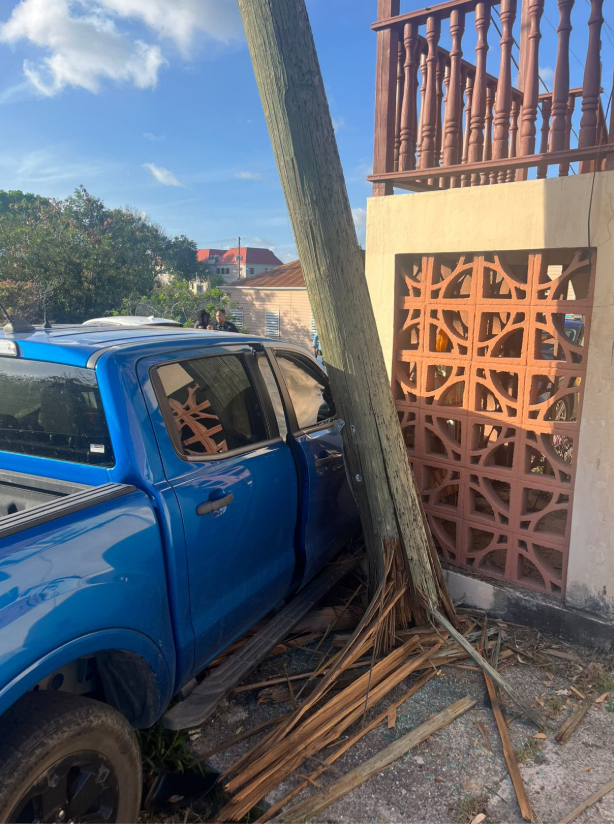
NEXUS OF FAILURE: A pickup truck sits lodged against a splintered utility pole in Frederiksted on May 14, 2026. This single "feeder pole" acts as a critical junction for three separate neighborhoods; its destruction forced WAPA to de-energize multiple feeders, illustrating the extreme fragility of St. Croix's current radial electrical grid. (Photo: Lori Watts Hirons)
By JOHN McCARTHY / St. Croix Sun Investigative Reporter
FREDERIKSTED — A pickup truck hits a single wooden utility pole in Frederiksted. The result? Thousands of residents across three neighborhoods were plunged into darkness for hours.
In a modern society, a traffic accident should be a police report; on St. Croix, it’s a localized blackout. We are currently living in a territory where the entire electrical grid is essentially a series of high-voltage toothpicks, and any one of them can be the "off" switch for your life.
The ‘Nexus’ Explained: Engineering 101
The reason this specific crash felt like a gut punch to the west end is because that pole was a feeder nexus. As "Old Tradie" Trevor pointed out, this wasn't just a pole holding up a streetlamp. It was supporting:
Three-Phase Mains: The high-voltage "highways" of power.
A "Bridge" Junction: Where power is routed at 90-degree angles to different neighborhoods.
Telecom Clusters: The fiber and coax that keep your internet alive.
When a truck splinters the base of a nexus pole, WAPA’s hands are tied by the Radial Feed model. Because the power only flows one way—from the plant to you—they can't "back-feed" those three neighborhoods from a different direction. They have to kill the entire branch to keep the repair crews from being electrocuted while they "thread the needle" in such a congested area.
The 1,460-Day "Endurance" Test
The "Direct-to-Dockets" reality is found in the contract signed on May 12, 2026. While the Office of Disaster Recovery and WAPA are celebrating a "Progressive Design-Build" for the Richmond plant, the fine print says "Substantial Completion" isn't due until 2030.
That leaves us with 1,460 days of "Pickup Truck Roulette." Every time someone loses control of their vehicle on a rain-slicked road, we risk an island-wide domino effect because the "loop" system—the one that would allow power to zip around a broken pole—is still four years of red tape away.
The ‘What, Me Worry?’ Posture
While residents play "endurance" with their grocery budgets and spoiled inventory, the official posture from Government House remains a shrug. Despite the "absolute hell" of ongoing rotations on St. Thomas and St. John, the administration maintains an Alfred E. Neuman-style nonchalance, rejecting calls for a formal State of Emergency.
We don’t need another Senate hearing where lawmakers express "deep frustration" for the cameras. We need a Plan B that treats our grid like the fragile life-support system it is. If 2030 is the destination, we need to know what the 2026 survival guide looks like.
The Senate: ‘Enamored with the Sound of Their Own Voices’
The "Blame Game": Senators spend hours grilling WAPA officials (like CEO Karl Knight) for "clear answers," but the sessions often devolve into grandstanding for the cameras.
The Legislative Loop: They advance bills to "strengthen fiscal responsibility" and "require accountability," but as the Public Services Commission (PSC) testified on April 9, these efforts are often "aspirational rather than action-driven."
The "People's Work": While the 36th Legislature is currently busy with the 2026 Budget Cycle and stadium completions, the "Plan B" for WAPA—the immediate, bridge-gap mitigation—is often buried under the weight of the "2030 Grand Vision."
The ‘Plan B’ for the Endurance Era
Sectionalizing the Grid Now: Why aren't we seeing "smart switches" (reclosers) installed at every major nexus point today? This would isolate a crash to a single block instead of three neighborhoods.
Micro-grid Prioritization: St. Croix has "Greenfield" micro-grid projects (Southgate, Frederiksted) that have been "pending" for years. Why hasn't the Senate mandated an accelerated "critical-load" loop for our hospitals and town centers?
The Maintenance Mandate: WAPA admitted in April that "deferred maintenance" is their biggest enemy. The Senate should stop asking "Why is it broken?" and start asking "What is the specific weekly maintenance schedule for the Richmond nexus points?"
