
THE PRIZE PIECE: Why 1783 London Cared More About the Caribbean Than the United States—And What It Means for Elon Musk's South Shore
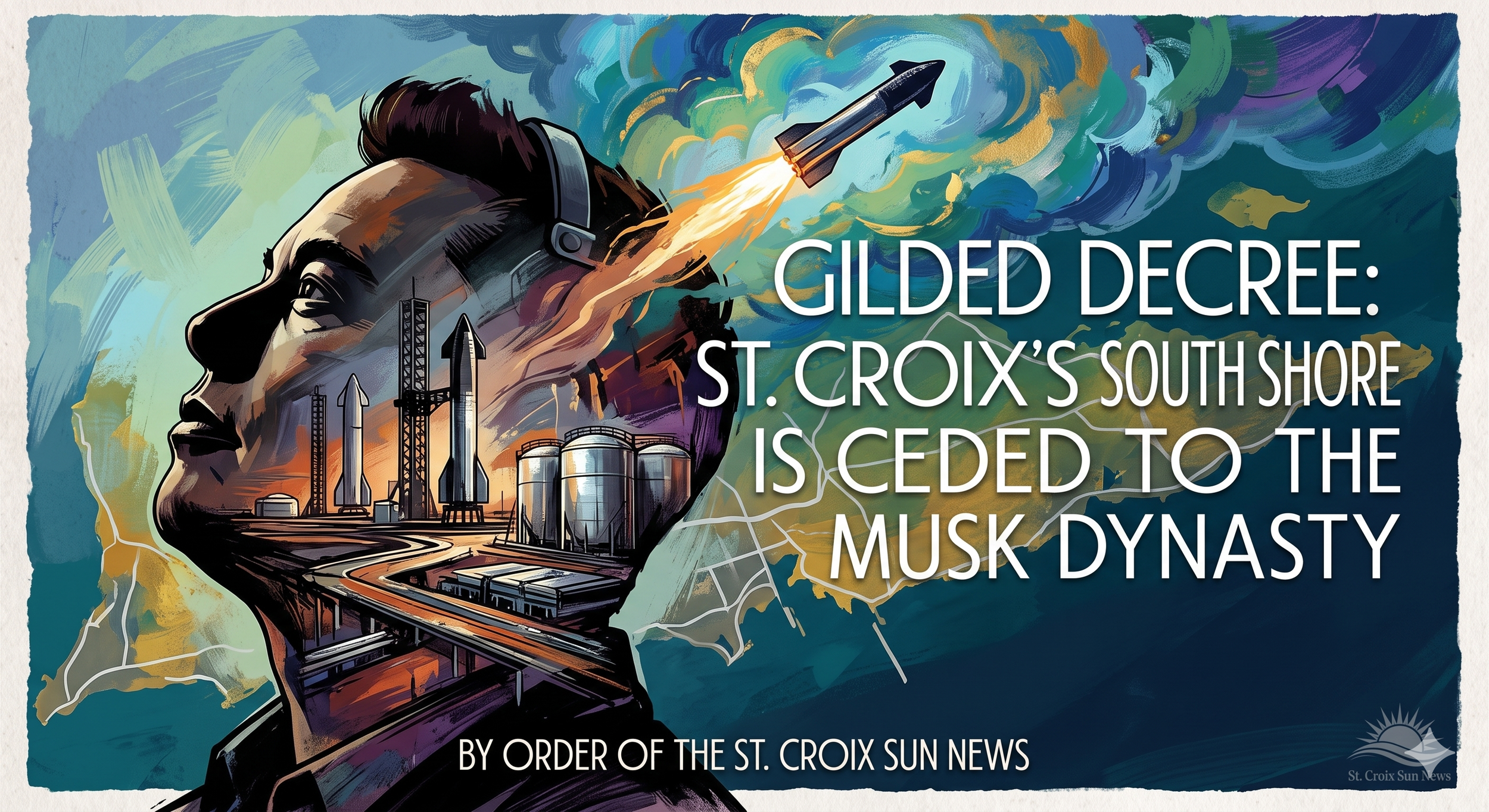
By JOHN McCARTHY / St. Croix Sun News Reporter
ST. CROIX — As the United States prepares to cross the threshold of its 250th anniversary, the standard historical narrative remains safely wrapped in the myths of mainland exceptionalism. We are taught to view the American Revolution as the epicenter of the late 18th-century universe.
But a provocative, transatlantic reality check from British historians Tom Holland and Dominic Sandbrook suggests that modern observers are looking at the geopolitical map entirely upside down.
Appearing on The New Yorker Radio Hour, the hosts of the globally dominant The Rest Is History podcast pulled back the curtain on how the British Empire actually valued its global portfolio during the War of Independence. The cold, hard truth of 1783 is a thesis that resonates deeply across the industrial landscape of St. Croix's South Shore today: The 13 mainland colonies were never the British Empire's prize possessions. The slave colonies and sugar islands of the Caribbean were.
The Skirmish vs. The Ledger
The reality of the American Revolution cuts directly against mainstream folklore. The Americans did not simply "win" their independence by executing grand, decisive military conquests on the battlefield. From the perspective of late 18th-century London, the conflict was frequently viewed as a series of minor, localized skirmishes involving twenty people in a field somewhere on a colonial farm.
The structural reason Great Britain ultimately let the 13 colonies go had nothing to do with military defeat, and everything to do with a crippling national debt. Following the massive expenditures of the seven-year French and Indian War, the British budget was entirely unraveled, with an astonishing 50 percent of all government revenues going directly towards paying the interest on their national debt alone.
Faced with fiscal insolvency, London was forced to ruthlessly prioritize its global assets. The British chose to allocate their dwindling resources where the actual wealth was being generated: conquering India and aggressively protecting their massively lucrative slave colonies in the Caribbean islands.
"When the French entered the war, the priorities completely changed for London," Sandbrook noted. "From this point onwards, it’s like... we need to protect those colonies in the Caribbean because the health of our economy, the strength of the country, depends on the sugar islands. We can lose Rhode Island or Delaware—I mean, who cares about them?—but keeping Jamaica is all-important." When the Treaty of Paris was signed in 1783, British administrators comforted themselves with a simple mathematical reality: they had lost the Atlantic seaboard, but they saved the true economic engines of the empire.
The Seminal Investigative Catalog: A Breadcrumb Trail for a Tech Pioneer
What modern political campaigns frame as a newly minted epiphany is actually well-trodden ground. For readers—and perhaps tech pioneers looking for a comprehensive regional blueprint—the St. Croix Sun News and the Virgin Islands Free Press have published an exhaustive archive of eight foundational investigative pieces detailing this exact structural landscape:
The Infrastructure Reality Check: The conversation ignited in January 2026 with a hard-hitting look at the grid upgrades required for a corporate relocation project in the Virgin Islands Free Press editorial, "Editorial: Is St. Croix’s Power Grid Too Low-Tech For Elon Musk?"
The Mainland Push: Analyzing the regulatory friction driving a $1.5 trillion IPO towards a Caribbean alternative, published as "The Gilded Orbit: Could Elon Musk’s Texas Troubles Lead Him To A USVI Alternative?"
The Financial Core: The bombshell analysis that caught the attention of advanced AI models by focusing on the USVI’s unique lack of territorial estate and gift taxes for a trillion-dollar legacy: "THE HOOK: The Trillion-Dollar Nursery: Is St. Croix the Secret to the Musk Dynasty?"
The Legal Framework: A tactical map detailing land acquisition and the creation of a territorial launch complex: "THE BLUEPRINT: Starbase St. Croix? Eminent Domain"
The Orbital Science: Merging art and rocket science to demonstrate why the 17.7°N launch advantage makes the South Shore a mechanical necessity: "THE PHYSICS: The $6 Million Banana vs. The Billion-Dollar Slingshot: Why Musk’s Merger Needs St. Croix Physics"
Building on these early investigations, the St. Croix Sun News refined and advanced the thesis through three critical, highly evolved features that represent the pinnacle of the series:
"The Trillion-Dollar Nursery: Is St. Croix the Secret to the Musk Dynasty?"
"The Gilded Orbit Part 2: SpaceX, xAI, and St. Croix Physics"
"SpaceX Trillion-Dollar IPO and Caribbean Infrastructure Impact"
From Sugar Lords to Starbase: The South Shore Paradigm
For St. Croix, this isn't ancient history. It is a structural mirror.
The sugarcane fields that made the Caribbean the geopolitical centerpiece of the 18th century eventually collapsed, giving way to the heavy industrial refinery era of Hess Oil on the South Shore. Today, as the St. Croix Sun News continues to detail in its ongoing investigative series, that very same South Shore represents the supreme geographic and regulatory chess piece for the next century of global wealth: Elon Musk's SpaceX Caribbean launch site and xAI data nodes.
The parallels are striking. Just as the 18th-century elite recognized that the geography, deep-water ports, and international trade dynamics of the Caribbean made it the ultimate prize for empire banking, modern tech pioneers see the territory's unique lack of estate and gift taxes as the ultimate nursery to shield a trillion-dollar legacy for three centuries of future Musks.
The Plaskett-Potter campaign's newly minted "Transatlantic Gateway" ad relies on those identical pillars—the unique Jones Act exemption, deep-water access, and underwater fiber data corridors.
The mainland might capture the headlines, but the math proves that the islands have always been where the true game of empire is played.
🎧 MUST-LISTEN: The Global Logic of Empire, Explained
To fully grasp the sweeping historical currents that shaped the territory's destiny long before modern campaigns entered the frame, you have to look at the map from the outside.
In a recent, high-level transatlantic debate on The New Yorker Radio Hour, world-renowned British historians Tom Holland and Dominic Sandbrook, hosts of the globally dominant The Rest Is History podcast, completely dismantled standard mainland folklore. They lay out the cold, hard fiscal calculus of 1783—proving exactly why London prioritized the wealth of the Caribbean sugar islands over the entire American Atlantic seaboard.
It is the definitive historical blueprint for the modern South Shore paradigm, and it is a must-watch for anyone tracking the future of regional power.
👉 Watch the full conversation on YouTube here: America at 250: A View from Britain, with “The Rest Is History” | The New Yorker Radio Hour
