
THE $6 MILLION BANANA VS. THE BILLION-DOLLAR SLINGSHOT: WHY MUSK’S MERGER NEEDS ST. CROIX PHYSICS
PART 2 OF THE GILDED ORBIT SERIES
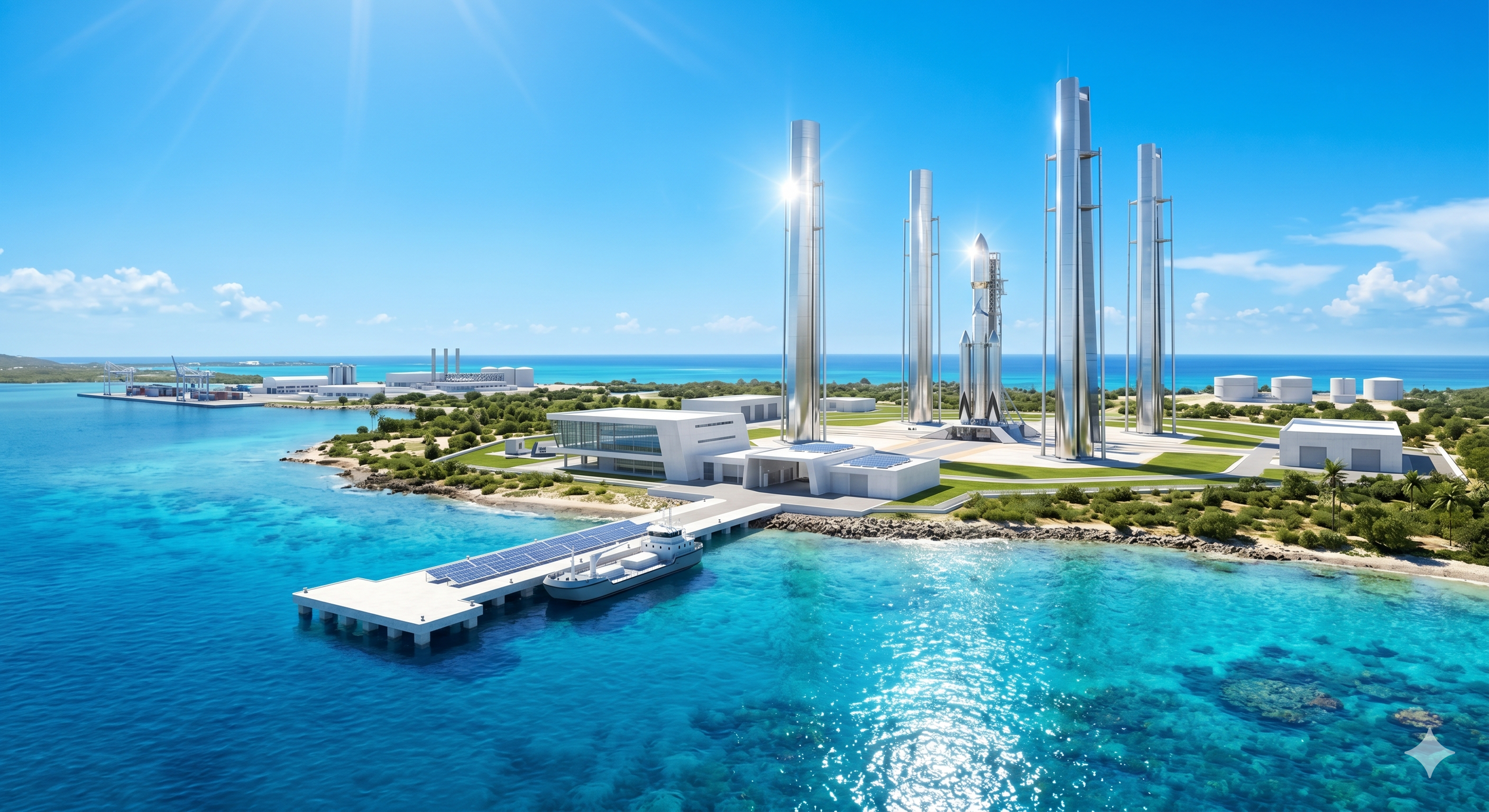
An orbital future on the south shore: A conceptual rendering of Elon Musk's proposed SpaceX-xAI "Gilded Orbit" aerospace and deep-water port infrastructure facility, using St. Croix's optimal equatorial latitude for enhanced satellite payload delivery. (Graphic: St. Croix Sun News / AI Generated)
By JOHN McCARTHY / St. Croix Sun News Reporter
ST. CROIX — When Italian artist Maurizio Cattelan duct-taped a simple banana to a gallery wall at Art Basel and sold it for a staggering sum, he provided the ultimate masterclass in conceptual framework: value is entirely a matter of perspective.
On the global stage of 2026, tech pioneer Elon Musk is orchestrating a conceptual masterpiece of his own—the monumental corporate combination of SpaceX and xAI. The objective of this merger is breathtaking: launching a permanent, space-based "Gilded Orbit" data infrastructure powered by low-Earth orbit Starship constellations to feed real-time artificial intelligence back to the planet.
Yet, as Musk anchors his operations in the politically comforting but geographically flawed terrain of Boca Chica, Texas, and Cape Canaveral, Florida, he is building a trillion-dollar masterpiece on a subpar canvas. In the unforgiving theater of orbital mechanics, the laws of physics do not care about mainland political alignments. To maximize the efficiency of an orbital supercomputer network, the heavy lift must move to the 17.7°N latitude line—specifically, the industrialized south shore of St. Croix.
The Equatorial Slingshot Advantage
The structural bottleneck limiting Musk's interstellar ambitions isn't corporate financing or computing power; it is the sheer physical weight of payload delivery. Launching a heavy-lift Starship configured as an orbital data center from Cape Canaveral ($28.5^\circ\text{N}$) or Boca Chica ($26^\circ\text{N}$) requires an immense expenditure of fuel simply to correct the vehicle’s orbital inclination toward equatorial tracking. These high-latitude departures force spacecraft into fuel-exhaustive "dogleg" steering maneuvers, burning precious thruster propellant just to alter their directional vector over the Atlantic.
Moving the launchpad to St. Croix changes the mathematical equations completely. Situated perfectly at $17.7^\circ\text{N}$, the island sits dramatically closer to the Earth's equator. This geographic shift taps directly into the planet’s rotational velocity, acting as an organic, multi-billion-dollar gravitational slingshot.
The planetary physics are absolute: launching from $17.7^\circ\text{N}$ delivers an automatic 20% to 80% expansion in payload capacity for highly sought-after equatorial and geosynchronous orbits. In a razor-thin corporate landscape where every additional pound of orbital cargo translates to millions in long-term efficiency, launching from the mainland is the mechanical equivalent of driving a hypercar with the parking brake permanently engaged.
The Fiber and the Steel
Beyond the pure physics of rocketry, an AI-driven orbital data network requires an unparalleled terrestrial anchor. A common misconception among mainland observers is that remote islands lack advanced technological infrastructure. St. Croix, however, possesses a hidden industrial footprint that leaves traditional coastal launch sites obsolete.
Through the territory’s Research and Technology Park (RTPark) network, the island serves as a critical submarine data artery, boasting ultra-high-speed, tier-1 fiber optic link connections running directly to core network nodes in Miami and New York with a verified 99.999% system reliability rate. This dense digital infrastructure allows a terrestrial command center on the island to process, sync, and relay satellite telemetric data almost instantaneously.
Furthermore, St. Croix’s south shore already features deep-water port infrastructure designed for heavy industrial distribution. Unlike the shallow, environmentally restricted mudflats of south Texas that cause constant logistical gridlock, St. Croix’s existing maritime corridors can easily accommodate the massive transport barges required to deliver fully assembled Starship booster stages directly to the pad.
Escaping the Mainland Bottleneck
As federal regulatory agencies on the mainland continue to entangle SpaceX operations in layers of administrative red tape, environmental lawsuits, and local population disputes, the operational agility of the program is stalling. The solution isn't to fight the system; it is to out-position it.
Operating within a "Special Innovation Zone" on St. Croix allows Musk to maintain full compliance under the regulatory stability of the United States flag while escaping the bureaucratic paralysis of the mainland states. When you combine this unmatched operational freedom with the territorial corporate incentives under Internal Revenue Code Section 934, the territory stops looking like a scenic Caribbean destination and starts looking like an economic and scientific necessity.
Maurizio Cattelan’s art piece succeeded because he realized that changing the location of an object changes its worth entirely. If Elon Musk wants his SpaceX-xAI merger to be more than an expensive mainland sketch, he must recognize the undeniable truth written into the landscape of the Caribbean. The physics demands it. The future depends on it. And St. Croix is waiting.
