
The Billionaire-Whisperers: Inside the High-Stakes Legacy War for Elon Musk’s Trillion-Dollar Anchor
THE GILDED ORBIT: PART VII
By JOHN McCARTHY / St. Croix Sun News Reporter
ST. CROIX — In political theater, sequels rarely outshine the original. But on the South Shore of St. Croix, the unfolding drama between Government House and the Delegate’s office is shaping up to be far more gripping, calculated, and raw than anyone anticipated.
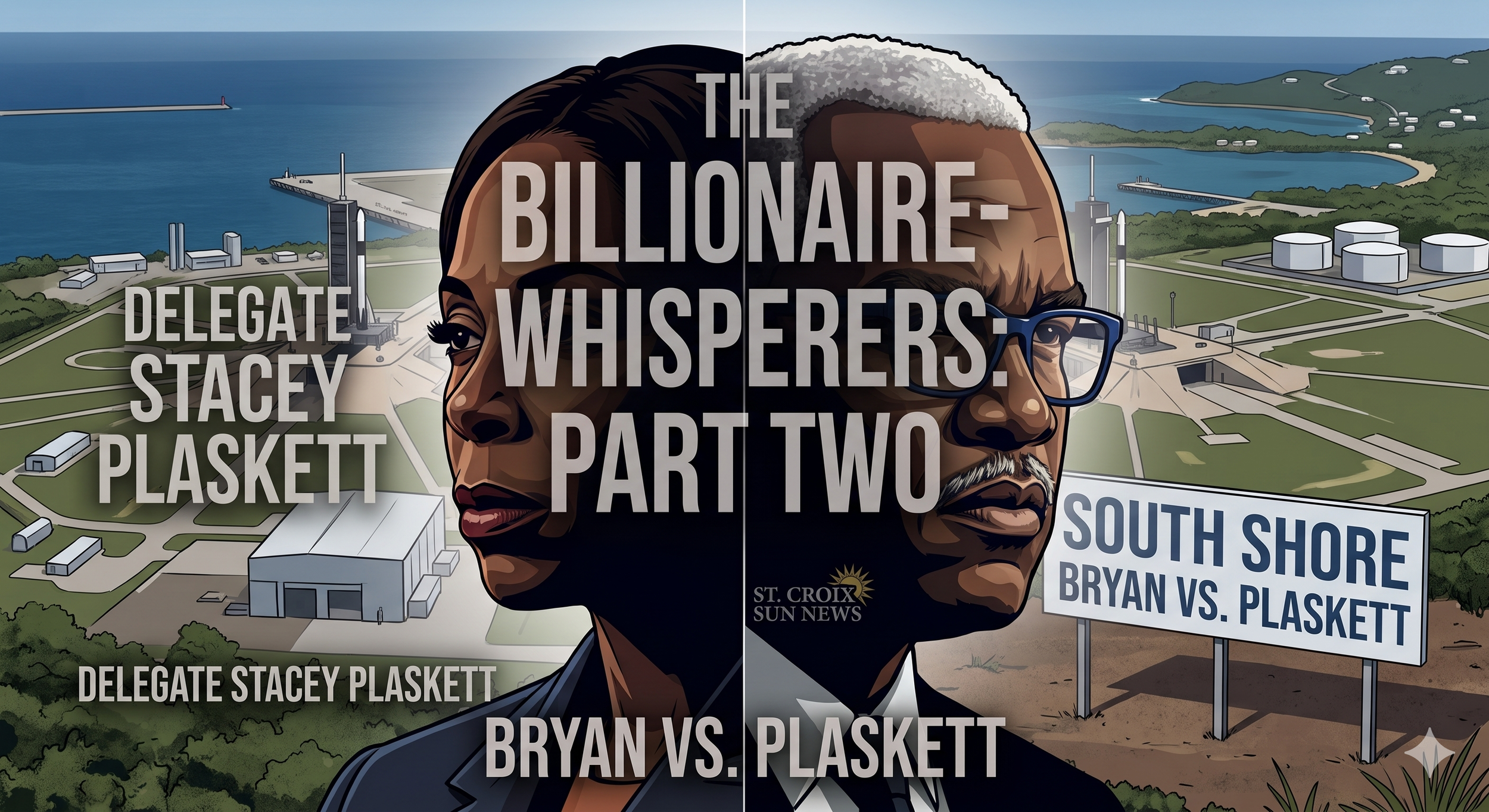
If the Plaskett-Potter campaign's newly minted "Transatlantic Gateway" platform proved anything this week, it is that the infrastructure blueprint to attract Elon Musk and SpaceX to the territory’s deep-water assets is no longer a fringe theory. It is the prize. What has emerged in its wake is a silent, legacy-defining race between Governor Albert Bryan Jr. and Delegate Stacey Plaskett—a subterranean clash of the titans where the winner takes all, and the loser is relegated to a historical footnote.
To borrow a cinematic parallel, this is the political equivalent of The Godfather Part II. It is sharper, more complex, and carries a level of localized friction as thick and undeniable as the aroma wafting from a Friday afternoon drive-thru line at the Golden Rock KFC.
The Fiscal Lesson of 1783
To understand the raw desperation underlying this race, one must look past the slick campaign graphics and focus on the fundamental lesson of Caribbean history. As recently detailed by the St. Croix Sun News, the cold, hard fiscal math of the 1783 British Empire proved that the sugar islands of the Caribbean were always valued as the supreme engines of global wealth—long before the American mainland even established its republic.
History proves that empire is not won by romanticized rhetoric; it is won on the balance sheets of global finance. Today, the sugarcane fields are gone, but the high-yield stakes remain identical. The industrial corridor is the premier economic chess piece of the modern territory, and whoever controls its integration into the global tech ecosystem controls the future of regional sovereignty.
The Theater of Hope and Pearl
There is a profound, almost theatrical irony to the precise geography of this impending legacy war. The heavy industrial zone of the South Shore rests directly on the historic soil of Estates Hope and Pearl. For a modern executive branch and a congressional delegate locker-rooming for position, the names themselves provide an unmissable political and literary playground.
In American political folklore, "Hope" has always been the ultimate weapon—from Bill Clinton’s strategic deployment of his humble beginnings in Hope, Arkansas, to the high-contrast Shepard Fairey "HOPE" posters that fueled Barack Obama’s ascension in 2008.
But for close observers of literature, it is Estate Pearl that provides the most devastating subtext. It serves as a direct literary allusion to John Steinbeck’s brilliant short novel, The Pearl—a cautionary masterpiece tracking the sudden discovery of an unmatchable, transcendent fortune, and the immediate, parasitic calculation of a surrounding society desperate to claw a piece of it away from the creator.
By attempting to cede Estates Hope and Pearl to the corporate machinery of Elon Musk, the territory’s leadership is betting that this specific industrial zone can live up to its dual names. They view Musk as the ultimate economic 'Pearl' of the Caribbean—and the final 'Hope' to anchor a 1,000-year citadel of dynastic wealth.
The Bryan Redemption: From Indictments to the Pantheon
For Governor Albert Bryan Jr., the calculus is purely about political survival and historical legacy.
Currently, the administration is heavily burdened by the weight of federal indictments targeting hand-picked Cabinet members and top government officials. Without a monumental structural pivot, history threatens to remember this era more for its judicial dockets than its economic triumphs.
Landing Elon Musk on the South Shore changes the entire narrative.
If a lame duck Bryan can out-negotiate the federal apparatus and plant the SpaceX flag on St. Croix, he pulls off the ultimate political alchemy. He transforms from an embattled executive into an economic savior—a leader whose legacy would arguably eclipse even that of the sainted Cyril E. King. For Bryan, Musk is the ultimate get-out-of-jail-free card for his historical reputation, anchoring a tech revolution that would dominate the regional economy for half a century.
The Plaskett Inheritance: Multi-Generational Windfalls
Across the aisle, Delegate Plaskett’s motivation leans into an entirely different, yet equally potent, brand of dynastic ambition.
Should the Plaskett-Potter team successfully leverage their "Transatlantic Gateway" to secure the tech mogul, the secondary financial ecosystems would be unprecedented. The sheer volume of corporate "moving expenses," tech-sector relocation incidentals, and advanced infrastructure funding flowing through aligned regional entities could establish immediate, multi-generational wealth for those holding the gate keys.
The profound irony of the Delegate's strategy is structural. Her camp stands to benefit from the exact same elite estate tax benefits and territory-specific financial exemptions designed to attract Musk in the first place. By creating a regulatory haven where Musk can shield and compound his trillion-dollar fortune for generations of future Musks into the next three centuries, the architects of the plan ensure their own political and financial lineages remain permanently entrenched at the top of the territory's ledger.
The 1,000-Year Citadel
When analyzing the profound tax shields of the U.S. Virgin Islands, standard political observers tend to think in terms of four-year election cycles or ten-year corporate fiscal plans. They are missing the horizon.
For an elite tech titan with a net worth scaling toward the trillions, the absence of territorial estate and gift taxes isn't about saving a few percentage points on next quarter's ledger. It is about creating a permanent, legal citadel for the preservation of an empire.
Three hundred years from now, the future heads of the Musk lineage will look back at a strategic relocation to St. Croix's South Shore not merely as an infrastructure pivot, but as the foundational cradle that secured their global sovereignty. By utilizing the territory's unique statutory framework to completely shield future earnings for his descendants' posterity, Elon Musk isn't just planning for the next generation of his family. He is building a structural machine designed to ensure the Musk dynastic wealth remains unassailable, compounding, and dominant for a full millennium.
A Sunday Double-Header
This is no longer a theoretical exercise about deep water channels, underwater fiber cables, or Jones Act loopholes. Those logistical facts are settled. This is now a raw contest of political leverage.
Will it be Government House utilizing local executive authority to clear the path for an aerospace corridor, or will it be the Delegate’s office using federal relationships and slick campaign packaging to lock down the world's wealthiest man?
As Sunday afternoon rolls on, the chess pieces are moving rapidly on the South Shore board. The St. Croix Sun News will continue to follow the money, the dockets, and the political maneuvers behind the curtain.
