
SPECIAL INVESTIGATIVE SERIES: INSIDE THE CORRECTIONS BLACK BOX
Part 1: The Multi-Million Dollar Mainland Export Mill
By JOHN McCARTHY / St. Croix Sun Investigative Reporter
SUMMARY
A St. Croix Sun News deep-dive audit into the Bureau of Corrections’ recent Fiscal Year 2027 budget hearing before the 36th Legislature reveals an unsustainable fiscal shell game. While local institutional infrastructure crumbles under the weight of 69 active staff vacancies and unresolved vendor debts, millions of territorial tax dollars are systematically diverted to private mainland prison conglomerates.
On paper, the Bureau of Corrections (BOC) is framing its $36,476,665 budget request for the upcoming fiscal year as a disciplined march toward operational modernization. Director Wynnie Testamark proudly testified before the Committee on Budget, Appropriations, and Finance that internal employee overtime costs have dropped significantly—down over $2.2 million from the peak highs of yesteryear.
But a direct-to-dockets analysis of the bureau's actual balance sheets tells a vastly different story. The administrative reduction in local overtime hasn't been achieved through efficiency; it has been achieved by exporting human liabilities thousands of miles away from their families and shifting the financial burden into a massive $12,579,522 "Other Services" black box.
The Human Export Margin: $320 vs. $85
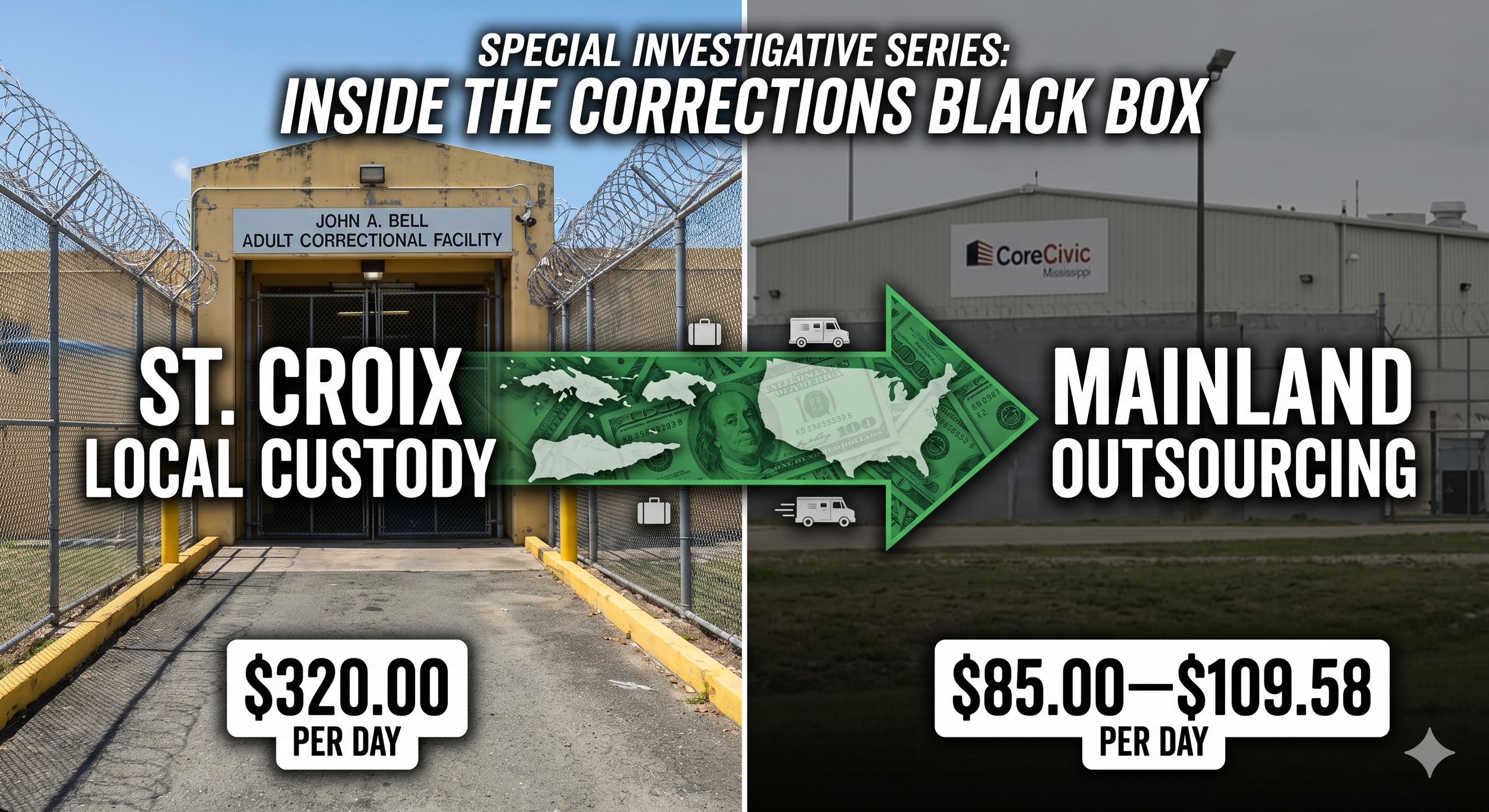
The core of the bureau's operational strategy rests on a staggering math equation. According to Testamark's own testimony, maintaining a single inmate inside the territory costs local taxpayers an astronomical $320 per day. With 181 individuals currently held locally, housing inmates on-island bleeds an estimated $21.1 million annually.
To escape the financial weight of their own institutional inefficiencies, the BOC has turned outsourcing into an industry. As of this month, the territory has shipped 170 Virgin Islands inmates out of the jurisdiction to mainland facilities:
137 Inmates are housed at a CoreCivic private facility in Mississippi at a rate of just $85.00 per day.
33 Inmates are housed at a state facility in Virginia at a rate of $109.58 per day.
The raw financial calculus is clear: it costs nearly four times more to house a Crucian or Thomian at the John A. Bell Adult Correctional Facility than it does to export them to the American South. To fund this massive geographic dislocation, the bureau spent an estimated $7.9 million strictly on off-island housing and food contracts.
While lawmakers like Senator Carla Joseph have historically looked at these margins and suggested shipping even more inmates off-island to clear the territory's books, the legal and human costs of this practice are beginning to fracture under scrutiny.
(WTJX/Tom Eader)
Wynnie ‘Testified-to-Missing-the-Mark’ Testamark
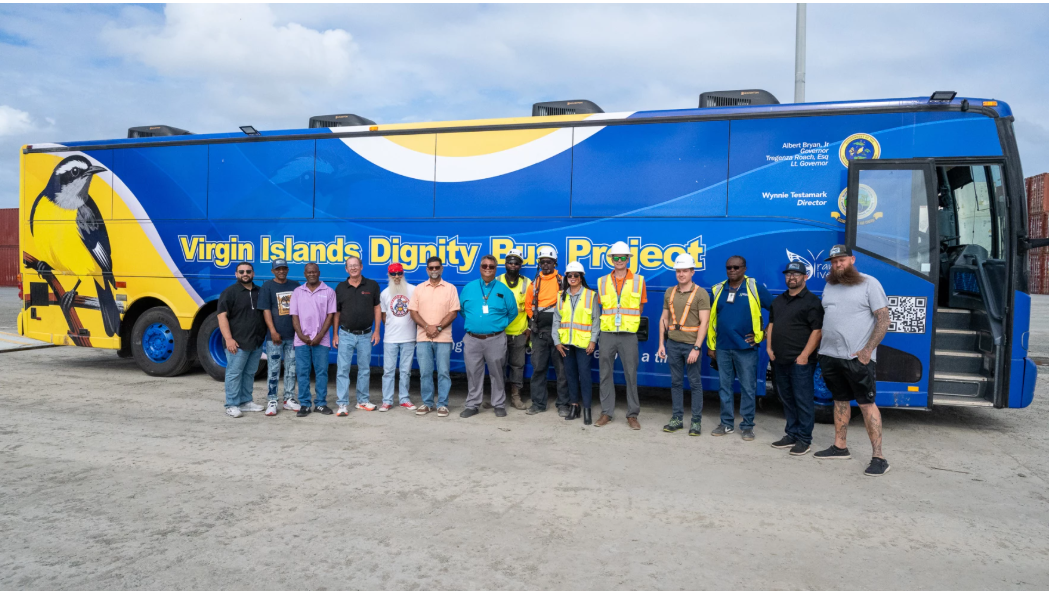
When Director Testamark took the well of the Legislature, she didn't just defend line items; she actively put her own administrative shortfalls on the record. The most glaring, localized example of this operational disconnect remains the fate of the heavily publicized "Dignity Bus" initiative.
Launched with heavy community fanfare as a mobile, grant-funded answer to systemic homelessness, the emergency vehicle was originally touted as a rolling shelter that would meet unhoused residents exactly where they were on the streets of Christiansted and Frederiksted.
Instead, the operation was quietly and permanently hitched to the secure grounds of the John A. Bell Adult Correctional Facility.
Under questioning from lawmakers, Testamark was forced to testify to missing the mark on her own flagship program, admitting under oath that multiple participants chose to walk away from the shelter early because living within the perimeter of a jail yard "can feel like an extension of incarceration".
It is a classic territorial pattern: a grand, progressive pronouncement at the press conference, followed by an institutional execution that transforms an outreach bridge into just another restrictive intake valve.
Suffer the Families
The administrative isolation isn't just felt by unhoused residents on the prison grounds; it is actively devastating the families of exported inmates. During the hearing, Senator Franklin Johnson brought the human cost of the bureau’s $7.9 million mainland pipeline into sharp focus, branding the current oversight system an absolute "travesty".
Johnson alleged that the BOC completely lacks a functioning tracking and communication system, revealing that the bureau failed to properly notify local families when at least two Virgin Islands inmates died while in the custody of mainland facilities.
While corrections leadership insists that exported inmates are tracked with "dignity and respect," the reality reveals an administrative apparatus that treats off-island prisoners as "out of sight, out of mind". The $7.9 million outsourced budget line doesn't just buy cheaper daily rates; it effectively buys the bureau a shield against local visibility—until the body bags return without prior notice to the next of kin.
The next installment of this series will examine the $3.8 million vendor logjam and the explosive inter-agency dispute between the Bureau of Corrections and Governor Juan F. Luis Hospital over millions in unpaid inmate healthcare bills.
A Note from the Digital Desk
If Elon Musk ran SpaceX with a financial model where exporting rocket components to Mississippi was four times cheaper than managing them at his main base—while simultaneously losing track of whether those components were still intact—his board of directors would have him removed by lunchtime. But in the landscape of territorial governance, missing the mark is just called a successful Thursday budget defense.
