
In the Cosmic Shadow: The 40-Minute Silence Behind the Moon
By JOHN McCARTHY / St. Croix Sun News Reporter
Beyond the Reach of Earth
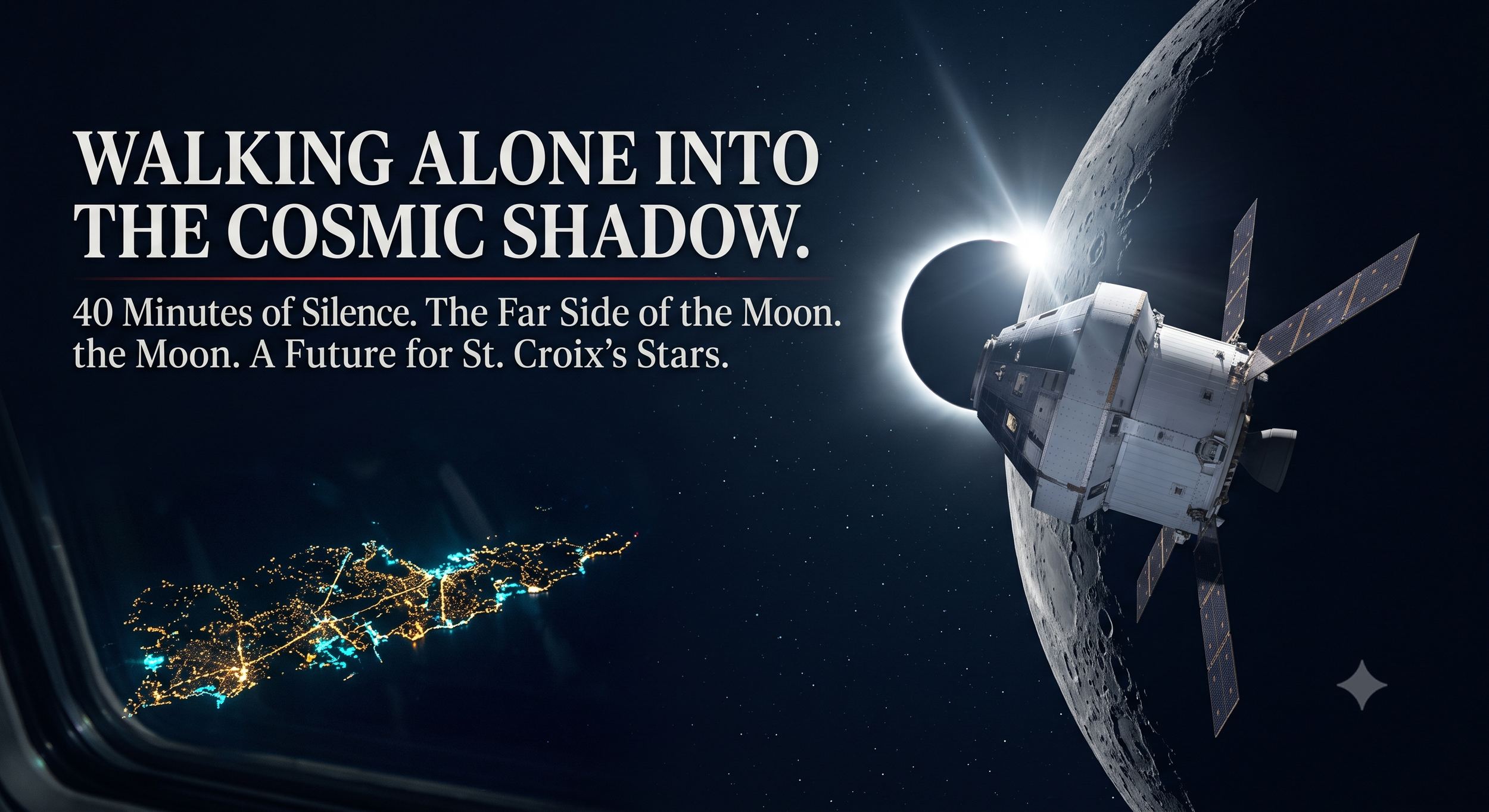
At a distance of over 252,000 miles from Earth—farther into the void than any human being has ever ventured—four astronauts aboard NASA’s Orion spacecraft coasted into the absolute unknown.
They were not just pushing the boundary of spaceflight; they were slipping behind the bulk of the Moon itself. As the curvature of the lunar surface blocked their line of sight to Earth, radio frequency signals degraded, crackled, and cut out entirely.
For 40 long minutes, mission control in Houston went completely dark.
🌍 Mission Control (Earth): Transmitting voice and telemetry across 252,000 miles...
🔕 The Shadow Zone: Signal drops to zero as the spacecraft slips behind the lunar horizon.
🌘 The Moon: Blocking all radio frequencies for 40 eerie minutes.
🛰️ Orion (In Silence): Four human beings witness a deep-space solar eclipse in absolute isolation.
📡 Re-acquisition: Orion emerges on the other side, restoring contact with Earth.
In that total radio silence, isolated from every other living soul in the cosmos, the crew experienced something no human eyes had ever witnessed: from deep space, they watched the Earth pass directly behind the Sun, casting the spacecraft into a breathtaking cosmic eclipse.
From the Classrooms of St. Croix to the Halls of the White House
While an Antarctic winter crossing tests the absolute limit of physical survival, the Artemis mission tests the outer boundary of human curiosity. But curiosity doesn't start on a launchpad in Florida—it starts in a classroom.
St. Croix has its own proud history of igniting that spark:
A Legacy of Science Education: Local educators like Steve Bullock—former St. Croix Avis reporter and dedicated teacher at Elena Christian Junior High School—proved years ago that Crucian students belong on the national scientific stage.
The Presidential Stage: Through dedicated NASA and STEM initiatives, local students earned invitations to the White House under President Barack Obama, demonstrating that a kid from the Virgin Islands can stand side-by-side with the country’s top scientific minds.
"The next engineer building a deep-space thermal shield, or the next astronaut floating in lunar orbit, could very easily be sitting right now in a classroom on St. Croix."
Built for the Dark
There is also something to be said for the unique resilience of a Virgin Islands upbringing.
While mission controllers in Houston might hold their breath through 40 minutes of deep-space blackout, a future astronaut raised on St. Croix won't blink an eye. After years of navigating WAPA's unpredictable grid shifts, island youth are practically pre-conditioned for total radio silence and sudden darkness.
"When you've mastered surviving local power outages on a Tuesday afternoon, a planned lunar blackout isn't a crisis—it's just business as usual."
Why This Story Matters Today
Space exploration isn't just about giant rockets or billionaire rivalries; it's about what happens when human ambition refuses to accept limits.
Artemis II At A Glance
Max Distance from Earth: ~252,760 miles (Record for crewed flight)
Duration of Blackout: ~40 minutes behind the Lunar Far Side
Core Objective: Testing life support for future Mars missions
USVI Connection: Inspiring the next generation of local STEM leaders
For more background on the mission's historic trajectory and the astronauts involved, check out NASA's Artemis II Daily News Conference. This briefing provides official context from NASA leadership on the spacecraft's journey around the far side of the Moon.
