
How Flock Cameras Are Locking Down The USVI (And Why Our Laws Keep Them In Check)
By JOHN McCARTHY / St. Croix Sun News Reporter
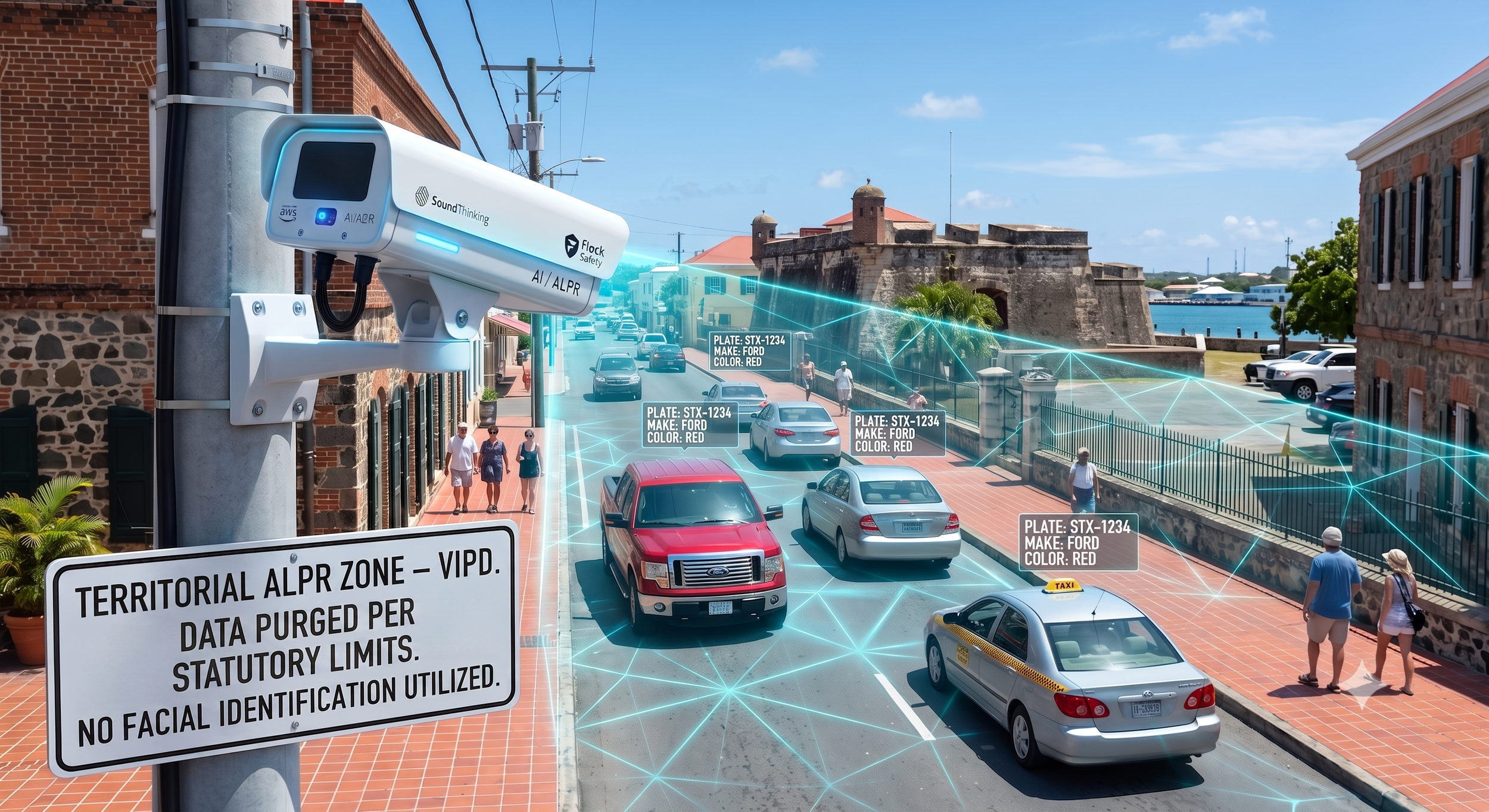
While mainland jurisdictions drift into "wild west" surveillance, the Virgin Islands Police Department is deploying AI license plate readers inside strict statutory boundaries. Here is how the digital grid works in Charlotte Amalie, Christiansted, and Frederiksted—and where the technology goes from here.
"In the mainland U.S., a suspect can cross three state lines in four hours. In the Virgin Islands, you can't drive off the island. Once a vehicle hits the VIPD grid, the clock starts ticking."
The Island Containment Grid
On the mainland, companies like Flock Safety operate an interconnected network spanning over 100,000 cameras. In that ecosystem, local police, private HOAs, and corporate malls pool vehicle tracking data into massive nationwide databases accessible across state borders without warrants.
In the U.S. Virgin Islands, the dynamic is fundamentally different. Geographic isolation creates a natural containment zone.
Instead of chasing suspects down interstate highways, the Virgin Islands Police Department (VIPD) uses Automated License Plate Readers (ALPR) at strategic arterial choke points:
Charlotte Amalie (St. Thomas): Monitored along high-traffic corridors like Crown Mountain Road, Veterans Drive, and waterfront access points. A stolen vehicle moving through Crown Mountain triggers real-time alerts in the VIPD Camera Monitoring Room, giving Special Operations units immediate intercept routes before a suspect can vanish.
Christiansted & Frederiksted (St. Croix): Stationed along key transit lines—including the Melvin Evans Highway, Centerline Road, and coastal town bypasses. When integrated with acoustic gunshot detection systems like ShotSpotter, the moment a muzzle blast is detected in town, nearby Flock cameras instantly log every vehicle fleeing the scene..
Statutory Boundaries: Avoiding the ‘Wild West’
The biggest differentiator for the USVI isn't just geography—it's the law.
While dozens of mainland states allow police departments and private entities to store driver location data indefinitely, the U.S. Virgin Islands established clear statutory rules through legislation like Bill 34-0142 (amending Title 20 of the VI Code).
Time-Limited Data Retention: Unlike states where vehicle scans sit in private server farms for years, VI statutory frameworks impose strict timelines on how long non-investigative plate images can be retained. If a scan isn't tied to an active warrant, stolen vehicle report, or felony investigation, the data must be purged.
Government-Only Oversight: The territory limits ALPR use strictly to authorized government agencies (like VIPD and the Bureau of Information Technology), preventing private entities or rouge neighborhood groups from creating unauthorized surveillance networks.
Facial Privacy Safeguards: While advanced high-speed optics can capture vehicle occupants through windshields, local legislative oversight mandates that facial images cannot be utilized or disseminated without a court subpoena or warrant.
What Lies Ahead: Near & Long-Term Predictions
As VIPD fully integrates its Real-Time Crime Centers (RTCC) across both districts, technology in the territory will rapidly evolve:
Near Future (1–3 Years): Integrated Synergy
BMV Inter-Island Tracking: Expect tighter integration with the Bureau of Motor Vehicles to eliminate unregistered, "ghost" vehicles being shipped inter-island without proper permits.
Mobile & Drone Integration: ALPR feeds will sync directly with patrol car dashboards, body-worn cameras, and tactical drones, giving field supervisors live tracking on suspect vehicles in real time.
Not-So-Distant Future (5+ Years): Predictive Analytics
Acoustic & Optical Fusion: Automated triggers where a ShotSpotter alert instantly locks down traffic light timings or flags getaway routes before responding officers arrive.
Port-to-Port Surveillance: Automated scanning at marine cargo freight docks to prevent unregistered or stolen vehicles from being quietly shuttled between St. Croix, St. Thomas, and St. John.
Where the Money Comes From
Federal Grants (The Heavy Lifter):
ARPA Funds: The VIPD allocated American Rescue Plan Act (ARPA) anti-crime grant funds directly toward expanding license plate readers, cameras, and in-car solutions.
U.S. Department of the Interior (DOI) Grants: Millions in multi-year DOI capital grants have been funneled into expanding territory-wide surveillance cameras and real-time crime center infrastructure.
U.S. Department of Justice (DOJ): Systems like ShotSpotter and specialized law enforcement tech were initially launched and supported through federal DOJ technology grants.
Territorial Legislation & Appropriations:
Territorial legislation (such as Bill No. 36-0068) appropriates local General Fund monies specifically earmarked for camera installations, data science integration software, and Real-Time Crime Center (RTCC) operations.
Local statutes often mandate that traffic or camera-generated revenue partly reimburses the General Fund while funding ongoing RTCC maintenance and staffing.
The Bottom Line
When used responsibly within strict legal boundaries, Flock technology turns an isolated island grid into a formidable law enforcement tool.
For innocent drivers navigating Centerline Road or Veterans Drive, statutory retention limits ensure your morning commute isn't stored in a permanent government archive. But for criminals attempting to use island roads as escape routes, the digital net is closing fast.
