
By: St. Croix Sun News Desk
KINGSHILL, St. Croix — Every time a high-powered weapon turns up in a Virgin Islands Police Department press release or a Superior Court affidavit, the exact same question floods local Facebook comment threads from St. Thomas to St. Croix: "Where are the guns coming from?"
For nearly four decades, the territory's rumor mill has answered that question by pointing fingers at convenient outside scapegoats—first claiming mainland white outsiders were flooding the islands with contraband, and more recently peddling baseless whispers blaming Arab-American store owners and gas station operators for sneaking firearms into the territory.
Superior Court records filed across both judicial districts this week offer a blunt, fact-based answer that requires zero conspiracy theories: increasingly, the guns are being built right here in the U.S. Virgin Islands.
Two Islands, One Friday Night, Two Ghost Guns
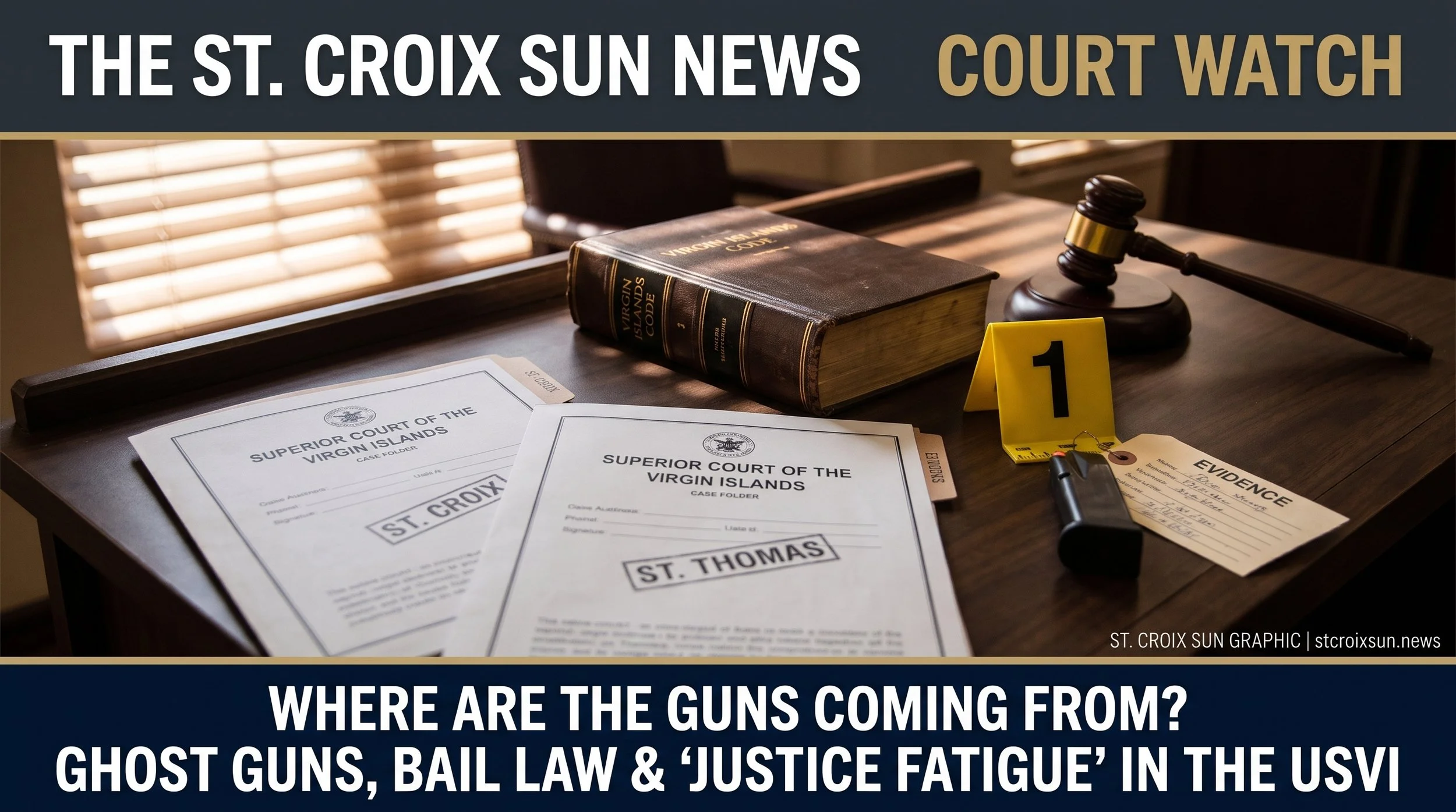
In St. Croix case SX-2026-CR-00307, VIPD Special Operations Bureau officers conducting a Friday night "Rapid Response" traffic stop near the Melvin H. Evans Highway and Eddie Ortiz Drive around 10:30 p.m. on November 20, 2026, recovered an unserialized "ghost rifle"—stashed inside a Sprayground bookbag on the front passenger floorboard with one round chambered, a fully loaded 30-round magazine inserted and an extra 31-round magazine (62 rounds total)—at the feet of convicted felon Luis Noel.
Roughly an hour later across the water on St. Thomas, in case ST-2026-CR-00313, VIPD Special Response Team officers responding to rapid gunfire that riddled a passing Kia Soul on Bluebeards Castle Way around 11:30 p.m. Friday tracked 24-year-old Jah'Quan Amari Nesbitt into roadside bushes and recovered a black unserialized handgun fitted with an illegal automatic-fire "switch" or "chip," loaded with one chambered round inside a 31-round extended 9mm magazine alongside a second 18-round extended Glock magazine.
There are no factory serial numbers on either weapon because neither firearm rolled off a licensed commercial assembly line or arrived in a secret shipping crate from overseas. Under federal and territorial law enforcement definitions, a "ghost gun" is a privately made firearm assembled from unfinished receivers, mail-order parts kits or 3D-printed components—precisely so it lacks a manufacturer serial number and cannot be traced through conventional retail gun records.
In plain English: when unserialized rifles and switch-modified automatic pistols surface on the exact same night on St. Croix and St. Thomas, the assembly line isn't an international smuggling ring. It is local hands putting parts together inside bedrooms, garages and backyards across the territory.
‘Justice Fatigue’ and Why the Law Ties Judges’ Hands Before Trial
Even more troubling than how those weapons were built is the public exhaustion—call it "justice fatigue"—that erupts every time repeat gun suspects cycle quickly back through the courthouse doors.
As The St. Croix Sun News sister outlet Virgin Islands Free Press reported Monday, Noel was supposed to be serving four and a half years of supervised probation following a May 27, 2026 global plea bargain in Superior Court that dismissed first-degree attempted murder and school-zone firearm charges across three separate 2025 prosecutions before he turned up in Kingshill less than six months later on new felony gun charges. Meanwhile, on St. Thomas, Magistrate Judge Simone M. VanHolten-Turnbull on Monday reduced Nesbitt's $100,000 bail to $5,000 cash—with the remaining $95,000 unsecured—clearing him for release under 24-hour GPS house arrest despite a prior 2023 Hospital Ground gunfire arrest and Friday night's automatic-fire "switch" recovery.
To residents living under the threat of gunfire on St. Croix and St. Thomas, those outcomes can feel baffling—fueling knee-jerk cynicism on social media alleging that judges must be related to defendants or somehow compromised.
In fairness to the bench, however, Superior Court judges are not pulling those release orders out of thin air—their hands are tied by territorial law before a defendant is convicted. Under Section 3 of the Revised Organic Act of 1954 and Title 5, Section 3504a of the Virgin Islands Code, almost every criminal defendant in the territory holds a constitutional and statutory right to pretrial bail. Under 5 V.I.C. § 3504a, holding a defendant without bail before trial is strictly limited to specific enumerated "dangerous crimes"—such as first-degree murder, first-degree rape, first-degree arson, first-degree robbery, first-degree burglary, kidnapping for ransom and major drug trafficking—or defendants caught threatening witnesses. Unlawful possession of a firearm (14 V.I.C. § 2253), even an unserialized ghost rifle or a switch-modified pistol, is not on that automatic no-bail list.
Life-and-Death Stakes in the Real World
Understanding why the law compels judges to set bail conditions does not make the real-world stakes any less urgent. When privately assembled, untraceable firearms meet statutory bail rules and plea bargains that treat repeat illegal gun possession like a routine bondable offense, the consequences on island roads and neighborhoods are literally life and death.
Conspiracy theories—whether blaming outside merchants for smuggling guns or blaming judges for backroom favors—persist because they offer easy villains. Reading the Superior Court dockets on St. Croix and St. Thomas, alongside the Virgin Islands Code itself, shows where the real work of fixing the pipeline actually begins.
