
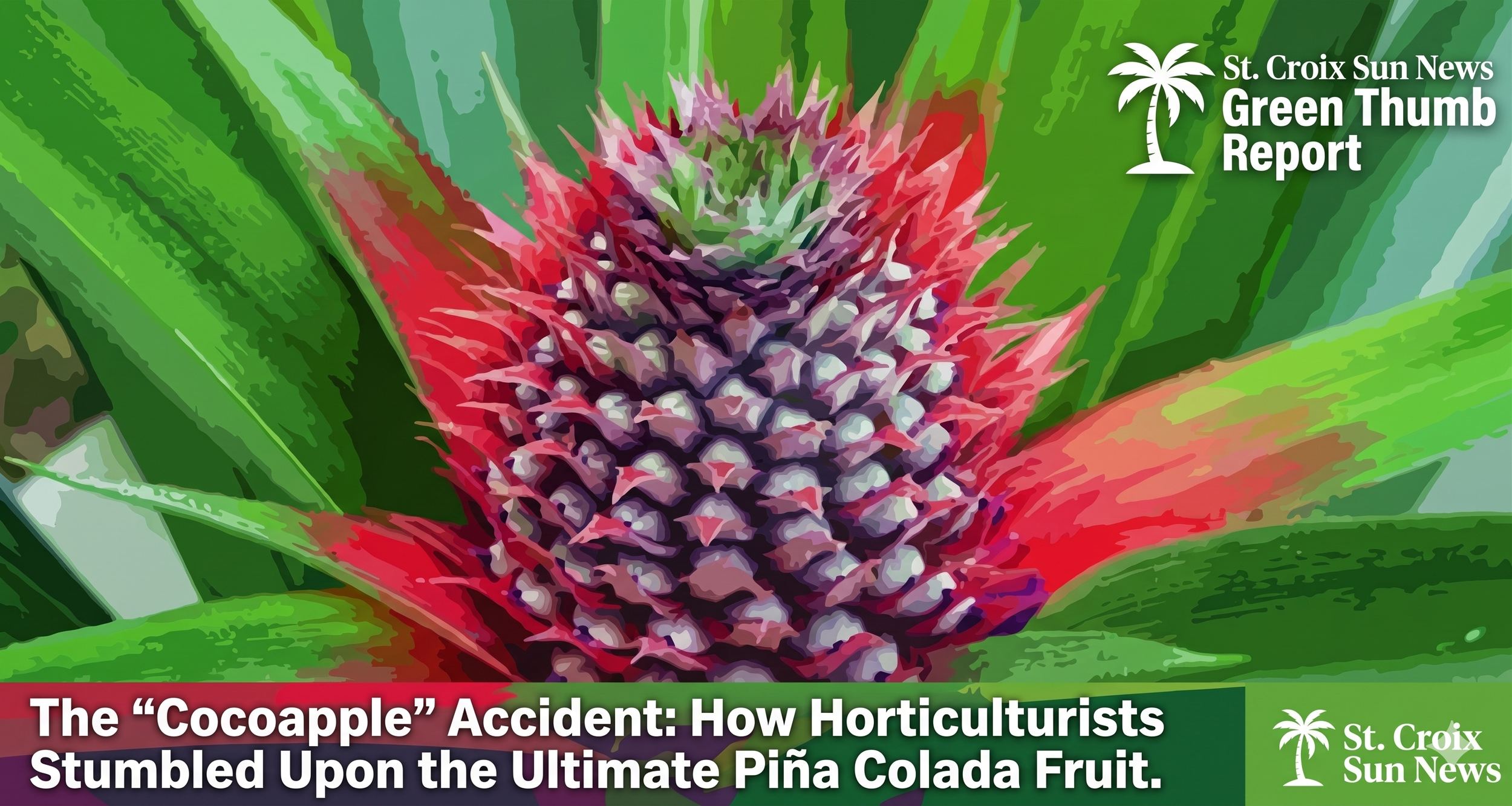
The ‘Cocoapple’ Accident: How Horticulturists Stumbled Upon the Ultimate Piña Colada Fruit
By JOHN McCARTHY / St. Croix Sun News Reporter
ST. CROIX — If you are looking to mix the perfect tropical drink, science might have just saved you a step—though it took a decade of accidental tinkering to get there.
Horticulturists working for the Department of Agriculture in Queensland, Australia, spent over ten years on a rigorous breeding project. Their actual mission? To engineer a superior, highly aromatic pineapple variety that was naturally sweeter, juicier, and lower in acidity to help local growers compete against cheap international imports.
Instead, they accidentally bred a pineapple that tastes distinctly like a coconut.
The Stumbled-Upon Secret: The ‘AusFestival’ Pineapple
Dubbed the "AusFestival" pineapple by the research agency, the fruit has predictably earned much more colorful nicknames in the media, ranging from the "cocoapple" to the "pineonut."
According to Garth Sanewski, a senior horticulturist on the project, the unique, creamy undertone wasn't engineered via genetic modification, but rather came about through traditional cross-breeding techniques.
"When we are doing the breeding, we are not actually looking for a coconut-flavored pineapple or any other particular flavor," Sanewski noted. "We’re looking for a nice-flavored pineapple... a variety that is sweet, low acid, and aromatic. It just happens to have this lovely coconut flavor which you won’t find in any other pineapple."
While purists might find the flavor crossover strange, the commercial implications are massive for the beverage and culinary industries. A fruit that natively combines the two primary flavor profiles of a piña colada could streamline everything from commercial juice production to cocktail mixing.
A Caribbean Counterpart?
While Australia claims the "cocoapple," the Caribbean has its own legendary, localized variations of the fruit. In Antigua and Barbuda, farmers grow the famous Antigua Black Pineapple.
Unlike the engineered AusFestival variety, the Antigua Black is an heirloom cultivar known for its exceptionally sweet flavor and lower acid content. It doesn't actually have black skin or taste like coconut; rather, its name comes from the dark green hue it retains even when it is fully ripe and ready to eat. It thrives uniquely in the specific volcanic soil and climate of the islands—proving that sometimes, nature creates a perfect luxury fruit without any accidental help from a lab.
Perhaps one day, if a certain tech billionaire ever follows through on his rumored musings to finally pack up his rockets, buy a massive plot of land, and move his entire operation down to the shores of St. Croix, he can try his hand at disrupting the agricultural scene by cross-breeding the Antigua Black with some local coconuts. Until then, the open-source recipe for a piña colada fruit remains a fascinating quirk of Australian agricultural science.
