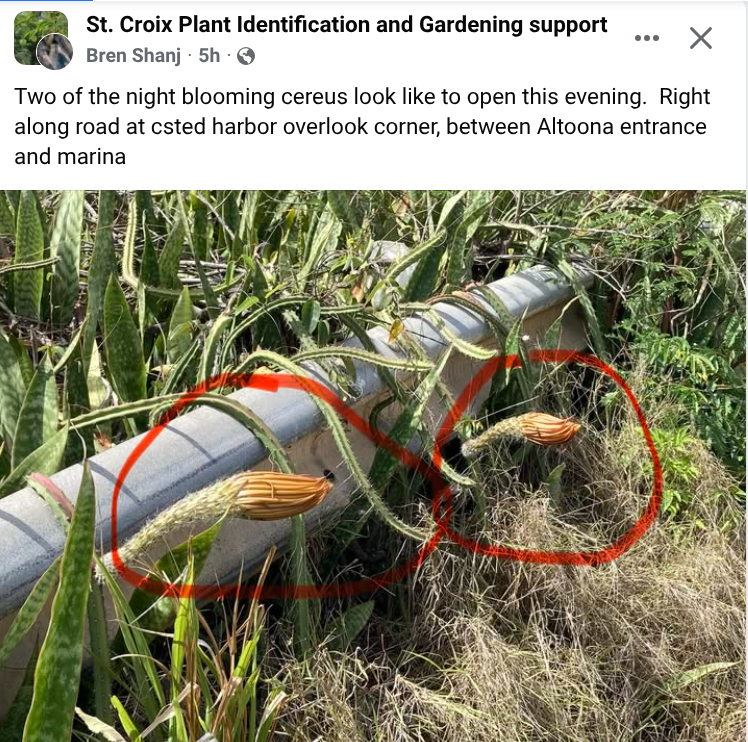
THE QUEEN'S TIMING: Night-Blooming Cereus Spotted Ready to Explode Along Christiansted Harbor Overlook
Fleeting Natural Wonder Prepares for ‘One-Night-Only’ Performance on the St. Croix Roadside
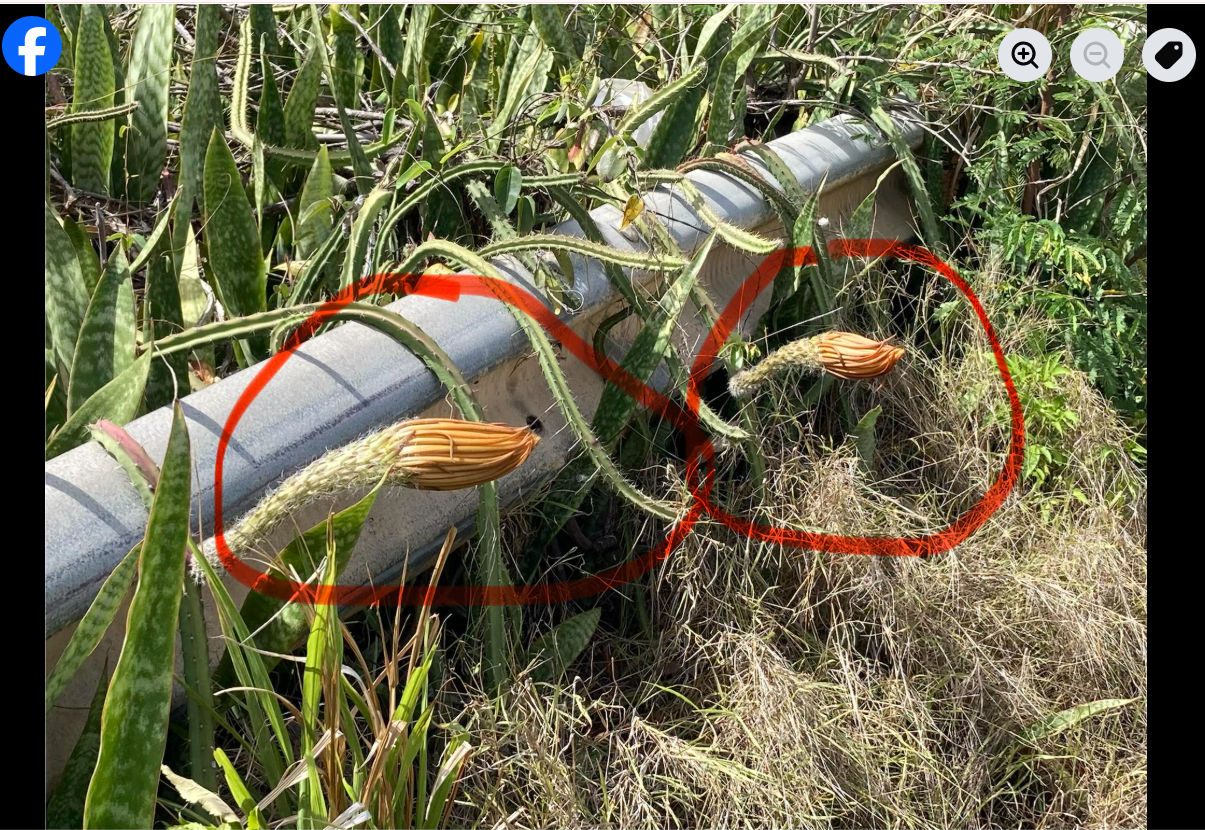
ROADSIDE WONDER: Two massive buds of a wild Night-Blooming Cereus cactus (Selenicereus) prepare to burst into bloom along a highway guardrail near the Christiansted harbor overlook on Sunday. Famous across the territory as the "Queen of the Night," the native plant's spectacular, fragrant white blossoms open for just one single evening before withering away permanently at sunrise. (Photo Courtesy: Bren Shanj / St. Croix Plant Identification and Gardening Support)
By JOHN McCARTHY / St. Croix Sun Staff Writer
CHRISTIANSTED — Sharp-eyed local commuters and gardening enthusiasts are keeping a close watch on a specific roadside guardrail near the Christiansted harbor overlook this weekend. Nestled between the Altoona entrance and the marina, a sprawling, tangled mass of wild cactus is preparing to unleash one of the most fleeting and dramatic botanical spectacles in the Caribbean: the annual opening of the Night-Blooming Cereus.
Known colloquially across the territory as the "Queen of the Night," the vine-like cactus (Selenicereus) spent the weekend pushing out massive, elongated floral buds. For 364 days a year, the plant blends seamlessly into the dry coastal brush, looking like nothing more than a leathery, angular green vine. But for just one single evening, those specialized buds will swell, unfurl, and burst into luminous, creamy-white blossoms that can stretch up to eight inches across.
Driven by the Dark
The biology of the Night-Blooming Cereus is a masterclass in evolutionary adaptation. Unlike standard tropical flora that rely on daytime bees and bananaquits for pollination, the Cereus relies entirely on nocturnal travelers.
As dusk settles over the harbor, the floral tubes begin to expand. By 9:00 PM or 10:00 PM, the massive white petals open completely, releasing an intoxicatingly heavy, sweet perfume designed to attract nectar-feeding bats and giant sphinx moths from miles away.
The show, however, comes with a strict expiration date. By the time the first morning sun hits the Christiansted horizon, the magnificent blossoms will completely collapse, wither, and close forever.
A True Local Native
While many backyard growers cultivate flat-leaved orchid cacti (Epiphyllum) on their galleries, the rugged, spine-bearing columnar variety seen weaving over the harbor guardrail is a highly resilient native species perfectly calibrated for the Virgin Islands’ coastal climate. It thrives in rock-strewn, well-draining soil and uses surrounding structures—whether a neighboring frangipani tree or a galvanized highway barrier—to anchor its cascading stems.
Local residents hoping to catch a glimpse of the rare blooms are encouraged to take a careful, slow evening drive past the overlook corner after dark. Just be sure not to blink—in the world of tropical botany, the Queen’s court only stays open for a matter of hours.