
From Silicon Valley Dockets to the Gridiron: How Elon Musk’s OpenAI Lawsuit Exposed Michigan’s $2 Billion Football War Chest
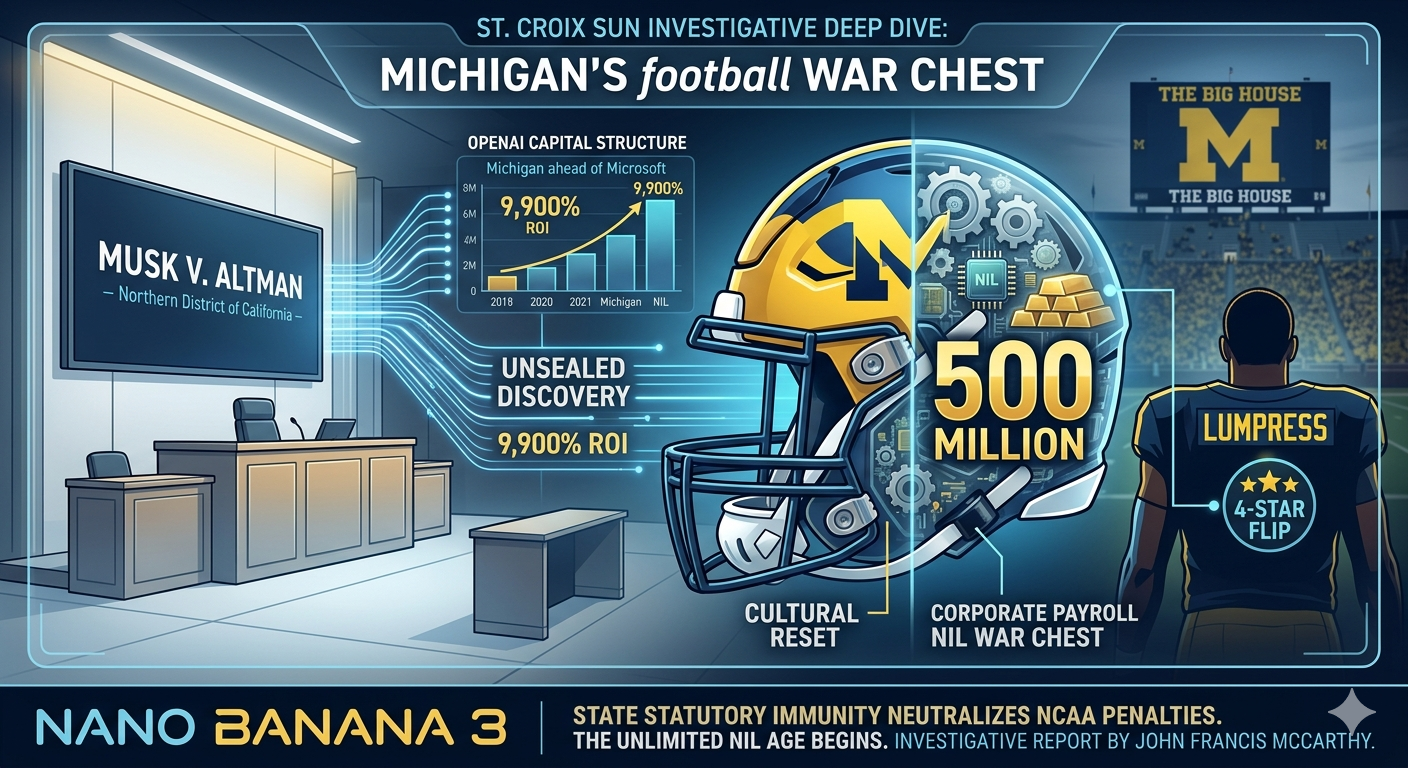
SILICON VALLEY TO THE GRIDIRON: A St. Croix Sun Investigative Desk graphic mapping the flow of early-stage tech capital from the federal court dockets of Musk v. Altman in California to the University of Michigan’s athletic department. Unsealed discovery files reveal a projected $2 billion OpenAI windfall that could fund a historic $500 million NIL roster payroll, fundamentally altering the landscape of collegiate sports under head coach Kyle Whittingham. (Infographic: Nano Banana 3 / St. Croix Sun)
By JOHN McCARTHY / St. Croix Sun Investigative Reporter
SAN FRANCISCO, CA / ANN ARBOR, MI — When tech billionaire Elon Musk filed his high-profile lawsuit against OpenAI and its CEO Sam Altman in the U.S. District Court for the Northern District of California, the legal world braced for a civil war over the future of artificial intelligence. What nobody expected, however, was that the fallout from this Silicon Valley courtroom battle would land like a thunderbolt directly on the landscape of college football recruiting.
Unsealed corporate filings and discovery documents unearthed by Musk’s legal team have pulled back the curtain on an unprecedented financial windfall for the University of Michigan. The dockets reveal that the university’s endowment turned an early-stage, direct investment in OpenAI into an expected $2 billion position—bypassing traditional venture capital blind pools to sit squarely ahead of tech giants like Microsoft in the payout structure.
Now, sources close to the program indicate that as much as $500 million of that staggering tech profit could be funneled directly into the university's athletic department to supercharge Name, Image, and Likeness (NIL) recruiting efforts.
To put that number into perspective, the University of Texas Longhorns currently lead the nation in roster acquisition, spending an estimated $47.9 million on their program this year. Michigan’s unsealed OpenAI war chest represents a self-sustaining corporate endowment that could allow the Wolverines to comfortably outspend the richest booster networks in college football for the next decade.
The financial gravity of this tech-backed shift is already being felt on the recruiting trail. Just days ago, 2027 four-star hybrid tight end Colt Lumpress shocked the SEC by flipping his long-standing commitment from Alabama to Michigan, abruptly canceling a highly anticipated official visit to Tuscaloosa scheduled for late May. Backed by a newly minted Michigan state law that explicitly strips the NCAA of its power to penalize state schools for NIL allocations, new head coach Kyle Whittingham is suddenly armed with an institutional treasury that completely changes the rules of modern sports recruitment.
The Hidden Cap Table: Bypassing the Silicon Valley Gatekeepers
To understand the sheer scale of the University of Michigan’s windfall, one has to look at the traditional venture capital playbook—and how the university completely tore it up.
Typically, public university endowments invest in hyper-growth tech startups through "blind pool" venture funds. This standard structure spreads concentration risk across multiple companies but heavily dilutes the returns through management fees and profit-sharing cutouts for Silicon Valley gatekeepers.
According to financial dockets unsealed during the explosive three-week Musk v. Altman federal trial in Oakland—which concluded on May 18, 2026, with a jury verdict centered on statute-of-limitations technicalities—Michigan bypassed the middleman entirely.
The court records reveal that the university’s public endowment executed a rare direct investment of $20 million into OpenAI during its earliest, quietest fundraising rounds. This check was cut years before Microsoft entered the picture with its initial 2019 partnership, placing the public university on the cap table alongside legendary tech incubators like Khosla Ventures and the Y Combinator Fund.
Crucially, the unsealed documents expose a "target redemption amount" of $2 billion for the university. Because Michigan’s capital was injected so early, the school’s payout priority actually sits ahead of Microsoft’s later, cumulative $23 billion tranches in specific corporate restructuring liquidations. With OpenAI’s valuation now hovering at a staggering $852 billion as it eyes a historic initial public offering (IPO), Michigan’s direct gamble has yielded a mind-boggling 9,900% projected return.
The Statutory Shield: Neutralizing the NCAA
While the national media has focused purely on how a $2 billion jackpot alters academic research, the real tremor is being felt in the athletic departments of the SEC and the Big Ten.
Rumors circulating out of Ann Arbor suggest that up to $500 million of this corporate windfall could be partitioned to supercharge Name, Image, and Likeness (NIL) roster acquisition. In the hyper-competitive arms race of modern college football, an institutional bank account of that magnitude is the equivalent of bringing a starship to a sword fight.
Yet, possessing a half-billion-dollar war chest is meaningless if governing bodies can block its distribution. This is where the true brilliance of Michigan's position comes into play: total statutory immunity.
Quietly preceding this financial revelation, the state of Michigan passed aggressive, protective legislation specifically designed to shield its universities from collegiate governing bodies. The state law explicitly bars the NCAA from investigating, penalizing, or stripping wins from any Michigan-based university over NIL compensation structures, provided they comply with state guidelines.
By grounding their recruitment capital in state-sanctioned corporate law rather than volatile booster collectives, the Wolverines have built a legal fortress. The NCAA cannot touch them, and rival programs cannot outspend them.
The Cultural Cleanroom: Whittingham’s Practical Blueprint
A half-billion-dollar treasury is a potent weapon, but capital requires competent stewardship. For the University of Michigan, the arrival of this unprecedented wealth coincides perfectly with a radical operational overhaul at the top of the football program.
The Wolverines’ recent history has been defined by severe off-field instability. The tenure of former head coach Sherrone Moore came to an abrupt, chaotic end on December 10, 2025, when Athletic Director Warde Manuel terminated him for cause following a university probe into serious policy violations. The administrative dismissal quickly escalated into a highly publicized legal and personal crisis for Moore, casting a long, distracting shadow over Ann Arbor and causing the program’s national recruiting rank to plummet toward the bottom of the Big Ten.
Enter Kyle Whittingham.
Hired on December 26, 2025, just two weeks after reluctantly stepping down from a legendary 21-year run at the University of Utah, the 66-year-old Whittingham represents the absolute antithesis of institutional drama. As the all-time wins leader at Utah, Whittingham built a Hall of Fame-caliber career on a foundational philosophy of strict discipline, mechanical efficiency, and hard-nosed, practical football.
Where the previous administration became mired in personal and regulatory controversy, Whittingham has established a corporate "cleanroom" environment. His approach strips away the modern cult of personality, shifting the focus entirely back to on-field execution, developmental stability, and structural predictability.
"We want to quiet the outside noise, get things back on track, and make it strictly about what we accomplish between the white lines," Whittingham noted during spring practices.
For elite recruits like Colt Lumpress, this combination of factors is irresistible. The modern elite athlete is no longer just choosing a school or a coach; they are choosing a business partner. By combining Whittingham’s unassailable, scandal-free blueprint with an institutional OpenAI war chest that essentially guarantees unlimited, self-sustaining payroll longevity, Michigan has created an unmatched pitch.
The Wolverines are no longer just competing in the Big Ten. Armed with Silicon Valley capital and protected by state statute, Michigan has quietly constructed the most formidable, legally insulated corporation in the history of amateur sports.
