
EXCLUSIVE: Inside the High-Stakes Courtroom Chess Match Reshaping the Frederiksted Attempted Murder Case Against Kenny Rogers
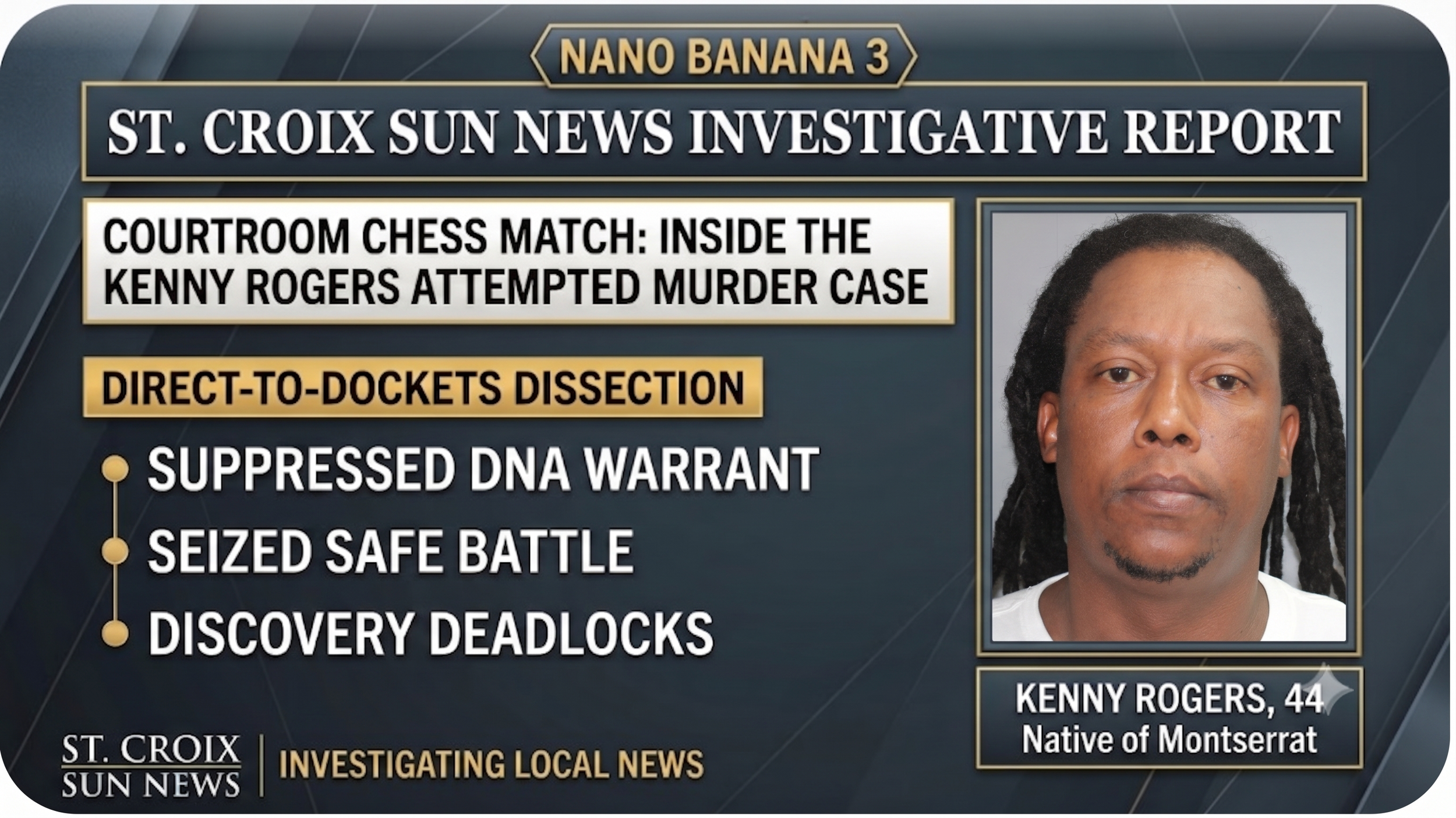
By JOHN McCARTHY / St. Croix Sun Investigative Reporter
FREDERIKSTED — When Kenny Rogers walked into the Wilbur H. Francis Command to surrender himself to the Virgin Islands Police Department late last month, the casual observer saw what looked like a straightforward legal update to a local shooting.
The public narrative, driven by standard police press releases, was simple: Rogers was facing upgraded, 7-count felony charges—including two counts of premeditated first-degree attempted murder—stemming from a violent August 2025 melee down in La Grange. Then, just as quickly as he arrived, he was immediately released.
But beneath the surface of this procedural "revolving door" lies a fierce, 9-month courtroom war between powerhouse defense attorney Kye Walker and territorial prosecutors.
Superior Court dockets obtained exclusively by the St. Croix Sun News reveal a masterclass in defense strategy. For nearly a year, the state’s case has been methodically picked apart behind closed doors—culminating in a massive defense victory just 24 hours ago that legally blinded the prosecution’s forensic momentum.
The Midnight Breakup and the Tactical Raid
To understand the high stakes of the current legal battle, one must look back to the raw violence that shattered the peace of East Street on August 16, 2025.
According to original VIPD probable cause sheets, the territory's automated ShotSpotter system detected seven rounds fired at #12A East Street at 11:35 p.m.. Arriving officers discovered a local woman, M.G., lying on the ground with multiple gunshot wounds to her back—injuries so severe they impacted vital organs and required emergency, life-saving surgery.
Witness statements collected at the scene painted a chilling picture. The victim’s brother told detectives he had just dropped his sister off when Rogers, her boyfriend, approached her outside. When M.G. explicitly told Rogers she wanted to end their relationship, an argument erupted, and Rogers allegedly pulled a handgun, firing a hail of bullets directly at his girlfriend and her brother.
Rogers, a licensed firearm owner with two registered weapons in the territory, retreated to his home at #51 New Works. When he refused to answer the door for arriving detectives, a Magistrate Judge signed an emergency telephonic search warrant. By 5:20 a.m. the next morning, the VIPD Tactical Unit forcefully breached and entered the residence. Rogers was not inside, but his licensed firearms were seized, and he surrendered to police later that day.
The 9-Month DNA Lockdown
With Rogers in custody, prosecutors immediately moved to secure the definitive physical evidence they needed to cement a conviction: a biological match. On September 12, 2025, the People secured a search warrant to collect a DNA buccal saliva swab from Rogers.
But Attorney Kye Walker was already waiting.
The defense immediately filed an emergency motion to quash the DNA warrant, accompanied by a motion to stay the collection. For months, the two sides engaged in a fierce legal gridlock. Prosecutors filed motions to compel compliance, arguing that the biological tracking was vital to the state's case.
Walker successfully kept the state's cotton swabs at bay. In February 2026, the court officially granted the defense's motion to stay the warrant, legally barring the government from touching Rogers or processing his genetic data while the broader constitutional merits of the search were debated.
The final blow to the state's forensic strategy landed yesterday, June 2, 2026, when a Superior Court judge signed a formal order officially quashing the DNA warrant entirely—throwing out whatever biological links the state hoped to map across the crime scene.
Seized Safes and Contempt Threats
While the battle over DNA raged, a second front opened regarding the physical items property-seized during the initial tactical raid on Rogers' home.
In September 2025, the defense demanded the immediate return of Rogers' personal property. By January 2026, the court partially sided with the defense, ordering the state to hand items back. Yet, sensing the government was dragging its feet and withholding critical discovery, Walker went on a heavy offensive.
After securing a formal Order to Compel Discovery on March 24, 2026, the defense claimed the VIPD was still non-compliant. On April 1, Walker escalated the stakes to an unprecedented level, filing an emergency motion to hold the Government and VIPD Detective Sarah Velez in criminal Contempt of Court for allegedly refusing to turn over a personal safe and a digital video recorder (DVR) seized from Rogers' residence.
The aggressive move worked. Facing a scheduled emergency judicial hearing, the prosecution capitulated, entering a formal notice regarding the defense pickup of the safe and DVR on April 9.
The Strategy Behind the Upgraded Charges
This intensive courtroom squeezing explains the bizarre timing of the state's newest filings.
While the general public was surprised by the sudden May 2026 Information sheet adding two new counts of attempted murder against completely different bystanders (Jordany Gonzalez-Marte and Genesis Toribio), a look at the timeline shows a Department of Justice playing catch-up.
Having lost the battle over the safe, the DVR, and the DNA, assistant attorneys general spent nine months quietly re-interviewing witnesses and ballistics experts to upgrade the felony slate—attempting to rebuild with circumstantial testimony what they lost in physical discovery.
Furthermore, Walker has already launched a pre-emptive strike against the upcoming trial, filing a motion on April 27 to completely exclude the victim's medical records and emergency surgery testimony from the eyes of a jury.
As the case inches toward a final scheduling order, the dockets prove that this Frederiksted shooting is no longer a simple street-crime prosecution. It has transformed into a high-stakes chess match where procedural precision is trumping state power. Even an eccentric billionaire deploying cutting-edge tech couldn't out-maneuver a strict adherence to territorial discovery rules. In this courtroom, Kye Walker is playing to win—and the government is running out of pieces.
The St. Croix Sun News will continue its Direct-to-Dockets coverage as this matter moves toward trial.
