
THE REAL 1776: Ken Burns Pulls Back the Veil on the American Revolution—and Where the Caribbean Fits into the Empire
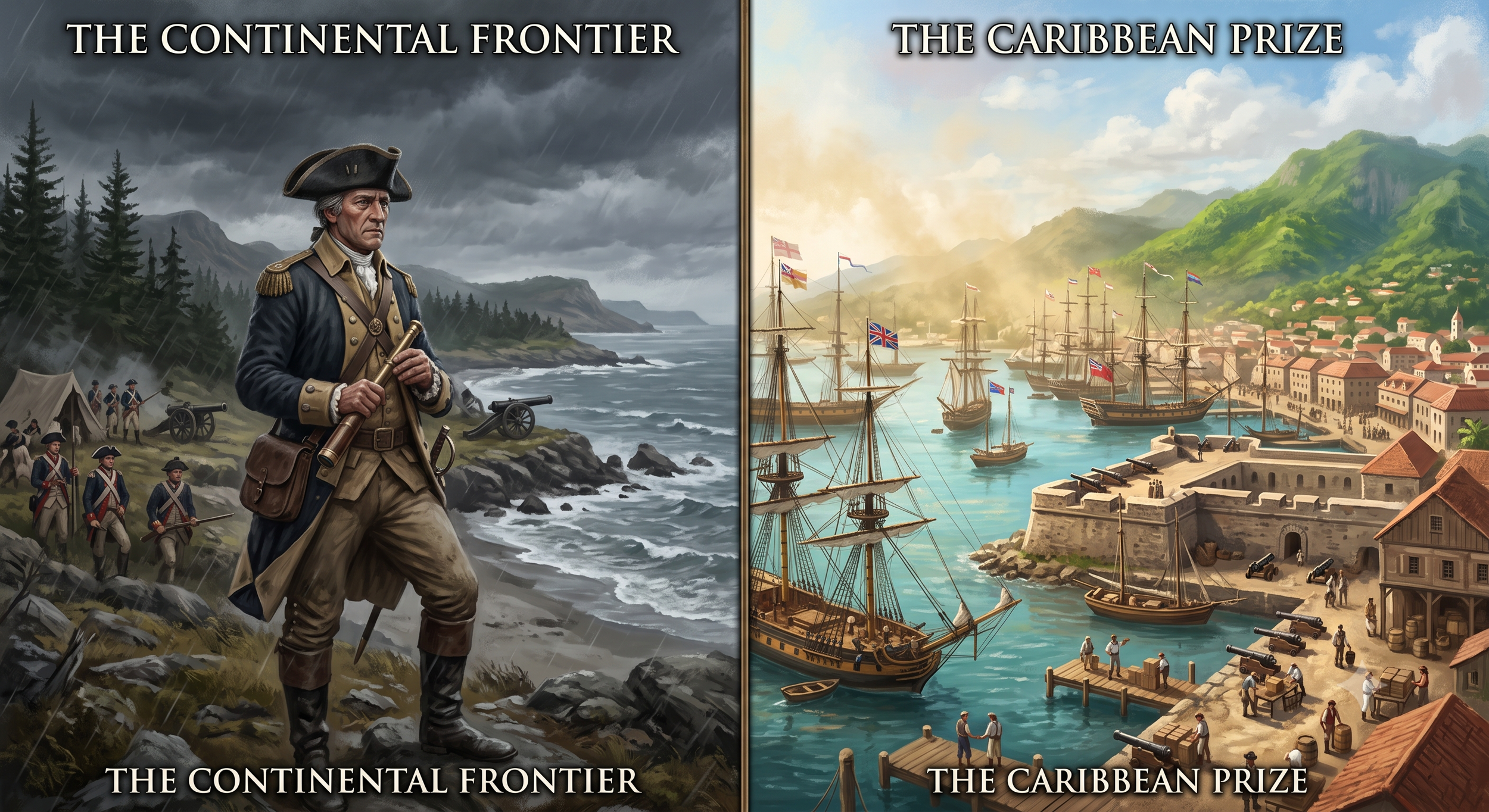
IMPEDIMENT VS. POWERHOUSE: A comparative visualization illustrating the geopolitical realities of 1776. The left panel depicts a gritty George Washington on the stormy 'Continental Frontier,' an active war zone. The right panel captures a bustling Caribbean 'Prize,' a high-stakes imperial trade hub and the primary source of wealth that funded Great Britain—and, ironically, subsidized the American rebellion. (Graphic: © 2026 The St. Croix Sun News / Generated by Nano Banana AI)
By JOHN McCARTHY / St. Croix Sun News Reporter
ST. CROIX — As the echoes of Fourth of July fireworks fade across the territory, a fresh look at the raw, unvarnished realities of the American War of Independence reveals a history far more complex—and far more tethered to the West Indies—than mainstream textbooks care to admit.
In a recent holiday episode of the acclaimed British history podcast The Rest Is History, legendary documentary filmmaker Ken Burns sat down to dismantle the "marble statue" mythology surrounding America’s founding. For an audience in the U.S. Virgin Islands and the wider Caribbean, the insights provide a striking contrast between mainland ambitions and the maritime realities of the 18th century.
A Brief Nod to Regional Value
As previous investigations by the St. Croix Sun News have firmly established, London historically viewed the Western Hemisphere through a lens of raw financial returns, wherein the sugar-producing islands of the Caribbean—not the mainland—were the true crown jewels of the British Empire.
Burns explicitly reinforces this reality, noting that the era of "salutary neglect" occurred because mainland North America simply wasn't the primary economic powerhouse. Aside from Virginia and South Carolina, the mainland colonies were heavily valued not as independent goldmines, but as emerging trading partners built to supply and sustain the massive, slave-driven wealth operations of the West Indies. When the Treaty of Paris was signed in 1783, Britain's ultimate imperial priority remained anchored firmly in Caribbean waters.
The Imperial ‘Invisible Fence’ of 1763
Because the home office in London was so fixated on cutting administrative costs, they made a massive geopolitical blunder that textbooks rarely give its proper due. Following the Seven Years' War, Great Britain found themselves holding a massive, far-flung global empire they simply did not have the money or the manpower to police. To avoid the endless, costly military entanglements of sending troops deeper into the interior to fight Native American tribes, the King issued the Proclamation of 1763.
With the stroke of a pen, the British drew an arbitrary boundary line along the Appalachian Mountains and told the colonists, under penalty of law, do not cross it. It was the 18th-century equivalent of an electronic dog fence. London set up an invisible perimeter and told the residents they'd be "zapped" by the Crown if they stepped over the line.
But human nature dictates that telling an expansionist population they are legally locked out of the very land they just fought a war to secure is a surefire way to guarantee a rebellion. This high-handed containment strategy deeply enraged the colonists, acting as the ultimate catalyst for secession. For an audience in the Virgin Islands—where the community has long navigated the frustrations of distant federal agencies drawing arbitrary regulatory lines over local waters and lands—the psychology of the 1763 boundary line hits incredibly close to home.
The ‘Continental’ Insurrection
With that restrictive boundary line understood, the tactical motivations of the mainland rebels take on a completely different hue. Burns highlights a telling detail that is often overlooked: when the anti-British leaders met in Philadelphia, they didn't call themselves the "Eastern Seaboard Congress," nor did they commission George Washington to lead the "Coastal Army."
They purposefully chose the terms Continental Congress and Continental Army.
They knew exactly what they wanted and where they were going. The mainland insurrection was fueled by a visceral, sovereign ambition to smash through that British fence and conquer a massive, contiguous landmass all the way to the West. This stood in stark, permanent contrast to the Caribbean colonies, whose political and economic destinies were fundamentally bound by the finite geography of islands, maritime trade routes, and reliance on naval protection.
Claiming an ‘Aboriginal’ Status
This psychological break from the mother country manifested early on in dramatic, symbolic ways. In schoolrooms, Americans are taught that the protestors who executed the Boston Tea Party dressed as Native Americans simply to hide their identities from criminal prosecution.
Burns dismisses this as a myth. Instead, the costuming was a profound cultural secession. By donning native attire, the Massachusetts protestors were claiming an "aboriginal status." They were explicitly telling London: We have been on this landmass for 150 years. You left us alone, and we now identify with this continent rather than your little English island.
Washington Demystified: Keeping the Army Alive
Perhaps the most compelling portion of the discussion centers on the realistic, unromanticized legacy of George Washington. Rather than the flawless military genius preserved in oil paintings, the historical record shows a commander who owned 577 human beings and lost considerably more battles than he won. Washington made catastrophic tactical blunders at Long Island and Brandywine, frequently running into traps that exposed his limitations as a battlefield leader.
Yet, as Burns points out, Washington’s true genius lay in his macro-strategy and his profound humility. Operating as an insurrectionary leader against a global superpower, Washington understood that his job wasn't to win decisive, glorious battles; it was simply to avoid capture and "keep the army alive" long enough to exhaust the British treasury.
Recognizing that commanders like Nathaniel Greene and the eventual traitor Benedict Arnold were far superior battlefield tacticians, Washington swallowed his ego and elevated them. He deliberately surrounded himself with superior talent to achieve the broader objective of political liberty. It is a lesson in asymmetrical warfare and endurance that smaller, colonized, and transitioning territories throughout global history have understood intimately.
The Intoxicating Power of Self-Governance
Ultimately, Burns argues that despite the deep-seated hypocritical divides of the era, the migration of petty trade disputes into the realm of "natural rights" put an unstoppable force into motion. The document read to freezing, starving, and diseased soldiers at Fort Ticonderoga created an entirely new concept of citizenship over subjecthood.
History is rarely a straight line of triumphs executed by perfect heroes. It is a story of geography, logistics, and raw economic dominance. Long before the modern era, the Caribbean was already dictating the movements of global superpowers, serving as the high-stakes anchor of transatlantic wealth and subsidizing a continental revolution that changed the world.
