
ARE CRUCIAN SUNSETS REALLY REAL? THE BRAIN-MELTING MATH CHALLENGING OUR CARIBBEAN REALITY
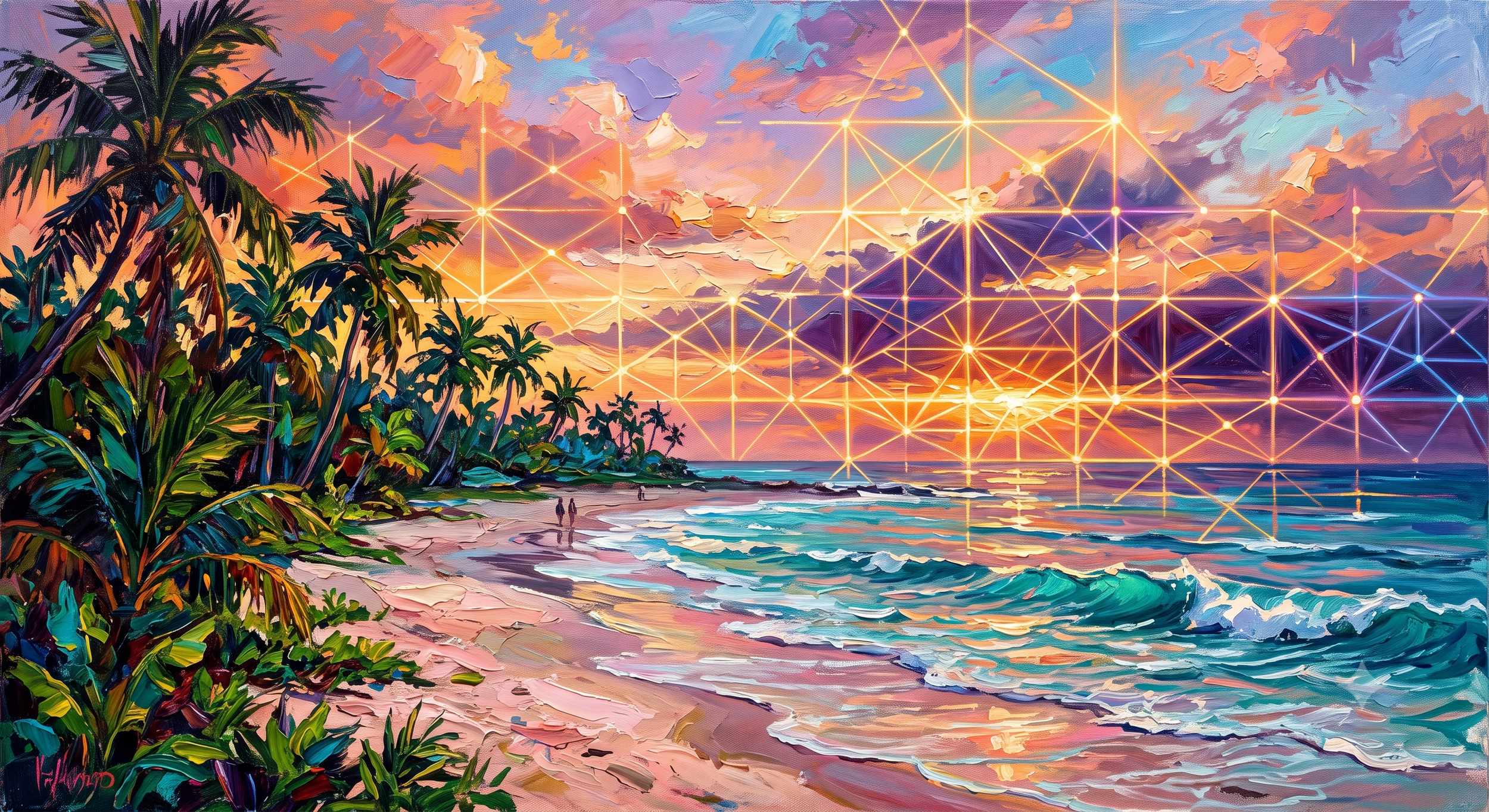
COSMIC HARDWARE OVER HALFPENNY BEACH: An impressionistic rendering depicts a classic St. Croix coastal sunset overlayed with a theoretical mathematical matrix, illustrating Donald Hoffman’s thesis that our space-time reality is an interactive biological projection.(Image Generated by Gemini AI | © 2026 St. Croix Sun News. All Rights Reserved.)
By JOHN McCARTHY / St. Croix Sun News Reporter
CHRISTIANSTED — Pull up a chair at a boardwalk bar in St. Croix, order a cold drink, and look out over the Caribbean Sea at dusk. The water is a brilliant turquoise, the sunset is a melting pot of orange and purple, and the breeze is soft. It all feels undeniably, beautifully real.
But according to UC Irvine professor emeritus of cognitive sciences Donald Hoffman, the probability that you are actually seeing objective reality is precisely zero.
In a recent mind-bending episode of StarTalk hosted by astrophysicist Neil deGrasse Tyson, comedian Chuck Nice, and sports announcer Gary O'Reilly, Hoffman laid out a radical mathematical thesis: evolution has entirely hidden the true nature of objective reality from our eyes, replacing it with a biological virtual reality (VR) headset.
“The standard view is that evolution shapes organisms to be fit, and surely to be fit we should see the world pretty accurately,” Hoffman explained during the broadcast. However, by utilizing evolutionary game theory—the mathematical framework of Darwin’s principles—Hoffman and his colleagues discovered something shocking. “The probability is zero that any organism has ever been shaped at any time to see any aspect of objective reality as it is. It’s just precisely zero.”
Bypassing the Truth for Survival
To make sense of this, Hoffman uses a simple analogy: a computer desktop interface. When you are editing a document, you see a neat blue icon on your screen. But the actual reality of that icon is a complex mess of millions of alternating voltages running through silicon chips. If you had to toggle those voltages manually just to write an email, your computer would be useless.
Similarly, evolution dumbs down the universe into an "avatar" system designed purely for survival and reproduction. Our senses don't give us a window to the truth; they give us a cheap headset to play the game of life.
To drive the point home, Hoffman shared the tragicomedy of the Australian jewel beetle. The male beetle has a simple survival hack: to find a mate, look for something dimpled, glossy, and brown. This worked flawlessly for millennia—until campers started throwing empty beer bottles into the outback. The bottles were the perfect shade of dimpled, glossy brown. The male beetles swarmed the glass, completely ignoring actual female beetles. They couldn't perceive that a bottle wasn't a mate because their evolutionary headset didn't need a deep understanding of reality—it just needed a quick shortcut.
The ‘Crappy Dimension’ and Beyond
The StarTalk crew was visibly rattled by the implications. Chuck Nice hilariously lamented that humans are trapped in a "crappy dimension" (technically defined by space-time physics as n=4, or three dimensions of space and one of time), unable to naturally peer into higher realms.
This led Tyson to ask the ultimate question: if everything is just a headset rendering, what happens to the physical world when we look away?
Hoffman took a firm stance rooted in quantum measurement theory. Just as a heavy-duty video game like Grand Theft Auto only renders the pixels and cars directly in the player's line of sight to conserve processing power, Hoffman argues that space-time and everything within it—including neurons, cliffs, and the literal human hand—is only rendered on the fly when observed.
It is a theory that echoes the famous simulation hypotheses championed by thinkers like philosopher Nick Bostrom, or tech billionaires like Elon Musk who famously mused that we are likely living in a base matrix programmed by a higher intelligence. However, Hoffman departs from the typical tech-bro simulation theory. He rejects the idea that a "geek at a computer" is running us in a physical world. Instead, he believes space-time is not fundamental at all; it stops at the Planck scale, and a deeper math of pure "observation" sits underneath it.
A New Scientific Frontier in the Summer of '26
For the skeptics wondering if this is all just a cosmic "just-so" story, Hoffman is putting his money where his math is. This summer, he is launching the Trace Research Institute, a multidisciplinary hub uniting mathematicians, biologists, and neuroscientists.
Over the next three years, the institute aims to tackle eight specific mathematical conjectures. The ultimate goal? To reverse-engineer our space-time headset and prove that the fundamental laws of physics—like Einstein's cosmic speed limit, the speed of light—naturally fall out of the mathematics of basic observation.
If successful, Hoffman claims the resulting technologies will make our current world look primitive. We might finally understand anomalies like Unidentified Anomalous Phenomena (UAPs) not as rule-breaking crafts, but as entities navigating the universe with a much faster, higher-dimensional "headset" than our own.
So, the next time you are sitting on the beach in Frederiksted watching the sun dip below the horizon, enjoy the view. Just keep in mind that the turquoise water and the soft sand might just be a beautifully constructed, local Crucian avatar—a customized piece of cosmic software rendering just for you.
To dive into the full, unrendered debate on consciousness, space-time, and whether or not we are all just humping the biological equivalent of a beer bottle, you can watch the full interview on theStarTalk YouTube Channel
