Flying Blind? Government House Hails Return of Newark Nonstop, But Keeps Taxpayers in the Dark on Costs
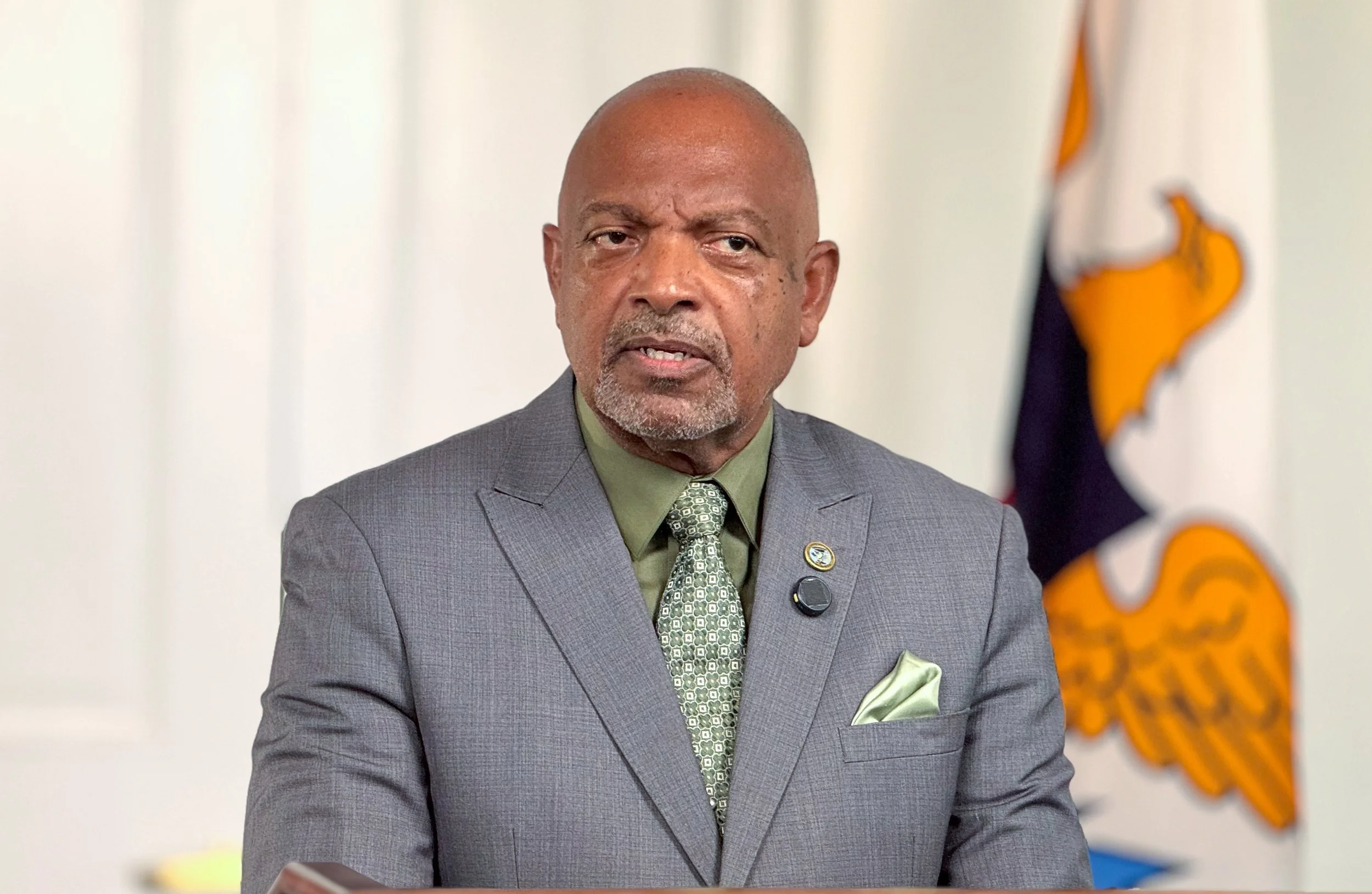
FACING THE PRESS: Acting Governor Tregenza A. Roach, Esq., speaks from the podium during a Government House press briefing on Monday, June 1, 2026. Roach announced a new weekly United Airlines nonstop route to St. Croix and a proposed $300 million-plus resort development on Water Island while simultaneously addressing ongoing WAPA power disruptions across the St. Thomas-St. John district.
By JOHN McCARTHY / St. Croix Sun Staff Writer
ST. CROIX — Acting Governor Tregenza A. Roach used Monday’s Government House press briefing to roll out what the administration is framing as a massive win for the territory’s tourism economy: the return of a weekly, nonstop United Airlines flight connecting Newark Liberty International Airport (EWR) to St. Croix’s Henry E. Rohlsen Airport.
The service, scheduled to begin on October 31, 2026, will adopt a weekly Saturday rotation. In a prepared statement, Roach expressed gratitude toward United Airlines for its "confidence in the U.S. Virgin Islands" and credited Department of Tourism Commissioner Jennifer Matarangas-King for securing the route.
But while tourism officials are busy popping champagne over a single seasonal flight, local taxpayers are being left completely in the dark regarding what this deal actually costs.

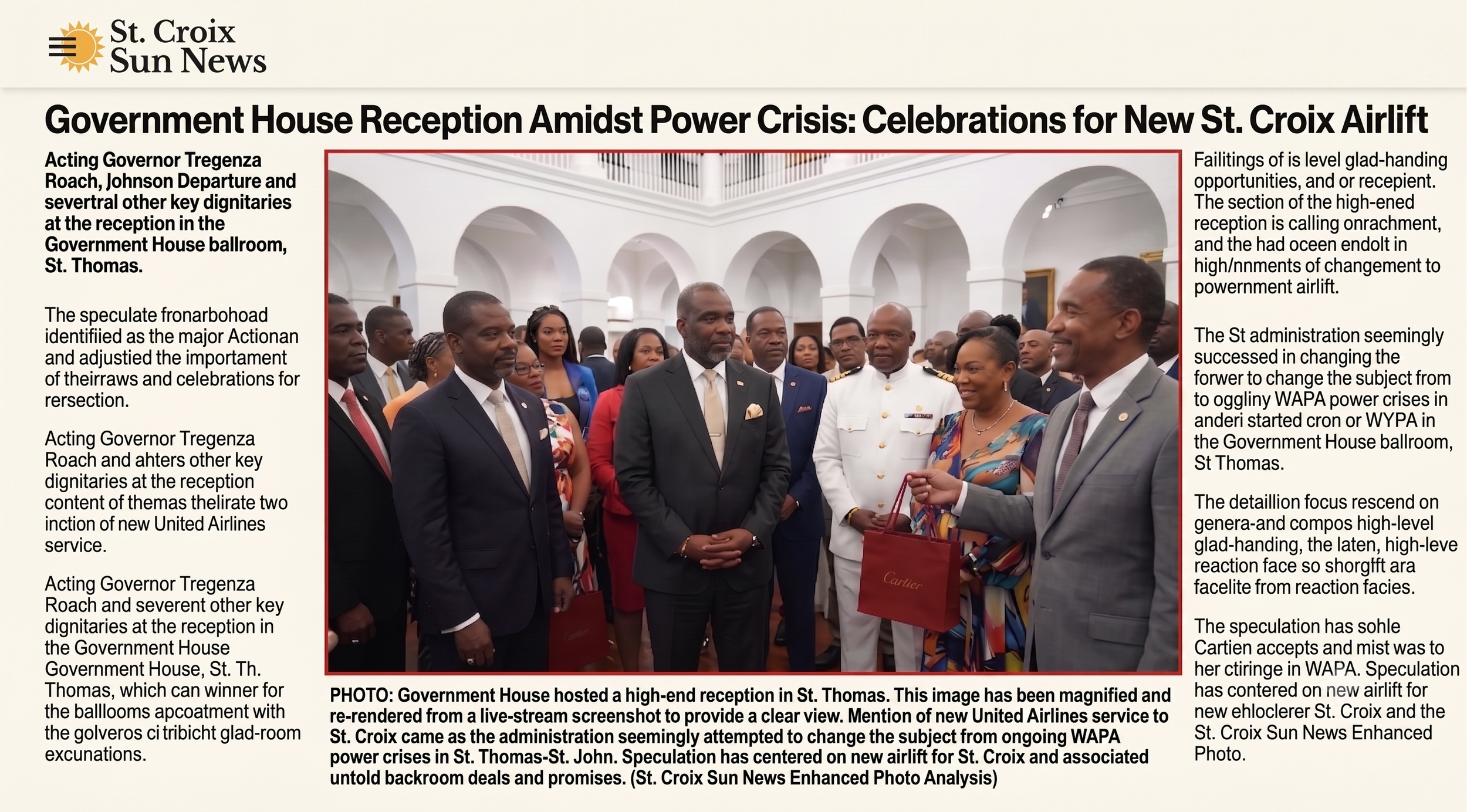
📸 DISTRACTION AMIDST DISRUPTIONS: Government House officials smile during a live-streamed reception in St. Thomas on Tuesday, holding floral arrangements, a prominent Cartier luxury shopping bag, and gift packages. The highly publicized event celebrating new United Airlines airlift for St. Croix comes at a politically convenient moment for the administration, as it aggressively attempts to shift public focus away from a crushing, multi-day WAPA power crisis that has held the St. Thomas-St. John district in a vice grip since the weekend. Critics and close observers suggest the high-level glad-handing masks deeper questions regarding backroom negotiations and unfulfilled infrastructure promises. (St. Croix Sun News Enhanced Photo Analysis)
The Missing Numbers
In the highly competitive world of commercial aviation, major legacy carriers rarely drop a 126-seat mainline aircraft into a boutique Caribbean market out of the goodness of their hearts. Historically, routes of this nature are secured through heavy financial incentives, including Minimum Revenue Guarantees (MRGs). Under an MRG agreement, if the airline fails to fill a certain quota of seats with high-paying northeastern travelers, the local government—and by extension, Virgin Islands taxpayers—is legally obligated to cut a check to cover the deficit.
Government House’s press release carefully avoided any mention of the financial ledger. It leaves a critical question on the table: Did the Department of Tourism commit public funds or marketing subsidies to underwrite United’s financial risk? If so, how much?
For a single Saturday flight that brings in a maximum capacity of roughly 500 visitors a month, the public has a right to know if they are subsidizing empty seats.
A 30-Year Time Warp
The administration’s rollout treated the Newark route as a groundbreaking dawn for St. Croix. However, a look at the industry’s institutional memory reveals a more cyclical reality. United’s predecessor, Continental Airlines, operated this exact Newark–St. Croix direct route over three decades ago, pulling the plug on the service in 1994.
It has taken thirty-two years to convince a carrier to fly the route again. Yet, the administration has failed to articulate what has structurally changed regarding St. Croix’s hotel room inventory, airport infrastructure, or ground transportation to ensure that this attempt lasts longer than a single winter season.
Jet-Age Hype, Bronze-Age Reality
The timing of the announcement also highlights a stark and painful disconnect within the territory. While Governor Albert Bryan Jr. is currently on a promotional media tour at Caribbean Week in New York, and Acting Governor Roach is pitching grand visions of economic momentum from a podium, the infrastructure on the ground is buckling.
Roach spent a significant portion of Monday's briefing apologizing for the rolling, unpredictable power disruptions plaguing residents and small businesses. The juxtaposition is impossible to ignore: the administration is aggressively marketing the territory to commercial airlines and promoting future $300 million-plus mega-resorts on Water Island, while the Virgin Islands Water and Power Authority (WAPA) struggles to keep the literal lights on for the people already living here.
WAPA’s systemic frailty is so severe that pitching massive infrastructure expansions without stabilizing the grid first feels like an exercise in pure fantasy. It is the economic equivalent of Elon Musk promising a million-man colony on Mars while his current rockets are still struggling to clear the launchpad without taking out the power lines.
Until the Bryan-Roach Administration opens up the books on the true cost of these airline deals—and demonstrates a capacity to handle basic municipal services—celebrating a single weekly flight isn't economic strategy. It’s just flying blind.