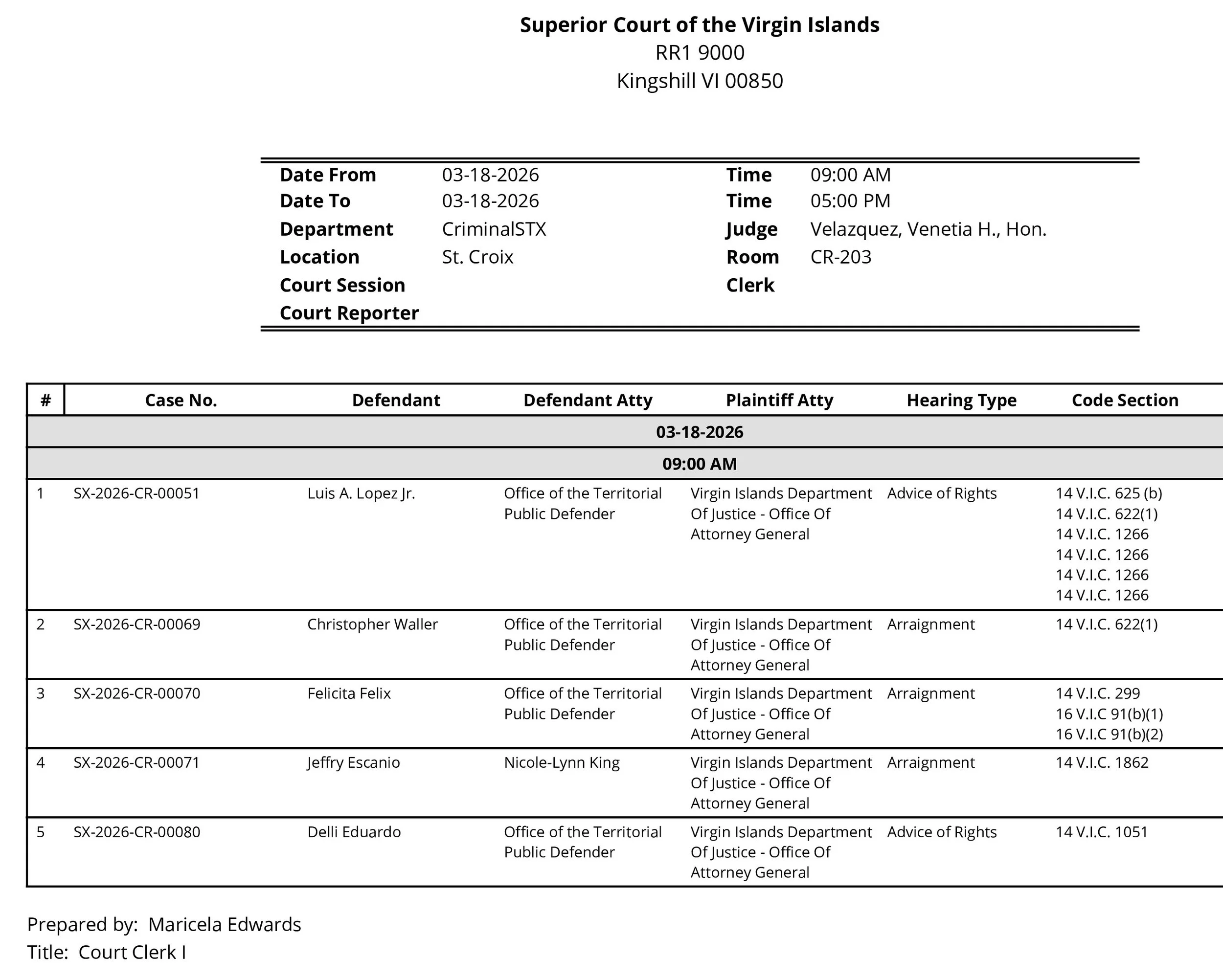
From Assault to Abduction: Wednesday’s Court Docket Reveals Surge in Serious Crimes

WEARING THE EVIDENCE: Luis Lopez Jr., 38, who was reportedly arrested while "prancing" through Christiansted in apparel stolen during a burglary at the Purple Papaya. Lopez is also charged with a 2025 rock-throwing incident at Sunny Isles that left a patron injured.
KINGSHILL —In this week’s Court Watch, we dive into the specific legal statutes governing two of the most serious cases appearing on Wednesday’s criminal calendar: Domestic Violence and First-Degree Robbery.
Understanding these codes is essential for tracking how justice is administered in the Virgin Islands, especially as the Superior Court continues to clear a heavy backlog of local offenses.
Domestic Violence: 16 V.I.C. § 91
The case of Felicita Felix involves charges of Simple Assault and Battery (14 V.I.C. § 299) categorized under the Domestic Violence statute (16 V.I.C. § 91).
In the Virgin Islands, domestic violence isn't a standalone crime but a designation added to other offenses—like assault, stalking, or harassment—when they occur between "housemates" or family members.
The "91(b)" Designation: This specific subsection allows the court to impose mandatory arrest policies and restricts the defendant’s ability to contact the victim.
Aggravating Factors: If a "deadly weapon" is involved or if the assault results in "serious bodily injury," the charges are often escalated from simple assault to third-degree assault, which carries much steeper prison time.
First-Degree Robbery: 14 V.I.C. § 1862
The arraignment of Jeffry Escanio brings 14 V.I.C. § 1862 into focus. This is one of the most severe "crimes against property" in the territorial code because of the element of danger involved.
The Definition: To sustain a conviction for First-Degree Robbery, the prosecution must prove the defendant took property from another person by force or fear while "armed with a dangerous weapon" or by inflicting serious bodily injury.
The Stakes: A conviction carries a mandatory minimum sentence of five years and a maximum of twenty years in prison. Unlike lesser theft charges, there is very little wiggle room for probation in these high-stakes cases.

VIPD mug shot of Delli Eduardo, of St. Croix, U.S. Virgin Islands
Continuing our Court Watch deep dive, we shift our focus to two of the more complex charges appearing on this week's criminal calendar: False Imprisonment and Kidnapping and Reckless Endangerment.
While domestic violence and robbery are frequently seen in the Superior Court, these statutes carry specific legal hurdles that the Virgin Islands Department of Justice must clear to secure a conviction.
False Imprisonment and Kidnapping: 14 V.I.C. § 1051
In the case involving Delli Eduardo, the court is examining one of the most serious "crimes against the person" in the territorial code.
Under Virgin Islands law, kidnapping isn't just about moving someone from one place to another; it's about the unlawful restraint of their liberty.
The "Seizure" Element: The statute covers anyone who "seizes, confines, inveigles, decoys, abducts, conceals, kidnaps or carries away" another person.
The Intent: To sustain a kidnapping charge, the prosecution often has to show the restraint was done with specific intent—such as to hold the person for ransom, use them as a shield, or facilitate the commission of another felony.
The Stakes: Kidnapping is a high-level felony. If the victim is released unharmed in a safe place, the penalties are still severe, but if bodily injury occurs, the defendant faces a mandatory life sentence without the possibility of parole.
Reckless Endangerment: 14 V.I.C. § 625
The charges against Luis A. Lopez Jr. include First-Degree Reckless Endangerment (14 V.I.C. § 625(b)). This charge is often applied in cases involving the discharge of a firearm or high-speed vehicular chases.
The Standard of Conduct: Unlike premeditated assault, reckless endangerment focuses on a "depraved indifference to human life." The defendant's actions must create a substantial risk of serious physical injury to another person.
Firearms Involvement: In the Virgin Islands, § 625(a) specifically addresses the "discharge of a firearm" in public places or where people are gathered. Doing so automatically elevates the act to a felony, punishable by up to five years in prison and significant fines.