
THE COLD, HARD TRUTH: Street Justice Outpaces VIPD as 2026 Homicides Remain Unsolved
By JOHN McCARTHY / St. Croix Sun Investigative Reporter
ST. CROIX — Want to know the most reliable way a homicide case gets closed by the Virgin Islands Police Department these days? The primary suspect has to get murdered first.
A grueling independent audit of the territory’s 2026 bloodshed reveals a staggering, indictment-level reality: of the 17 homicides recorded across St. Croix and St. Thomas so far this year, the VIPD’s Criminal Investigation Bureau has achieved a near-total blackout on proactive arrests. Instead, the only cases wiped from the active docket are those where street justice or self-defense beat the boys in blue to the punch—leaving the rest of the territory's families waiting on a police department that seems far more adept at riding around in air-conditioned SUVs than solving capital crimes.
Historically, the territory’s police public relations machine treats each homicide as an isolated tragedy, routinely deflecting systemic failure by lamenting "senseless acts of violence." But when you zoom out and look at the macro picture of 2026, the numbers don't just speak—they scream.
As of mid-June, the territory has recorded 17 homicides—nine on St. Croix and eight on St. Thomas. Out of those 17 files, the number of proactive, warrants-served, old-fashioned police arrests initiated by VIPD homicide detectives stands at a near-total flatline.
Instead, the only dockets moving out of the "active" tray are those where the streets or self-defense did the work for them. On St. Croix, a March robbery case closed only because the targeted victim turned the tables and neutralized the suspect. On St. Thomas, a high-profile kidnapping defendant met his end in a hail of gunfire right as his trial neared a verdict.
The rest? A catastrophic backlog of cold, hard data.
A Timeline of Inertia
From east to west, the list of unresolved files grows while investigative tires spin in place:
The triple execution near the Estate Concordia dumpsite in February.
The broad-daylight gunning down of 47-year-old Kaleem Iles in Mon Bijou in May.
The early-morning double homicide of Wahili James and Samuel Rivera at a Peter’s Rest bar.
The heartbreaking June 12 execution of 15-year-old high school student Tre'Vante Etienne on Vester Gade in St. Thomas, where the standard VIPD response was issued within hours: No suspect information is available.
In nearly every instance, the Criminal Investigation Bureau and Major Crimes Units follow an identical playbook. They tape off the scene, wash the asphalt, and issue a boilerplate media advisory begging the public to call Crime Stoppers with tips. It is an operational strategy that essentially treats law enforcement as a passive repository for anonymous information rather than an active, investigative force.
The Cost of High-Level Distraction
To understand how the territory’s flagship law enforcement agency devolved into a glorified transcription service for street gossip, one has to look at the top. The operational paralysis trickling down through the ranks coincides perfectly with years of executive-level chaos. When a police commissioner like Ray Martinez is pushed out under the shadow of a federal indictment—alleging bribery, wire fraud, and extortion over technology contracts—the institutional focus inevitably shifts from securing the streets to securing legal defense.
While leadership was allegedly preoccupied with chasing greenbacks and managing grand jury fallout, the baseline accountability required to run a functional homicide unit evaporated.
Taxpayers are currently funding millions of dollars for the VIPD’s high-tech ShotSpotter integration, upgraded surveillance grids, and a massive fleet of pristine SUV squad cars. Yet, if gunfire is detected in seconds, but suspects can't be identified for months, the return on investment for the public is zero. Until the boys in blue roll down the windows of those air-conditioned cruisers, hit the pavement, and rebuild the community trust shattered by years of institutional decay, the 2026 report card remains an undeniable, tragic “'F.”
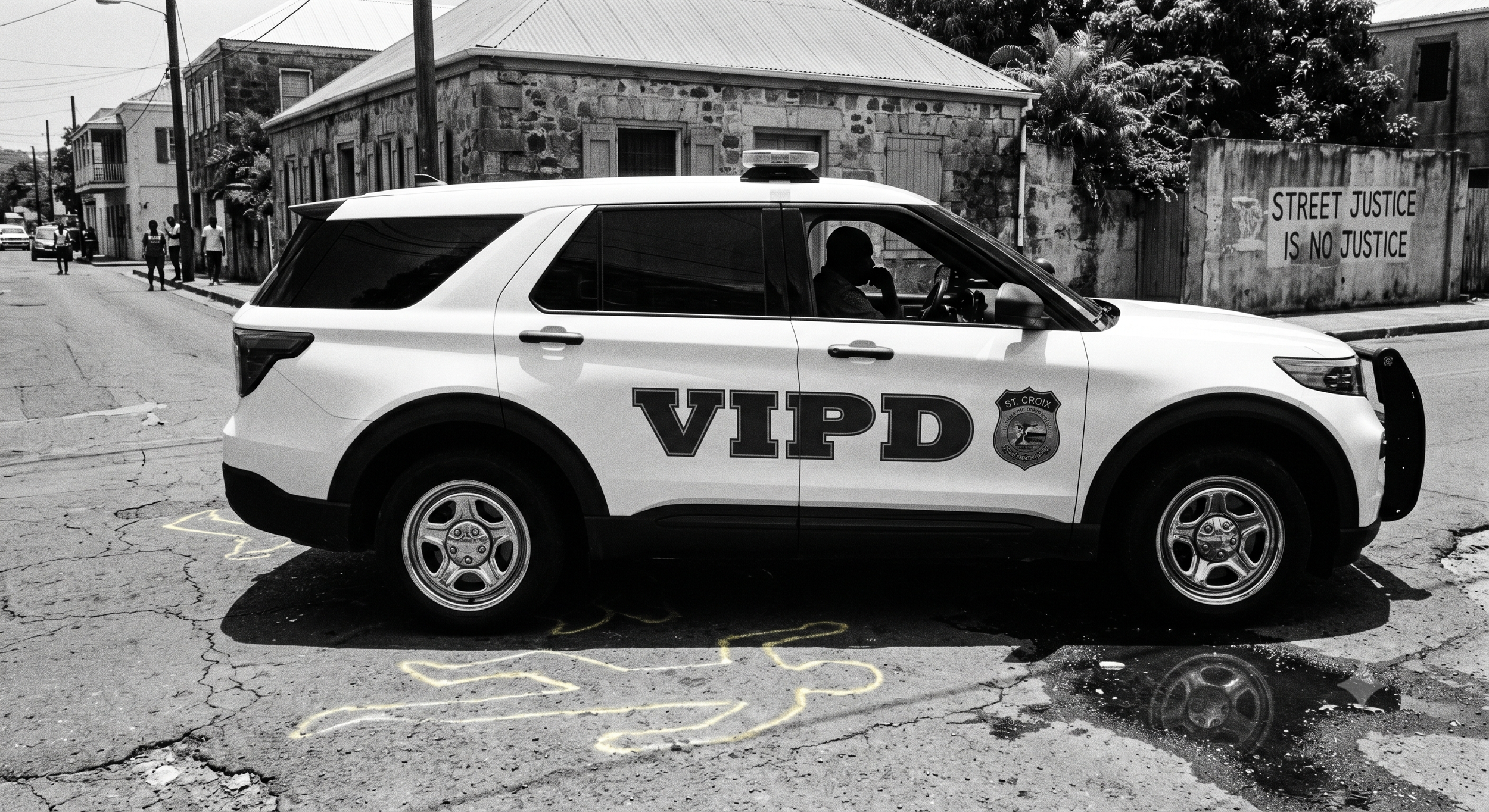
INACTIVE LINES: A Virgin Islands Police Department (VIPD) patrol vehicle idles on a St. Croix street near a freshly marked crime scene. Despite significant investments in fleet upgrades and surveillance technology, territorial homicide clearance rates remain critically low, with the vast majority of 2026 violent crime investigations remaining open and unresolved. (Photo: St. Croix Sun News/AI Graphic)
