
The Fragile Treasury: How the Departure of Just Two Taxpayers Cost the USVI $20 Million
By JOHN McCARTHY / St. Croix Sun News Reporter
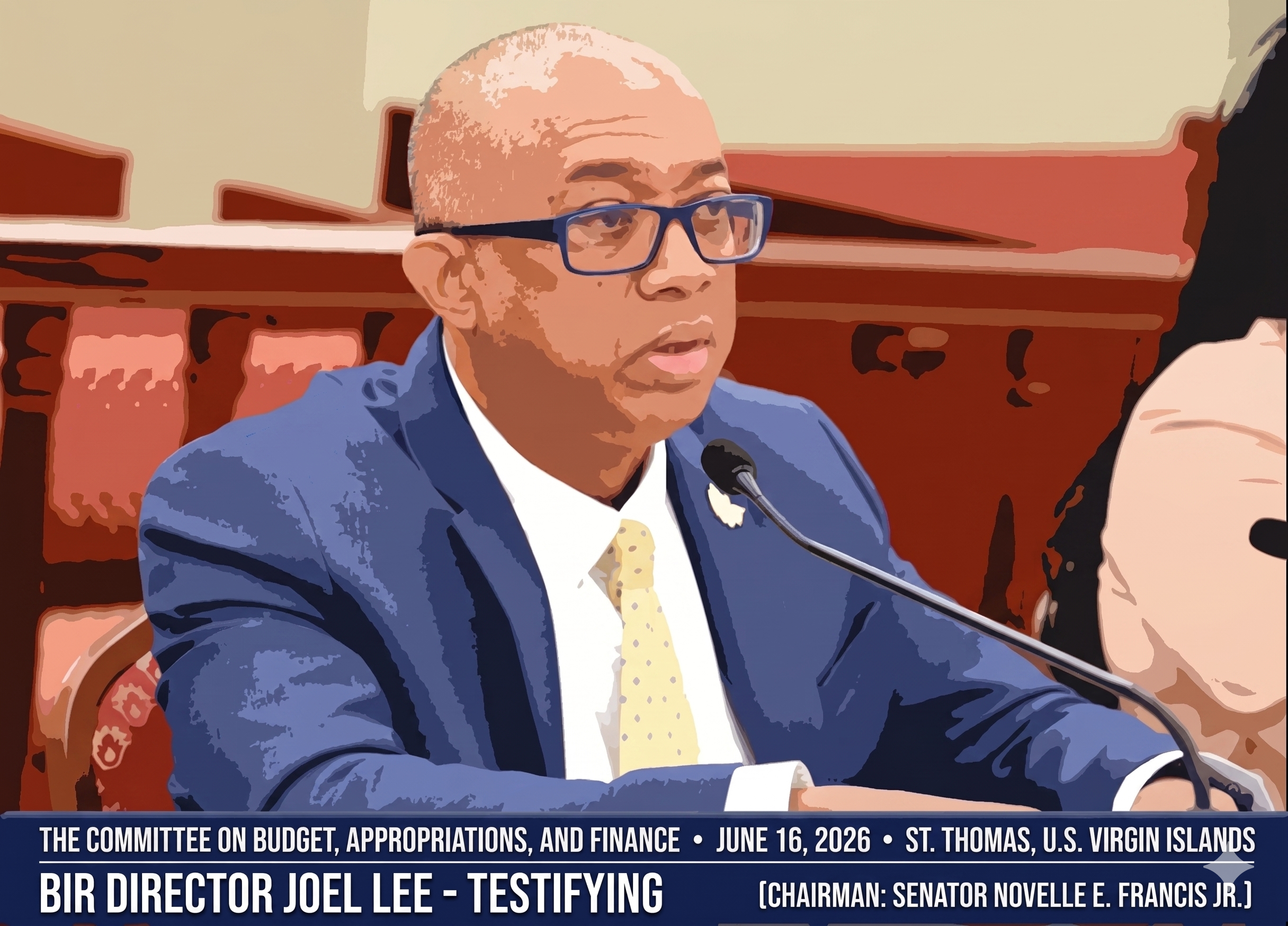
ST. CROIX — When Bureau of Internal Revenue Director Joel Lee sat before the Senate Committee on Budget, Appropriations, and Finance on Tuesday, he delivered a stark revelation that exposed the structural fragility of the Virgin Islands' economy.
To explain a sudden, sharp deficit in projected income tax collections, Lee pointed to a single, volatile factor: the quiet departure of just two high-net-worth individuals from the territory.
According to Lee's testimony during both the mid-year Budget Overview and his agency’s formal budget hearing, the physical relocation of these two former residents cost the local treasury an estimated $20 million in lost revenue. Had they remained on island, Lee noted, the BIR would have collected approximately $20 million more than current fiscal totals.
The revelation underscores a dangerous reality for the U.S. Virgin Islands: a tax base so radically top-heavy that the private whims and relocation choices of two people can instantly jeopardize territorial budget projections.
A Top-Heavy Dependency
For decades, the territory’s economic development strategy has leaned heavily on attracting ultra-wealthy residents through lucrative tax incentive programs, such as those managed by the Economic Development Authority (EDA). While these programs aim to stimulate local investment, Lee’s testimony reveals the profound vulnerability of anchoring a public treasury to a handful of transient "whales".
When a territory relies so fundamentally on a micro-fraction of its population to fund basic public operations, fiscal stability becomes an illusion. A permanent move to the mainland—or even a sudden corporate pivot to an alternative tax haven—leaves an immediate, multi-million-dollar crater in the government's cash flow.
This $20 million shortfall arrives at a moment of acute financial strain for the government. Earlier in the budget cycle, financial officials testified that the central government has faced severe liquidity pressures, managing a tight reserve of cash on hand while juggling tens of millions in unpaid accounts payable.
The $14 Million Illusion
On paper, Director Lee presented an agency that appears to be performing ahead of schedule. Through May 2026, the BIR collected $610 million in total revenues, representing a $14 million increase over the same period in the prior fiscal year.
However, the departure of the two unnamed high-net-worth individuals effectively erases the victory of that nominal increase. Without their exit, the territory would be looking at an additional $20 million—capital desperately needed to address rolling power grid instabilities, public infrastructure deficits, and critical agency funding. Instead, the $14 million gain functions as a cosmetic band-aid over a bleeding artery.
Furthermore, the government’s recent efforts to extract immediate liquidity through tax amnesty initiatives have come at a steep long-term price. While the amnesty program generated $6 million in quick cash for the treasury, Lee admitted the BIR was forced to waive $11 million in penalties and interest to secure it—sacrificing future revenue to resolve immediate cash constraints.
The Sovereign Risk
The broader takeaway from Tuesday's hearing is not merely about a missed $20 million projection; it is a warning about sovereign risk. If the exit of two taxpayers can disrupt the financial forecasting of an entire territory, the local government is operating on a fiscal tightrope.
When global billionaires treat jurisdictions as temporary encampments, the local populace is left to navigate the fallout when those taxpayers pack up stakes. For the USVI, the current budget landscape proves that a treasury built on the shifting sands of ultra-wealthy residency is a treasury permanently at risk.
A check of the Superior Court's online docket systems indicates that formal documents from parallel legislative fiscal updates are still being processed into the public record.
