
LEGISLATIVE OVERHAUL: Territory Firearms Laws Face Major Modernization As Second Amendment Rights and Public Safety Act Passes
By JOHN McCARTHY / St. Croix Sun News Reporter
CHARLOTTE AMALIE — The legal framework governing weapon possession, licensing, and public safety across the territory has undergone a sweeping transformation following the formal passage of the "2026 Second Amendment Rights and Public Safety Act" by the Virgin Islands Legislature. The comprehensive overhaul, spearheaded by the Virgin Islands Department of Justice in coordination with the executive branch and territorial law enforcement, aims to bring local statutes into alignment with recent landmark United States Supreme Court decisions while aggressively expanding prohibitions on illegal hardware.
According to a formal statement issued by Attorney General Gordon C. Rhea on Monday, June 15, 2026, the updated legislation establishes rigid statutory barriers to interdict the flow of highly lethal, untraceable weaponry. The act institutes strict territorial bans on explosive devices, fully automatic firearms, and un-serialized "ghost guns," while heavily criminalizing tactical accessories like large-capacity magazines and aftermarket switches designed to convert semi-automatic platforms to automatic fire.
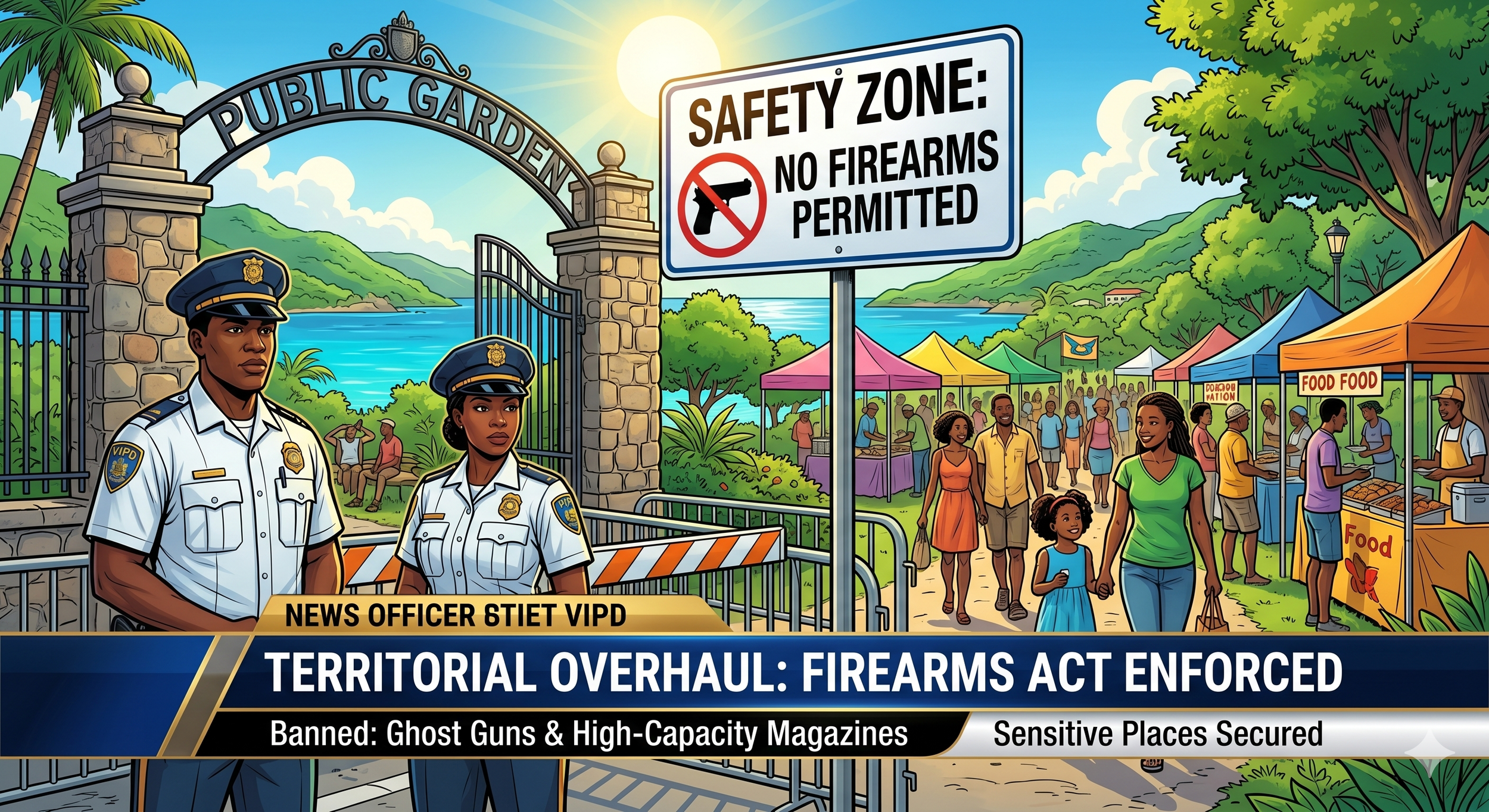
In addition to hardware prohibitions, the modernized public safety act establishes strict "sensitive places" designations where firearms are explicitly banned from entry, regardless of a carrier's licensing status. These newly codified zones include all territorial schools, hospitals, government-owned buildings, and large-scale public events. Federal and territorial prosecutors note that the measure is explicitly tailored to close existing legal loopholes that previously hindered active enforcement during high-profile community gatherings.
The legislation further tightens background parameters to prevent firearm access for specific high-risk categories. The statutory updates mandate the absolute denial of firearm access to individuals with standing violent felony convictions, fugitives fleeing justice, and persons currently subjected to active domestic violence protection orders or formal judicial adjudications declaring them a danger to themselves or others. Department of Justice Assistant Attorney General Sean Bailey and St. Thomas Criminal Division Chief Timothy Perry provided extensive drafting assistance to align the structural compliance of the act with modern constitutional jurisprudence. The implementation timeline for local licensing enforcement bureaus is expected to take effect immediately.
