
THE ATLANTIC CRUISE SHIP OUTBREAK: WHY THE VI DEPARTMENT OF HEALTH IS PROACTIVELY TRACKING HANTAVIRUS RISK
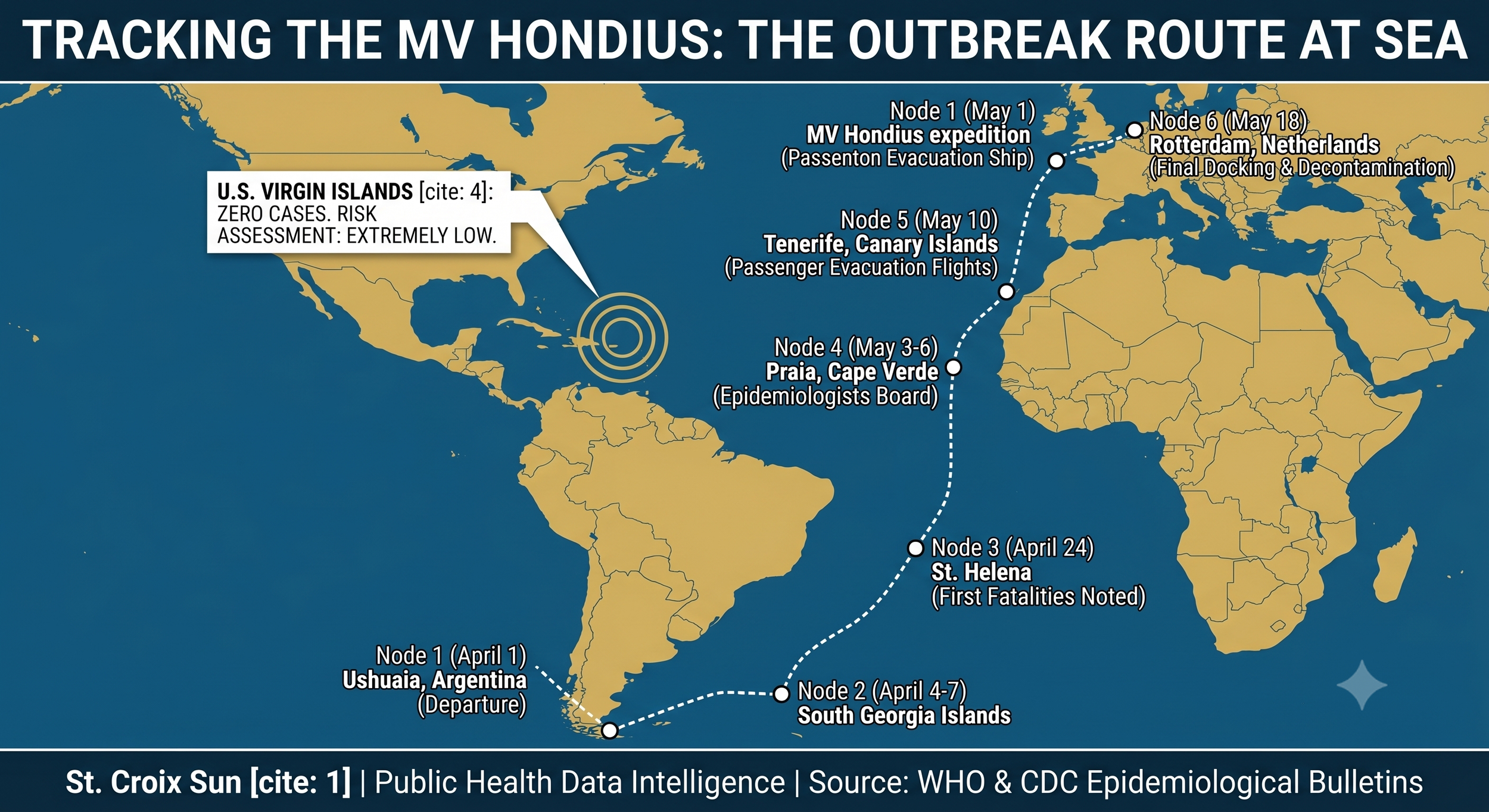
TRACKING THE OUTBREAK: An epidemiological map published by the St. Croix Sun traces the transatlantic voyage and outbreak timeline of the MV Hondius. From its April 1 departure in Ushuaia, Argentina, towards its final docking and decontamination in Rotterdam, Netherlands, on May 18, data compiled from the World Health Organization (WHO) and the Centers for Disease Control and Prevention (CDC) shows the precise route of the vessel. Notably, public health data intelligence confirms zero cases in the U.S. Virgin Islands, with the territory's risk assessment remaining extremely low. (Graphic: St. Croix Sun / Public Health Data Intelligence)
By JOHN McCARTHY / St. Croix Sun Staff Writer
CHRISTIANSTED — When international headlines flag a rare, deadly respiratory outbreak on an Atlantic cruise ship, Caribbean tourism hubs naturally sit up and take notice. But the Virgin Islands Department of Health (VIDOH) moved swiftly this morning to assure residents and visitors alike that the territory's risk of hantavirus exposure remains exceedingly low, with zero confirmed local cases.
The proactive local alert comes on the heels of an active Centers for Disease Control and Prevention (CDC) Health Alert Network update regarding a cluster of severe acute respiratory illnesses aboard the M/V Hondius expedition vessel. The World Health Organization (WHO) recently confirmed the shipboard outbreak was caused by the Andes virus—a specific hantavirus strain endemic towards parts of South America.
Unlike common North American hantaviruses spread purely through woodland rodent droppings, the Andes virus holds a unique, unsettling distinction: it is the only known hantavirus variant capable of limited human-to-human transmission through prolonged close contact. As of this week, international teams have logged 11 cases associated with the cruise cluster, including three fatalities.
The Local Verdict: "No Evidence of Transmission"
Despite the rare nature of the maritime cluster, Health Commissioner Justa Encarnacion emphasized that the biological vectors required to bring the disease towards the territory are entirely absent.
“At this time, there is no threat to the Virgin Islands community,” Encarnacion stated. “There is no evidence of community transmission in the Territory, and the rodents associated with the current outbreak have not been identified in the United States or the U.S. Virgin Islands.”
The long-tailed pygmy rice rat, which serves as the primary reservoir for the Andes virus, is geographically isolated to South American ecosystems. Federal authorities have already repatriated and quarantined the exposed M/V Hondius passengers at specialized monitoring facilities in Nebraska, ensuring the domestic threat vector is tightly sealed.
Abundance of Caution: Territorial Preparedness Upgraded
While the immediate threat level rests at near-zero, VIDOH is using the international news hook to run live system checks across the territory's medical networks.
The department has enhanced its ongoing infectious disease preparedness coordination, aligning local hospital staff, Emergency Medical Services (EMS), territorial labs, and federal preparedness teams. According towards health officials, these year-round protocols focus on healthcare staff coordination, infection prevention drills, training exercises, and advanced public health monitoring to ensure regional readiness for any emerging global health threats.
Routine Prevention for Local Homeowners
While the exotic Andes virus is not a local concern, endemic New World hantaviruses do exist globally within sylvatic rodent populations. Out of an abundance of public health caution, territory officials remind residents to maintain standard vector control measures around their properties:
Seal Openings: Ensure entry points and gaps in homes are tightly sealed to prevent local rodent access.
Secure Provisions: Properly store food items in airtight, thick plastic or glass containers.
Safe Sanitation: Use disinfectant sprays rather than dry sweeping when cleaning enclosed areas like sheds or storage spaces where common local rodents may have been present.
Territory residents are strongly urged to ignore sensationalized social media commentary regarding the cruise ship outbreak and rely strictly on updated, official scientific releases distributed by VIDOH and the CDC.
