
THE $958.2M DISCONNECT: Bryan’s Final Legacy Budget Outlines Millions for Infrastructure While Street-Level Public Safety Short-Circuits

GOVERNMENT HOUSE BRIEFING: Governor Albert Bryan Jr. addresses the territory from the podium at Government House. The Bryan-Roach Administration today submitted its final proposed Fiscal Year 2027 Executive Budget to the 36th Legislature, outlining a $958.2 million spending plan that faces immediate scrutiny from a community demanding deeper investments in public safety and local mental health infrastructure. (Photo: Government House)
By JOHN McCARTHY / St. Croix Sun Staff Writer
CHRISTIANSTED — Government House officially dropped a massive administrative bombshell today, submitting Governor Albert Bryan Jr.’s final proposed Fiscal Year 2027 Executive Budget to the 36th Legislature—a staggering $958.2 million spending plan boldly themed "Investing Today for the Communities of Tomorrow: Infrastructure, Recreation and Housing."
But while the administration’s press release boasts about pumping nearly a billion dollars into parks, housing, and grand legacy infrastructure projects, a viral video of a chaotic police struggle at Tutu Park Mall has exposed a dark, underfunded reality on the ground.
To the street, the incident doesn't look like a "community of tomorrow." It looks like an institutional failure of yesterday.
The Mechanics of an Operational Failure
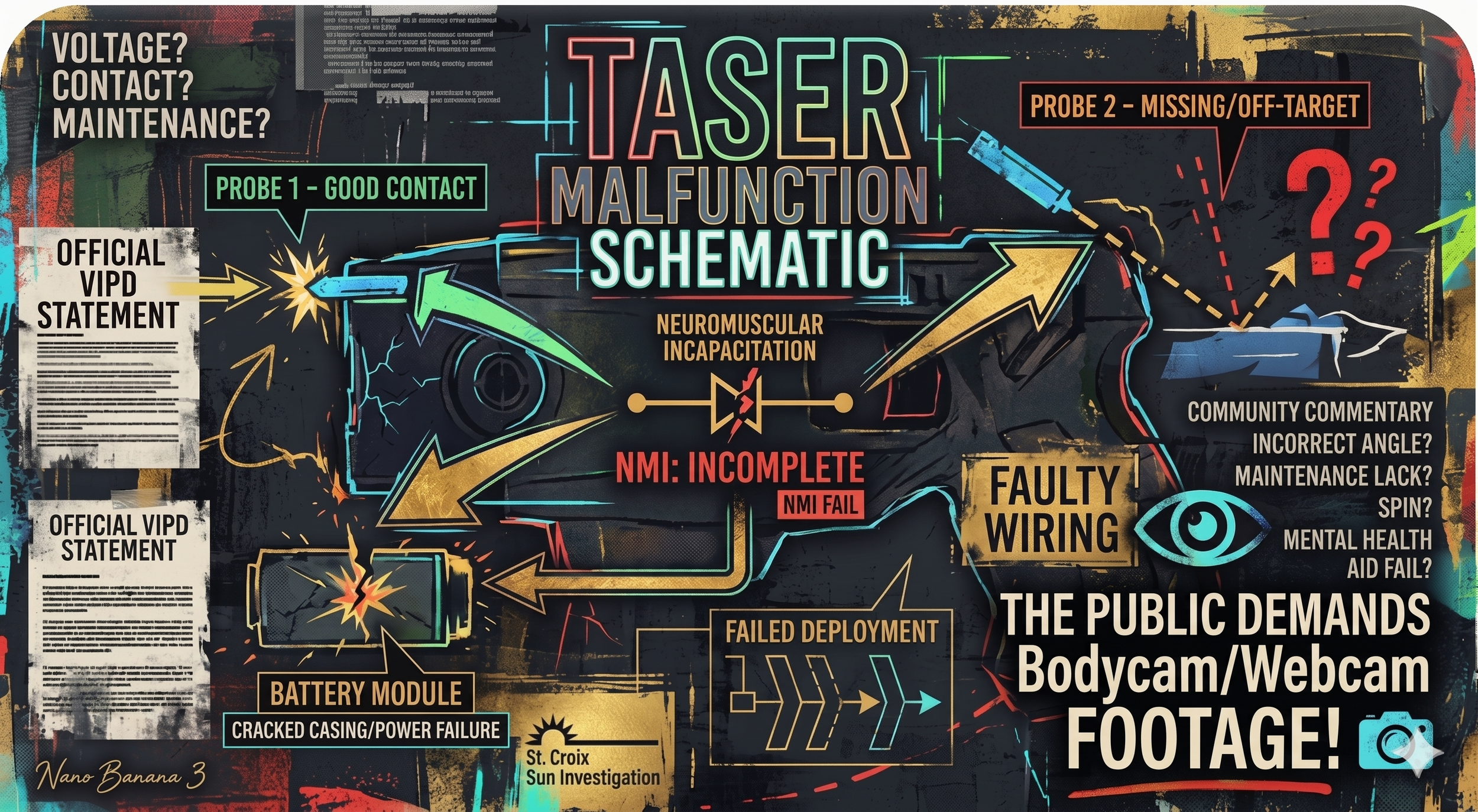
Following a VIPD press release attributing the violent arrest of a well-known mental health patient to a "tactical gear failure," the St. Croix Sun and VIFP have been flooded with commentary. While the public remains deeply divided, experienced security professionals and tactical experts are pointing out that the failure wasn't just mechanical—it was a failure of basic operational proficiency.
In a highly detailed public critique, local resident Alson Lockhart broke down the operational reality of the department's standard-issue equipment:
"The baton failure is on the officer's end. Watching the same video everyone else watched, it appears nearly impossible to deploy a baton at that angle and with that level of force while still generating the force necessary for it to fully expand," Lockhart noted.
Turning his attention to the malfunctioning electronic weapon, Lockhart added, "As for the TASER, many people view it as some kind of magic solution... For a TASER to be effective, several factors come into play, including the suspect's tolerance level, the type of clothing being worn, probe spread, and whether both probes make effective contact to achieve neuromuscular incapacitation (NMI)."
Industry standards and local security training models back this up completely. A deployment too close to a target causes the internal dart coils to land tightly together, completely failing to achieve the "probe spread" required to disrupt the body's motor nervous system. This leaves officers entirely vulnerable in an off-balance, close-quarters hand-to-hand brawl.
The Budget vs. The Badges
This technical reality shifts the spotlight from the responding officers directly onto the desks at Government House. If the territory is operating on a near-billion-dollar budget, why are front-line units being sent onto the streets with critical training deficits in close-quarters deployment, de-escalation, and routine equipment maintenance?
Prominent community voices are refusing to accept the standard administrative spin. Commenter Ingrid Lewis-Fleming leveled a blistering critique directly at the operational discipline and oversight of the responding units:
"Charge the taser before going to the beauty salon to put on that long weave," Lewis-Fleming wrote, fiercely questioning the tactical protocols on display. "Abuse of a mental patient... officers are taught to identify mental patients first before abusing patients, and why is her knee on the patient's neck?"
Jails are Not Asylums
The core issue underlying the entire Tutu Park Mall incident is a multi-million-dollar infrastructure deficit that a coat of paint cannot fix. By continuously failing to fund a dedicated, secure psychiatric care facility and specialized, mobile Crisis Intervention Teams (CIT), the government has effectively turned frontline police officers into makeshift asylum workers—and local jails into modern-day dumping grounds for medical patients.
As Governor Bryan prepares to push his final $958.2 million legacy budget through the Legislature, the community is sending a loud, clear message from the comments section to the capital: Stop spending money on legacy projects while our public safety infrastructure, tactical training, and mental health systems are completely short-circuiting on the asphalt.
The St. Croix Sun will continue to audit the FY 2027 budget line items as hearings begin.
