
ST. THOMAS CRUISE SHIP PASSENGER FOUND DEAD AT FREDERIKSTED PIER; DOJ MISSES CRITICAL MORGUE DEADLINE
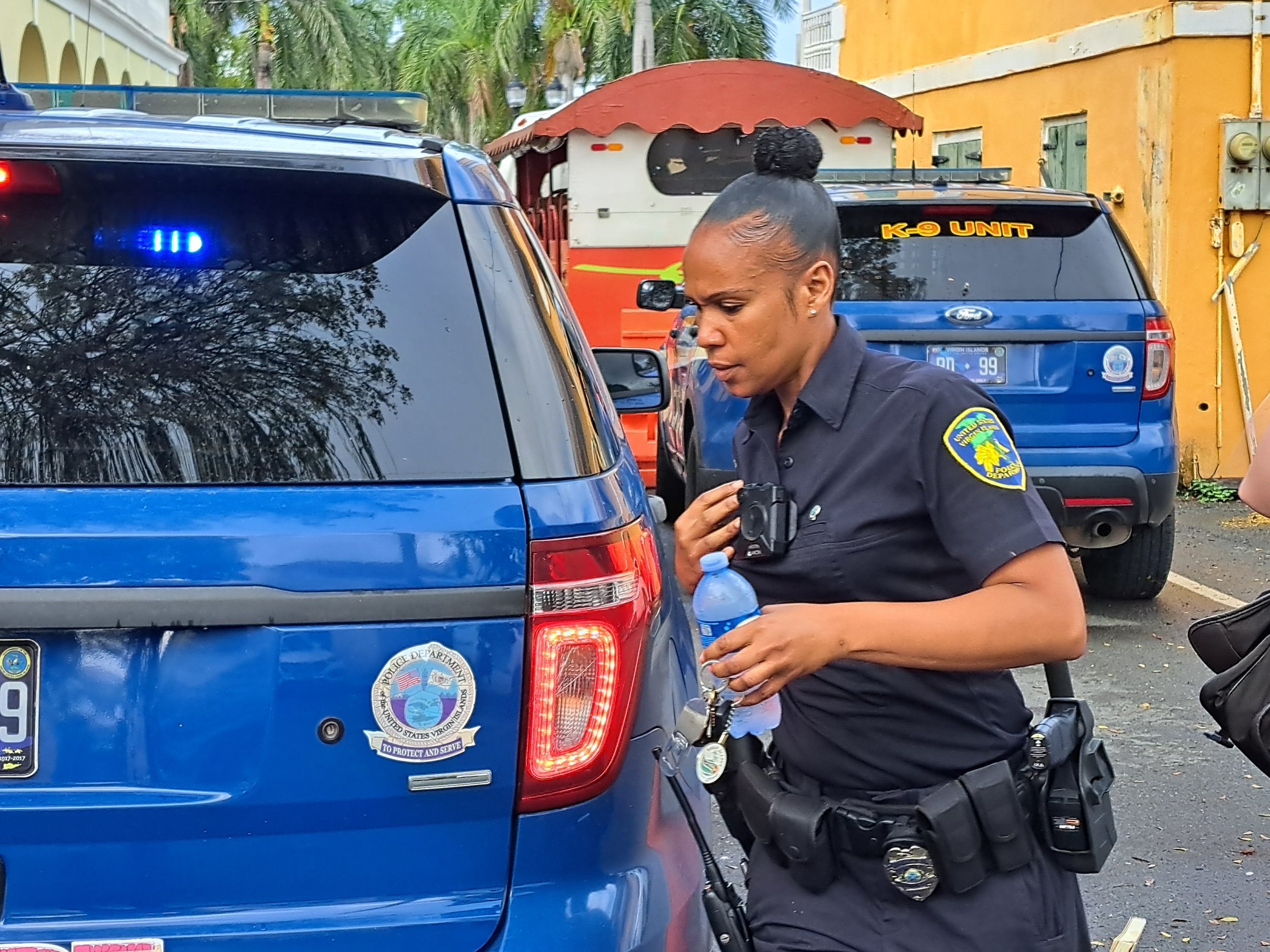
INVESTIGATION AT THE PIER: Flashing lights of the Virgin Islands Police Department cut through the morning air near the Frederiksted Pier on Wednesday, April 8, following the removal of a deceased passenger from the Adventure of the Seas. While local law enforcement responded to the scene, the Department of Justice’s forensic infrastructure remained inactive just miles away, with the critical April 10 Golden Grove morgue deadline once again left unmet. (Photo: St. Croix Sun)
By JOHN McCARTHY / St. Croix Sun Investigative Reporter
FREDERIKSTED — While homeless individuals are forced to wander the Frederiksted Waterfront Promenade looking for a “dignity bus,” the machinery of justice on St. Croix remains frozen in time.
On Wednesday morning, April 8, the Royal Caribbean vessel Adventure of the Seas pulled into the Ann E. Abramson Marine Facility with more than just tourists. It arrived with a tragedy on Deck 12—a male passenger who reportedly passed away during the transit from St. Thomas.
As VIPD forensics and the Medical Examiner boarded the ship at 7:00 AM, they weren't stepping into a modernized forensic era. They were stepping back into the "long and tortuous road" of a broken system. Today, April 10, 2026, was the very day Attorney General Gordon Rhea promised the St. Croix community that a modular autopsy suite at Estate Golden Grove would finally be "operable."
The April 10 Mirage
In January, AG Rhea explicitly set this "April 2026" target to end the $112,000-a-year expense of flying deceased individuals off-island for post-mortem examinations. He called the completion of the Golden Grove facility "imminent."
However, as of this morning's deadline, the "imminent" has become invisible. The Adventure of the Seas passenger, removed from the ship in Frederiksted, has effectively become a stress test for a system that hasn't delivered. Sources close to the investigation suggest that without the Golden Grove facility being "operable" as promised, the deceased must once again navigate the same arduous logistics the government claimed were ending today.

A Pattern of Silence
The St. Croix Sun and Virgin Islands Free Press reached out to both the Department of Justice and the Virgin Islands Port Authority (VIPA) for clarification on the status of the Golden Grove facility and the handling of the Wednesday incident.
As of 5:00 PM today, Attorney General Gordon Rhea, VIPD Communications Director Glenn Dratte and VIPA Public Information Officer Monifa Brathwaite did not immediately return requests for comment.
The silence from the DOJ stands in stark contrast to the activity at the Kingshill complex, where the Superior Court continues to process cases of "depraved indifference," while the government's own infrastructure remains under a blue tarp at the Container Port.
Editorial Note: The Cost of the Wait
For the 52+ families affected by these delays and the taxpayers footing the bill for off-island transport, the missed April 10 deadline isn't just a scheduling error—it's a failure of governance. Elon Musk might be launching rockets to the stars, but on St. Croix, we can't even move a modular trailer from the port to the morgue.
MARIE’S MARITIME CHECK: Reader Marie Petronzio correctly notes that cruise ships are floating cities equipped with their own morgues and physicians trained to handle onboard deaths. Under standard protocols:
Medical Pronouncement: The ship’s physician confirms the time of death and initiates the medical logs.
Storage: Remains are moved to a specialized morgue facility below deck until the vessel reaches a port deemed capable of handling the disembarkation.
The Burden of Cost: Families are almost always responsible for the $5,000 to $25,000 cost of repatriation, a reality that drives the robust market for travel insurance.
THE SUN’S REALITY CHECK: While the cruise line’s job is strictly defined, the "Handoff Hazard" begins at the dock.
The Legal Deadlock: A ship’s doctor can pronouce a death, but they cannot issue a final, legal death certificate recognized by U.S. insurance companies or estates. That power belongs solely to the registrar of the port where the body is disembarked—in this case, the USVI Government.
The Bureaucratic Stink: If the local system is backed up—as we’ve seen with the 2-to-3-month wait times reported by residents—the family is left "at the mercy" of a land-based bureaucracy that doesn't share the cruise line's sense of urgency.
The Bottom Line: You can’t blame the cruise line for the rules of maritime law, but you can blame a local "Stable Anchor" system that turns a standard legal procedure into a multi-month nightmare for grieving families.
