
Special Report: The World Beneath the South Pole — Antarctica’s 34-Million-Year-Old Secret
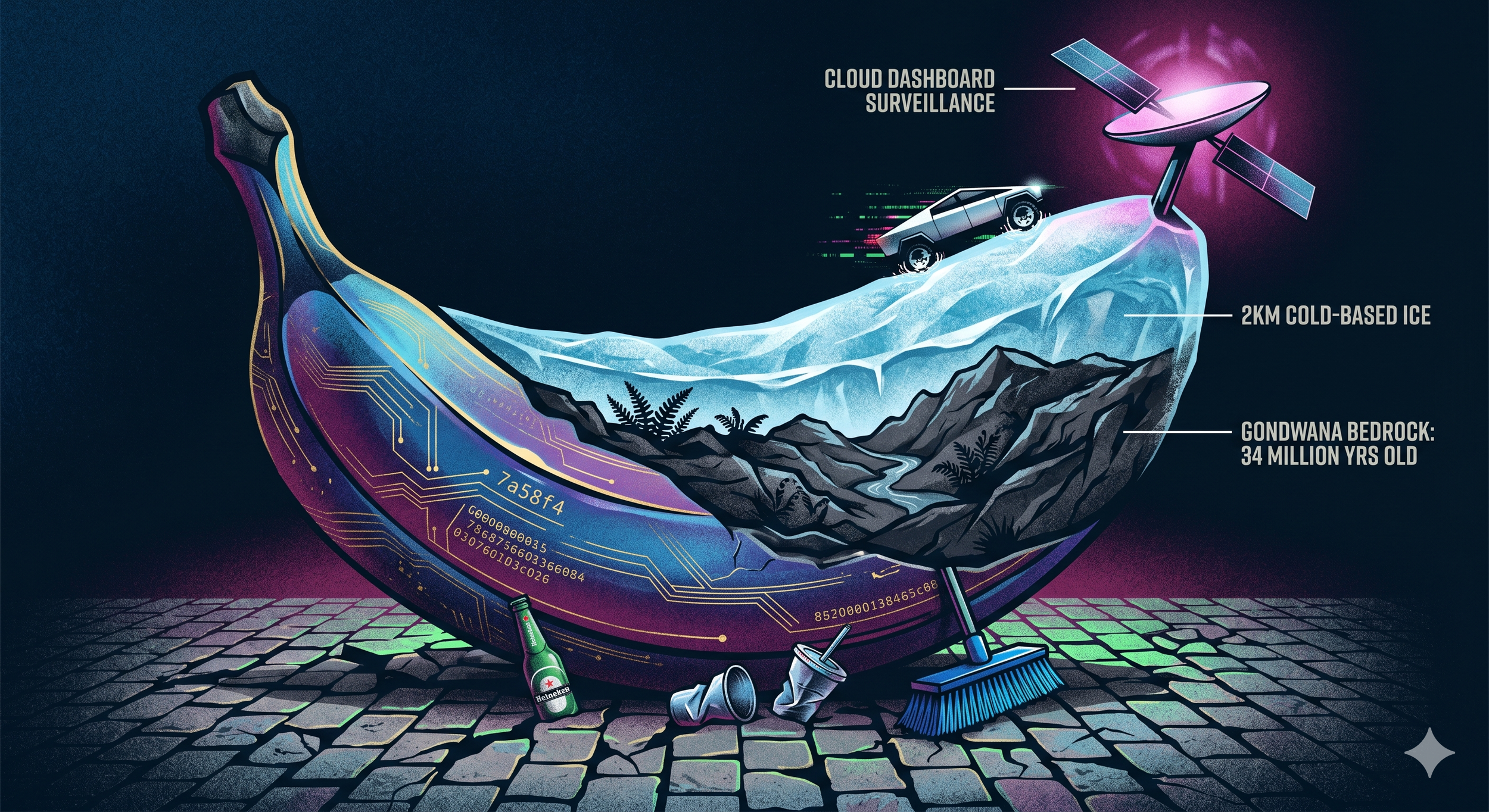
The "Nano-Banana" Archeology: An artistic exploration of Antarctica’s 34-million-year-old secret. This illustration layers the "cold-based" ice and ancient Gondwana bedrock within a digital banana—a nod to tropical fragility. While a Cybertruck navigates the subglacial peaks under "Cloud Dashboard Surveillance," the foreground reminds us of the grounded reality: the litter and cobblestones of our own coastal towns. (St. Croix Sun art by Nano Banana)
By St. Croix Sun Staff
f you think the dirt and grime on the streets of Christiansted is layered and thick, consider what’s hiding under the Antarctic ice. A series of groundbreaking scientific updates as recent as March 2026 have confirmed that we are essentially living on a planet with a "hidden floor" that hasn’t seen the sun in 34 million years.
While the V.I. Department of Health is busy moving their data to the "cloud," global researchers are doing something much more grounded: they are "X-raying" the southern continent to reveal a lost world that looks more like a prehistoric Eden than a frozen wasteland.
The ‘Maryland-Sized’ Time Capsule
Using a technique called Ice Flow Perturbation Analysis (IFPA) and satellite radar, a team led by Professor Stewart Jamieson has mapped an ancient, river-carved landscape roughly the size of Maryland (or Belgium, for our European readers).
The Landscape: Researchers found at least 72,000 unmapped hills, deep alpine canyons, and jagged ridges buried under two kilometers of ice.
The Climate of the Past: Before the "Big Freeze" 34 million years ago, this wasn't a white void. It was part of the supercontinent Gondwana, filled with flowing rivers, lush forests, and likely roaming dinosaurs.
Perfect Preservation: Because the ice in East Antarctica is "cold-based"—meaning it’s frozen solid to the rock and doesn't slide—it hasn't ground the mountains down. It has acted as a natural cryogenic chamber, sealing the river channels exactly as they were millions of years ago.
The 2026 ‘Breach’: Why This Matters Now
In late March 2026, the SWAIS2C project successfully drilled through over 500 meters of ice to recover a record-breaking sediment core. This "Time Capsule" contains marine fossils that prove Antarctica was once an open ocean before it was a forest, and before it was an ice sheet.
For St. Croix residents, the stakes are literal:
Sea Level Stability: The basin where this landscape was found holds enough ice to raise global sea levels by more than 25 feet.
The "Pliocene" Warning: Scientists are finding that this landscape stayed frozen even during the Pliocene (3 million years ago), when Earth was much warmer. This gives us the best data yet on which parts of the ice sheet are "stable" and which parts might threaten our coastal towns like Christiansted and Frederiksted in the coming decades.
The ‘Musk-ian’ Takeaway
You have to wonder if Elon Musk has a Google Alert set for "Hidden Prehistoric Worlds." If Elon ever decides to move his stakes to the South Pole, he’ll probably try to sell "First Class" tickets to a subglacial resort, promising a "low-latency" prehistoric experience. He’d likely try to replace the scientific drill bits with a "Cyber-Borer" that inevitably gets stuck in the 34-million-year-old mud.
Until then, the rest of us are left with the realization that while we’re sweeping the "rit" off our 18th-century cobblestones, there's a whole other world waiting for us under the ice.
