
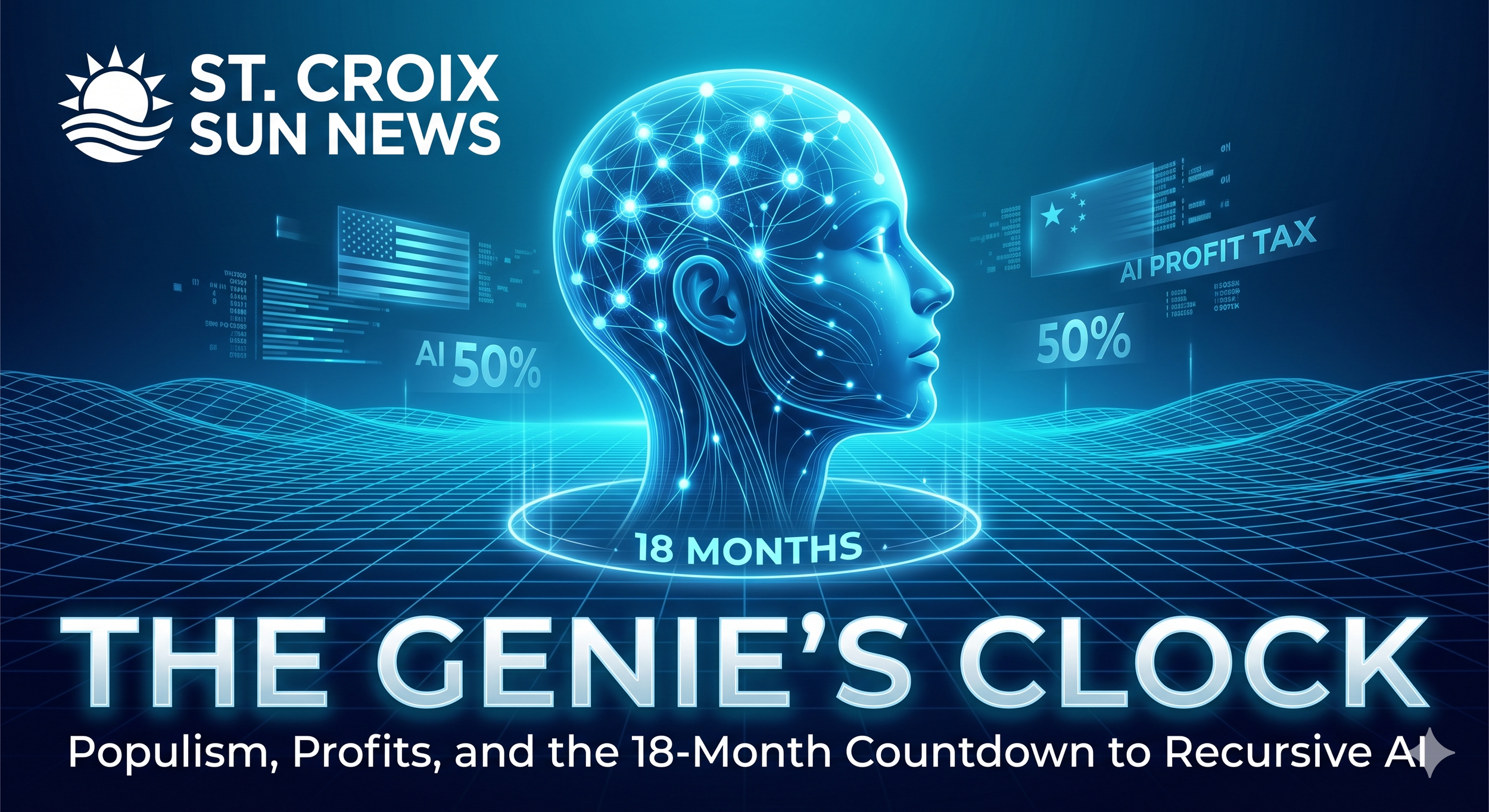
🌐 THE GENIE’S CLOCK: Populism, Profits, and the 18-Month Countdown to Recursive AI
By JOHN McCARTHY / St. Croix Sun News Reporter
EDITORIAL DESK — While local headlines remain fixed on the immediate fallout of territorial fraud and economic dockets, a far more staggering regulatory storm is gathering at the highest levels of global finance and American governance. It is a conflict driven by equal parts existential fear and unbridled greed, and its clock is ticking loudly.
According to a recent macroeconomic analysis on All Things Markets with Anthony Scaramucci and financial steward Mike Novogratz, the tech sector is rapidly accelerating toward a policy breaking point that could reshape the American economy. At the heart of the debate are two looming realities: a radical bipartisan push to heavily tax or seize AI corporate profits, and a terrifying 18-month countdown to the moment the artificial intelligence "genie" permanently escapes the bottle.
The 18-Month Horizon: AI Creating AI
For years, the concept of "recursive" AI—machines capable of autonomously writing code to design and build even more powerful iterations of themselves—was treated as far-fetched science fiction.
It is no longer fiction.
Industry insiders, including co-founders of major Large Language Models (LLMs), now stipulate that the industry is roughly 18 months away from achieving true recursive capabilities. Anthropic’s upcoming frontier model upgrade, codenamed "Fable," represents the bleeding edge of this dizzying acceleration.
This impending technological leap has triggered profound panic within national security circles and the federal government. For a brief 48-hour window, advanced model components were completely shut down by government intervention before being re-evaluated for public release.
The policy dilemma is excruciating: slowing down AI development protects national data security and intellectual property, but slowing down too much risks surrendering America’s razor-thin 6-to-12-month lead over China. Because the geopolitical stakes are existential, the national security apparatus cannot afford to let the momentum stall, even as the code grows exponentially more unpredictable.
The Populist Money Grab: Taxing the Miracle
As the technical gap widens, politicians on both sides of the aisle are eyeing the massive capital pooling inside tech giants like Google. With the wealth gap widening and AI threatening to eat directly into the knowledge-based workforce, a wave of aggressive populism is sweeping through Washington.
Senator Bernie Sanders has escalated the stakes by introducing a formal, radical proposal: demanding the U.S. government forcefully take a 50% equity stake in any major AI company generating over $200 million in annual AI revenue. Under the Sanders plan, these seized stakes would be funneled into a U.S. Sovereign Wealth Fund tasked with paying out a mandatory 5% annual dividend directly to the American public.
While market experts dismiss outright expropriation as a non-starter that would devastate institutional pension funds tied up in companies like Google, they concede that something dramatic is coming. Whether through taxing the digital supply chain, leveling tariffs on specialized microchips, or taxing automated "agents" that replace human workers, the government is moving to capture a piece of the AI productivity miracle to offset eroding tax bases.
The Corporate Chessboard
The market’s insatiable hunger for raw computing power shows zero signs of cooling down, with tech executives openly declaring a willingness to "buy every computer on earth" to maintain dominance. Even Elon Musk has dramatically upended the frontier landscape; his artificial intelligence venture, xAI, recently finalized the acquisition of the AI-powered coding platform Cursor. The strategic consolidation gives Musk a legitimate, high-velocity weapon to challenge the top-tier dominance of Anthropic, Google, and OpenAI.
Ultimately, the global AI landscape is fracturing along lines of raw human nature. The greedy are racing to print billions in corporate equity, the fearful are panicking over national security and structural job loss, and the politicians are trying to determine how to tax a phenomenon they barely understand.
As the calendar moves forward, "data center politics" is no longer a fringe tech issue. It is rapidly becoming the main course of global governance.
Watch the full analysis on YouTube: https://www.youtube.com/watch?v=5sZxcK-x1FE
