
January 3rd, Not January 6th: How a ‘Rump Congress’ Could Thwart the Will of the American Voter
‘The Final Battle for Democracy’: Conservative Jurist J. Michael Luttig Exposes Post-Midterm Power Grab
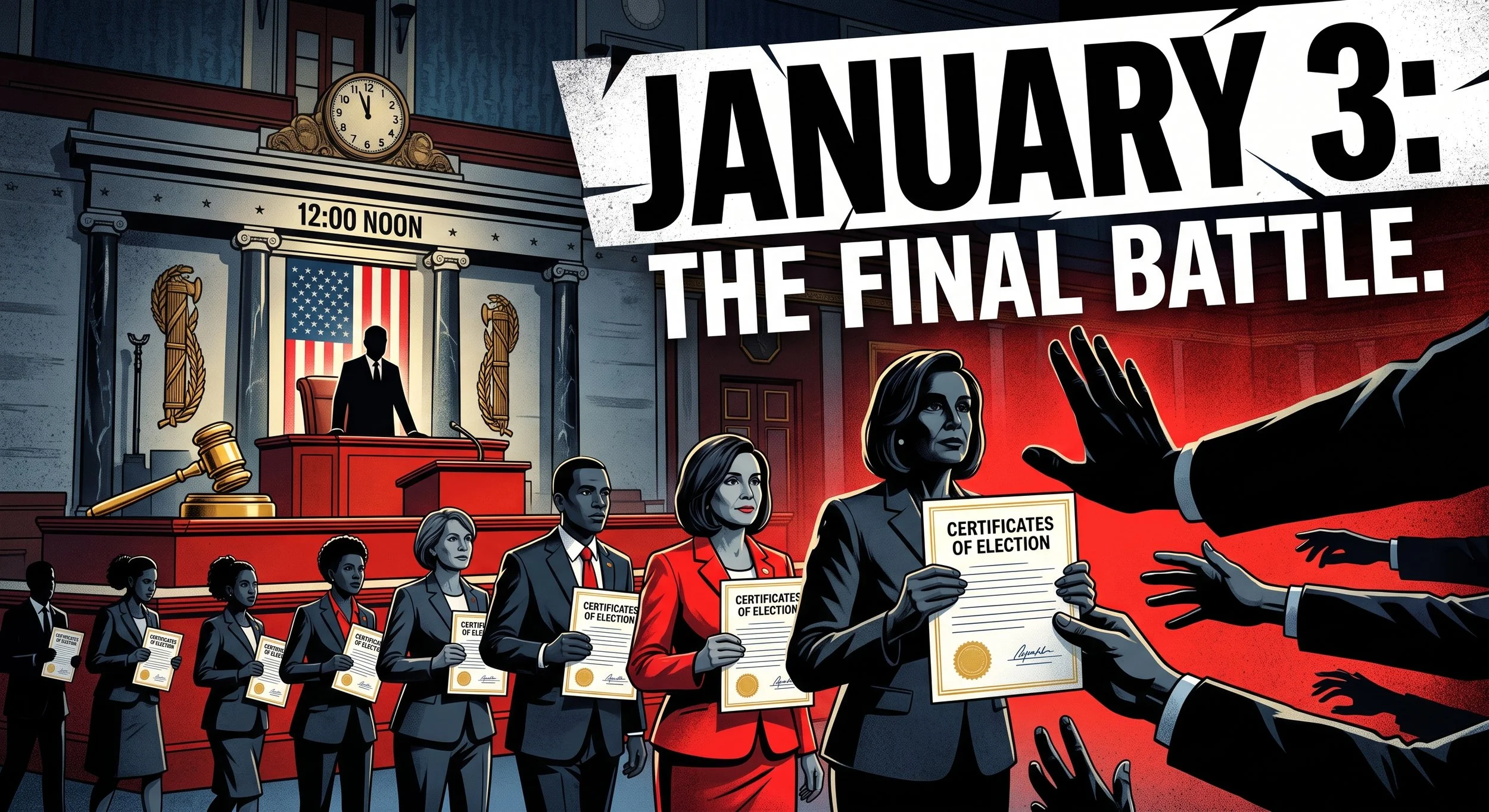
An artistic digital rendering of the U.S. House of Representatives chamber floor, illustrating a fictional confrontation where a queue of members-elect holding "Certificates of Election" is obstructed by reaching hands as a clock strikes noon. This image was AI-generated.
By JOHN McCARTHY / St. Croix Sun News
WASHINGTON — While the American electorate and media watchdogs remain hyper-focused on ballot boxes and the procedural counting milestones of January 6th, one of the nation’s most revered conservative constitutional authorities is raising a far more alarming siren.
Former Fourth Circuit Court of Appeals Judge J. Michael Luttig warned that the critical stress point of the upcoming congressional midterms will arrive precisely at high noon on January 3rd. Should Democratic candidates secure a decisive majority in the House of Representatives, Luttig cautions, congressional Republicans could execute a procedural maneuver to systematically refuse to seat those winning candidates—locking in an artificial majority before a single oath of office is administered.
Speaking with Sean Wilentz and Sidney Blumenthal on Legal AF’s The Court of History, Luttig described the impending political collision not merely as standard partisan friction, but as the potential "final battle for America's democracy."
The Noon Vacuum: Enter the ‘Rump Congress’
At 12:00 p.m. on January 3rd, under the Twentieth Amendment of the U.S. Constitution, the outgoing Congress officially ceases to exist. There is no sitting Speaker of the House, no established chamber rules, and not a single sworn representative.
Instead, power briefly falls into what Luttig terms a chaotic “rump congress.” In this constitutional twilight zone, the chamber consists entirely of members-elect bearing state-certified credentials who have not yet taken the oath of office. Because no one officially holds constitutional authority over the chamber floor, the initial roll call and organization—traditionally overseen by the non-member Clerk of the House—are uniquely vulnerable to procedural hijack.
Weaponizing Article I: The Mechanism to Nullify Voters
Under Article I, Section 5 of the Constitution, each house serves as the judge of the elections, returns, and qualifications of its own members. Historically, this clause allowed Congress to verify credentials or address unresolved contested races.
Luttig warns that this mechanism could be brazenly weaponized. By manufacturing challenges against certified election slates from Democratic districts—or leveraging floor objections before the full body is sworn in—a minority faction could refuse to seat enough winning Democrats to seize numerical control. With a suppressed roll call, they could swiftly elect their own Speaker, adopt permanent rules, and cement control of the legislative branch, effectively nullifying the ballots cast by millions of American citizens.
Executive Ambition vs. Constitutional Law
The blueprint for this procedural confrontation, Luttig noted, stems from continuous public assertions by Donald Trump that Republicans must maintain total control of the federal election outcomes.
"Under the Constitution, the president has zero authority and power over federal elections in the United States," Luttig emphasized, noting that administration of elections belongs solely to the individual states unless explicitly legislated by Congress. Any effort by party loyalists to subvert state certifications from the House floor would represent a fundamental breach of their constitutional duty.
A Warning to Lawmakers: ‘The Last Public Office You’ll Ever Hold’
"If you dare try this, if you dare betray your oath and this country... this will be the last public office you'll ever hold."—Judge Luttig
Luttig did not mince words regarding the personal and historical stakes for lawmakers who might consider aiding such an institutional coup. Calling directly on the American public to hold their representatives to account, the former federal judge warned that any member who chooses party fealty over constitutional order should face swift electoral extinction: "If you dare try this, if you dare betray your oath and this country... this will be the last public office you'll ever hold."
In a political climate so surreal that mainland headlines read more like dystopian thrillers—leaving observers to wonder whether even Elon Musk might pack his bags and escape to the peaceful shores of St. Croix—Luttig’s analysis cuts through partisan noise with cold, judicial clarity.
The Lincoln Testament: Temporary Tenants of Power
To close his testimony, Luttig reflected on President Abraham Lincoln’s August 22, 1864, address to the 166th Ohio Regiment. Reading Lincoln’s timeless observation that presidents are merely temporary occupants of the executive mansion, Luttig underscored that the genuine struggle of American governance is preserving equal privileges and self-determination for generations to come.
As the nation heads toward November and the subsequent January transition, Luttig’s message remains unequivocal: democracy's survival hinges not only on voter turnout at the polls, but on the public’s readiness to defend the certification and seating of those rightfully chosen to govern.
To hear the complete constitutional analysis and Judge Luttig’s reading of President Lincoln’s 1864 address, watch the full interview on Legal AF’s The Court of History: Judge Luttig EXPOSES Trump's LAST MINUTE Scheme to SAVE HIMSELF!!! on YouTube.
