
THE HORMUZ STANDOFF: A Parent’s Guide to the Risks and Realities of ‘Project Freedom’
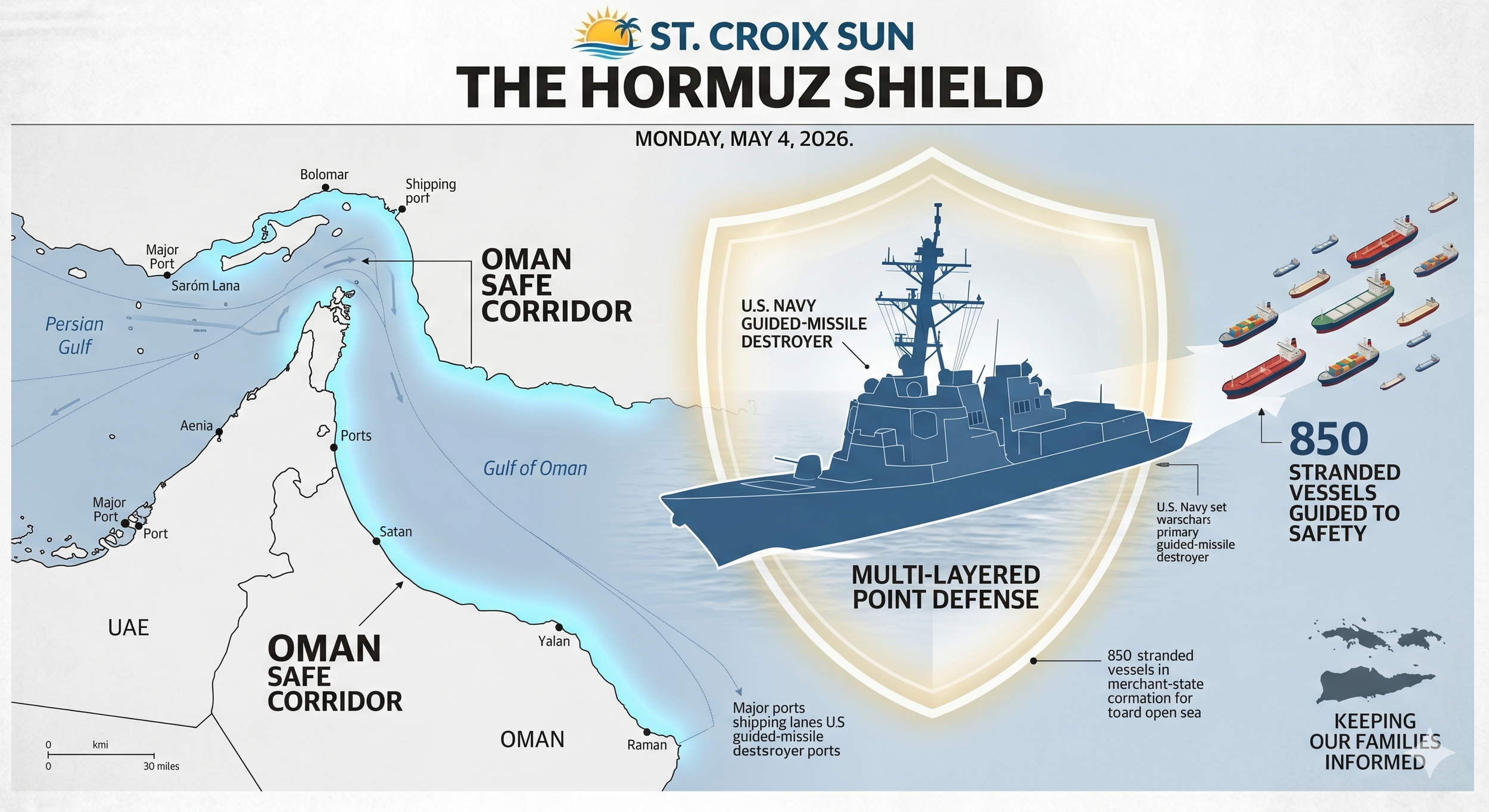
🌅 THE HORMUZ SHIELD: An infographic prepared specifically for military families in the U.S. Virgin Islands, mapping U.S. Naval Central Command's current defensive strategy in the Strait of Hormuz. We break down 'Project Freedom's' multi-layered point defense network (center), the proposed safe maritime corridors near Oman (left), and the humanitarian effort to guide 850 stranded commercial vessels (right) as of May 4, 2026.
By JOHN McCARTHY / St. Croix Sun Staff Writer
ST. CROIX, USVI — As the U.S. Department of Defense launches "Project Freedom"—a massive operation to escort 850 stranded commercial vessels out of the Strait of Hormuz—families across the U.S. Virgin Islands are watching the headlines with bated breath. With local sons and daughters serving aboard Navy vessels in the region, the distance between the Caribbean and the Middle East has never felt shorter.
To separate the "clickbait" from the combat reality, The St. Croix Sun has compiled a breakdown of the current military situation, the official government position, and the objective dangers facing our troops.
1. The Incident: Fact vs. Psychological Warfare
On Monday morning, Iranian-aligned media claimed to have struck a U.S. Navy frigate near the port of Jask.
The Objective Reality: U.S. Central Command (CENTCOM) has issued a categorical denial of these claims. Military analysts suggest this is a classic "information operation" by the Iranian Revolutionary Guard Corps (IRGC), designed to project strength to their domestic audience and sow anxiety among Western families. As of this report, no U.S. vessel has been struck, and no combat casualties have occurred.
2. The Mission: What is ‘Project Freedom’?
The U.S. Navy is not currently engaged in an offensive invasion. Instead, they are executing a high-stakes "guiding" mission.
The Goal: To unlock a maritime "parking lot" of 850 commercial ships trapped since the conflict’s onset in February.
The Force: Over 15,000 personnel and 100 aircraft are providing a "protective umbrella" for these merchant sailors.
The U.S. Stance: The administration maintains this is a humanitarian necessity to stabilize global supply chains and rescue the 20,000 merchant sailors currently stranded.
3. The Objective Dangers
While the Navy’s defensive systems are the most advanced in the world, the risks in the Strait of Hormuz are three-fold:
Drone Swarms: Iran frequently utilizes low-cost, explosive-laden drones. However, U.S. ships are equipped with multi-layered "Point Defense" systems (like the Phalanx CIWS) specifically designed to neutralize these threats before they reach the hull.
Un-surveyed Mines: The primary danger to ships is not always a missile, but "silent" sea mines. Navy minesweepers and specialized divers are currently working ahead of the fleet to clear safe corridors.
Electronic Warfare: Iran has attempted to "jam" GPS and communication signals. U.S. personnel are trained to operate under "EMCON" (Emission Control) conditions, meaning they can navigate safely even if digital signals are disrupted.
4. A Message to Families
The Department of Defense emphasizes that the Navy’s current posture is "defensive and de-escalatory." While the IRGC may engage in provocative maneuvers, the U.S. fleet operates with strict "Rules of Engagement" (ROE) designed to protect the lives of sailors while avoiding an all-out regional war.
For the parents in St. Croix and across the territory, it is important to remember that our service members are part of the most protected, most technologically superior maritime force in history.
