
FROM TRINIDAD TO GOVERNMENT HOUSE: HOW THE ‘YANKEE DOLLAR’ AND ‘RUM AND COKE’ SHAPED CARIBBEAN CALYPSO
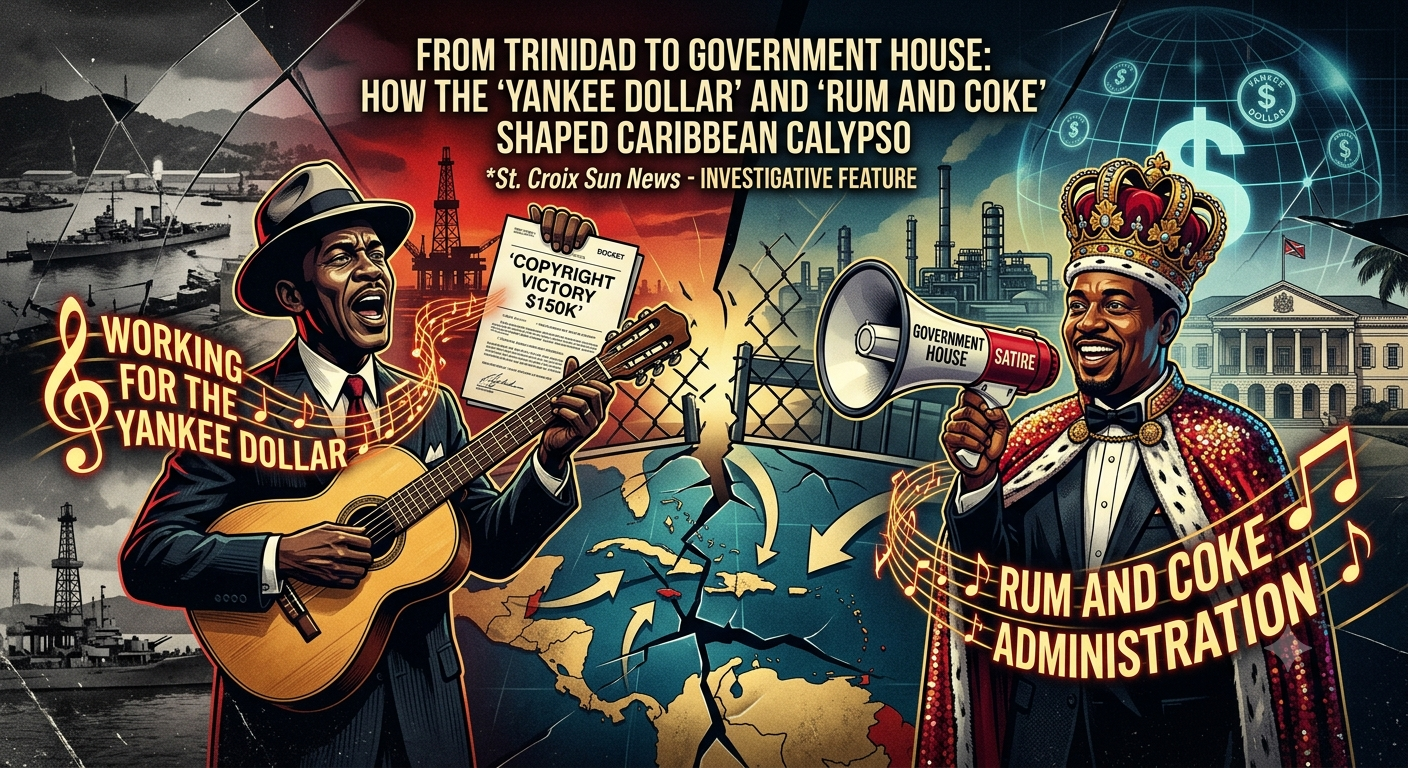
IMAGE ANALYSIS: This St. Croix Sun News investigative feature graphic illustrates the cultural and political intersection of Caribbean Calypso. The visual narrative traces the genre's history from Lord Invader (left), who successfully sued for copyright of the wartime critique "Working for the Yankee Dollar," to St. Croix's King Derby (right), whose music satirized the local Farrelly-Hodge 'Rum and Coke' Administration. The graphic highlights how Trinidad's post-war transition from military bases (left) to the global oil economy (right) shaped regional music and political commentary. (Graphic: Nano Banana/St. Croix Sun News)
By JOHN McCARTHY / St. Croix Sun News Reporter
INTRODUCTION: THE RHYTHM OF THE NIGHT
If you log onto social media on any given morning to check the territory’s digital pulse, you are likely to be greeted by the grim reality of the local beat: pixelated police flyers of nameless suspects wanted for neighborhood robberies. There is no glamour in the raw blotter. But every so often, the digital landscape throws a curveball that connects the modern territory to a century of global history, musical warfare, and high-level political scandal.
A recent modern calypso drop on YouTube by Trinidad’s Kes & Tano features a slick, heavy-bass update of the classic anthem "Rum & Coca-Cola." For the casual listener, it’s a catchy party track. But for those with deep roots in the U.S. Virgin Islands, the song triggers an entirely different frequency—unearthing memories of wartime occupation, systemic exploitation, and a legendary piece of homegrown political satire that once caused panic at Government House.
THE WORLD WAR II ORIGINS: WORKING FOR THE YANKEE DOLLAR
The musical DNA of "Rum and Coca-Cola" dates back to 1943 in Trinidad and Tobago. Originally composed by the legendary calypsonian Lord Invader (Rupert Grant), the track was never meant to be a lighthearted beach tune. It was a blistering piece of first-hand investigative reporting set to a rhythm.
During World War II, the sudden influx of over 100,000 U.S. servicemen to the massive American military base at Chaguaramas completely disrupted the local economy. Armed with high-paying "Yankee dollars," the soldiers created an artificial boom town. Lord Invader’s unfiltered lyrics documented a dark social reality:
"Both mother and daughter / Workin' for the Yankee dollar..."
The track exposed how the sudden blast of foreign wealth led to an explosion of vice, with local women favoring the big-spending American GIs over local men who could barely afford a plain soda water.
The track was promptly stolen. American entertainer Morey Amsterdam heard the song during a USO tour, brought it back to New York, and fraudulently copyrighted it. Recorded by the Andrews Sisters in 1944—who later admitted they had absolutely no idea the song was about wartime exploitation—it sold seven million copies. Though radio stations tried to ban it for promoting alcohol and vice, Lord Invader successfully fought a landmark legal battle in 1948, winning $150,000 in back royalties, proving that West Indian creators have always had to fight tooth and nail for their credit.
THE TWILIGHT OF THE WARTIME ECONOMY
When the Axis powers were defeated and the uniforms vanished, the economic dependency didn't disappear—it just evolved. Both Trinidad and the U.S. Virgin Islands shifted from the frantic cash flow of military bases straight into the industrial muscle of the global oil industry. The "Yankee dollar" was no longer carried by young sailors on shore leave; it arrived via massive corporate entities building sprawling refineries like HOVENSA on St. Croix. The local workforce was still trading their labor for foreign corporate capital, transitioning the islands from military outposts to critical energy cobs.
GOVERNMENT HOUSE SATIRE: THE ‘RUM AND COKE’ YEARS
But calypso has always been the ultimate counter-programming to institutional power, and its ability to weaponize popular tropes found its perfect home on St. Croix decades later.
When Governor Alexander A. Farrelly and Lieutenant Governor Derek M. Hodge took the reins of Government House, local reporters on the beat had direct phone access to an administration that quickly earned an affectionate—and sometimes merciless—street nickname: The "Rum and Coke" Administration.
Local lore was unapologetically blunt. Governor Farrelly was known to possess an old-school fondness for local rum; Lieutenant Governor Hodge, strikingly thin and sharp, was rumored to have a affinity for a far more illicit white powder.
Enter Camille "King Derby" Macedon, the undisputed heavyweight of Crucian calypso. Seeing the perfect alignment of political vice and musical heritage, King Derby released his own local weapon titled "Rum and Coke" in 1989. It wasn't just a party song; it was a devastatingly funny, direct jab at the territory’s highest leadership.
The political sting was so sharp that the administration reportedly scrambled to suppress it. Rumors and legal complaints long persisted that local authorities and carnival committees put tremendous pressure on the airwaves to keep Derby's "Rum and Coke" from being blasted to the public, proving that nothing terrifies an elected official quite like a local calypsonian with a microphone and a witty hook.
THE UNBROKEN CHAIN
Decades after King Derby shook up Government House, and nearly a century after Lord Invader watched American troops change the economic fabric of Trinidad, the music is still proving its permanence. Whether it’s modern media outlets trying to counter-program breaking investigative exposés by bringing legends like King Derby into the television studio for a heavy dose of nostalgia, or contemporary Virgin Islands hitmakers like Rock City continuing to dominate the global pop charts with West Indian song structures, the lineage remains unbroken.
The next time you hear that familiar calypso bounce, remember: it isn’t just an appetizer for the morning. It’s the historical ledger of the Caribbean, written by people who knew exactly how to speak truth to power—and cash—long before the rest of the world caught on.
OUT-CUE: LISTEN TO THE HISTORY
The next time you hear that familiar calypso bounce, remember: it isn’t just an appetizer for the morning. It’s the historical ledger of the Caribbean, written by people who knew exactly how to speak truth to power—and cash—long before the rest of the world caught on.
To experience the raw grit of the original wartime record that started a global legal battle, you can listen to Lord Invader’s Original "Yankee Dollar" Calypso Track ... https://www.youtube.com/watch?v=p4UI02FZZ9c and hear the exact musical truth that American pop culture tried to claim for its own.
