EDITORIAL: The Competency Loophole—When Judicial Orders Threaten Public Safety
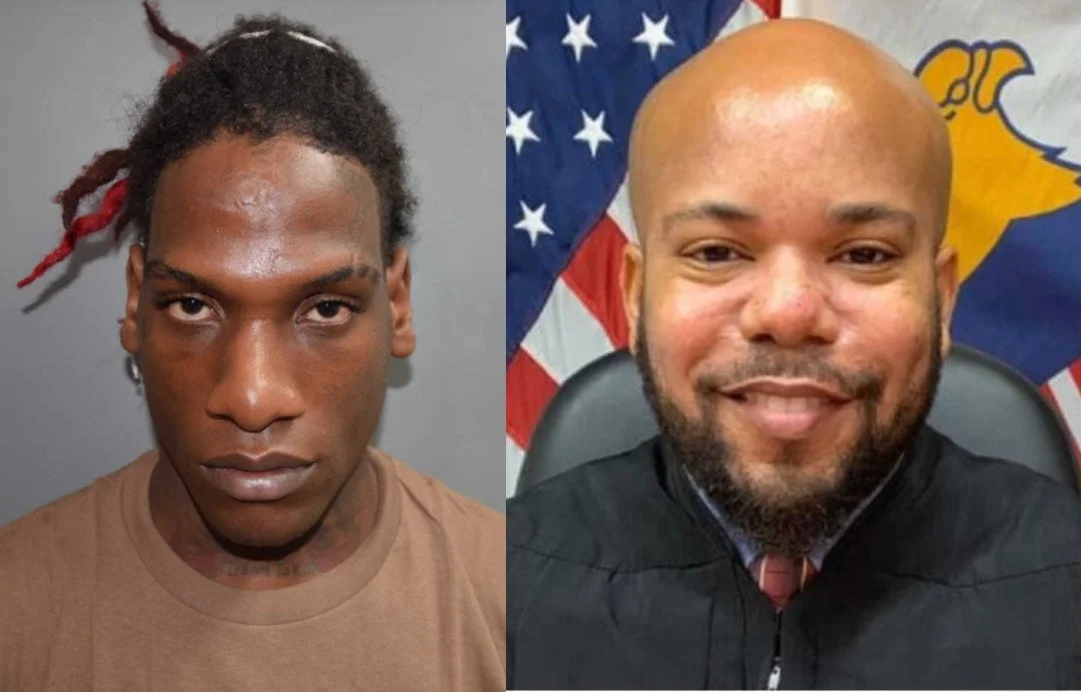
SYSTEMIC LOOPHOLE: Defendant Elijah T. Spencer (left), who faces active charges including attempted murder and carrying a fully automatic "ghost gun," has had his criminal proceedings stalled by mental competency rulings. V.I. Superior Court Judge Ernest E. Morris Jr. (right) issued orders for Spencer's inpatient psychiatric placement despite a critical lack of forensic mental health facilities and infrastructure within the territory. (St. Croix Sun News Photo Composite / VIPD mugshot / VI Judiciary archive photo)
ST. CROIX SUN NEWS EDITORIAL BOARD
There is something profoundly broken in the Superior Court of the Virgin Islands, and the stench of institutional failure is growing impossible to ignore.
Consider the surreal legal theater surrounding Elijah T. Spencer, the co-defendant charged in the brutal April 2023 execution of homeless veteran Milton "Bobo" Gordon on Company Street. While his co-conspirator, Ryan Branch, was sentenced to 30 years in prison earlier this year, Spencer’s trajectory through our justice system exposes a gaping, dangerous vulnerability in territorial governance.
The public is being asked to accept two entirely conflicting realities simultaneously. On one hand, the judicial system has repeatedly stalled proceedings against Spencer, pointing to evaluations that declare him mentally incompetent to stand trial. On the other hand, look at what this "incompetent" individual was allegedly doing while out in the community.
According to Superior Court records, while out on the streets, Spencer was hit with a First Amended Information in Docket No. SX-2025-CR-00118, charging him with Attempted First-Degree Murder for willfully and with premeditated design shooting at two individuals outside the Frontline Bar and Grill on April 19, 2025.
If that weren't enough to shatter the illusion of public safety, consider Docket No. SX-2025-CR-00139. On June 10, 2025, when Detective Teaclla Buckley and the Special Operations Bureau executed a raid at #585 Mount Pleasant West, they discovered an illicit arsenal hidden literally inside Spencer's bedroom wall. This was not just a simple handgun; it was an un-serialized "Ghost Gun" equipped with a "sear chip"—a tactical modification that enables a weapon to fire as a fully automatic machine gun with a single squeeze of the trigger—alongside an extended magazine packed with 32 live rounds.
How can a defendant be deemed too mentally incapacitated to understand a courtroom, yet perfectly functional when it comes to allegedly executing a nightclub shooting and engineering a hidden wall cache for fully automatic military-grade weaponry?
The absurdity does not stop with the defendant; it extends directly towards the bench. When Judge Ernest Morris Jr. ordered the government to conduct a mental competency evaluation for Spencer, the mandate was issued with the full, undeniable knowledge that the Virgin Islands completely lacks the forensic psychiatric infrastructure, facilities, or specialized personnel to fulfill it.
Ordering a service that does not exist is not just an exercise in bureaucratic futility—it is a dangerous dodge. By continuously issuing unfulfillable orders, the court creates a legal limbo that paves the way for high-risk individuals to cycle back into our neighborhoods under toothless supervision frameworks, shifting the entire burden of physical risk onto everyday citizens.
When judges knowingly exploit this systemic vacuum, releasing suspects who then rearm themselves or commit further violence towards our community, where does the accountability lie?
If a physician prescribes a treatment they know is unavailable, or if a contractor signs off on a foundation they know will collapse, they face severe liability. Yet, members of the judiciary can repeatedly issue empty mandates that return armed risks to our streets with total impunity.
It is time to challenge this judicial shield. If the territory cannot safely evaluate or house a defendant due to a collapse of mental health infrastructure, the solution cannot be to simply dump the danger back onto the public. Judges who issue empty competency orders, fully aware that the necessary resources do not exist, must be held publically and structurally accountable for the fallout. When their signatures on an order directly precede the introduction of fully automatic ghost guns into our towns, the bench shares ownership of the danger that follows. Our judicial system must protect the public, not manage its own failures at the expense of community at large.