
WEEKEND BEACH ALERT: DPNR SHUTS DOWN HULL BAY OVER SEWAGE BACTERIA SPIKE WHILE ST. CROIX SAMPLES ARE COMPLETELY ABANDONED
By JOHN McCARTHY / St. Croix Sun News Reporter
CHARLOTTE AMALIE — Environmental regulators issued an urgent territory-wide public health warning today, blacklisting a popular northern St. Thomas shorefront due to dangerous levels of bacterial contamination while leaving the entire island of St. Croix completely unmonitored ahead of peak weekend recreational activities.
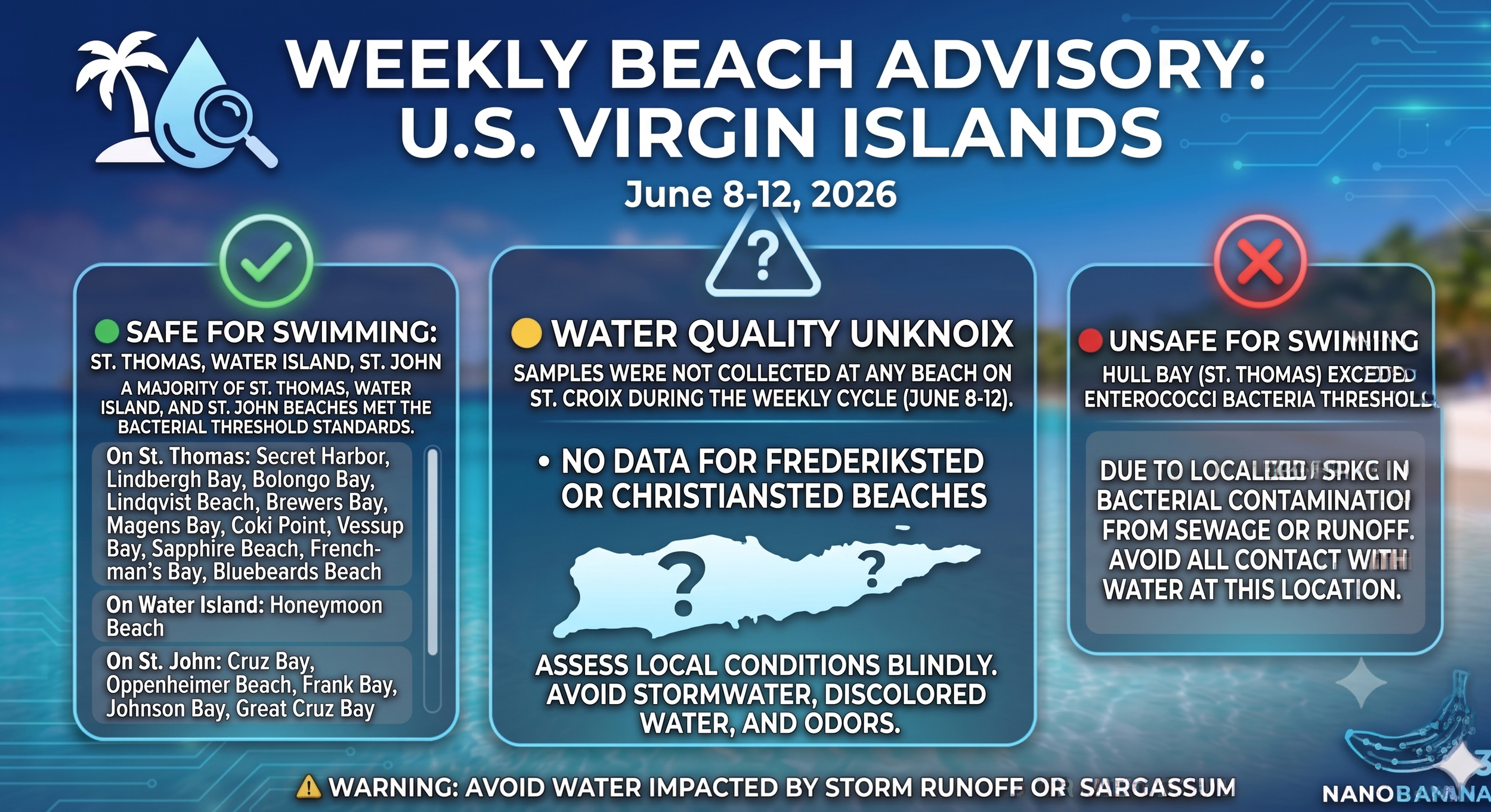
The Department of Planning and Natural Resources released its weekly Beach Water Quality Monitoring Program logs on Friday afternoon, June 12, 2026. While technical evaluations cleared eighteen popular swimming and fishing sites across the territory, a sudden surge in environmental health risks has forced an immediate advisory against entering the water at one primary St. Thomas location.
Bacterial Thresholds Shattered at Hull Bay
According to official data authorized by the Office of the Commissioner and managed by Media Relations Coordinator Jamal Nielsen, localized laboratory testing revealed an alarming spike in contamination on St. Thomas. Technical analysis of water samples confirmed that Hull Bay on St. Thomas has officially failed to meet water quality standards.
The popular northern beach severely exceeded the territory’s established Enterococci Bacteria threshold, rendering the area unsafe for swimming, snorkeling, or fishing.
DPNR scientists warn that Enterococci indicators are directly linked to the presence of untreated sewage and heavy stormwater runoff. Environmental health experts emphasize that swimming in waters compromised by these contaminants places beachgoers at an elevated risk of contracting gastrointestinal illnesses, skin infections, and other waterborne diseases.
Regulatory Blackout Leaves St. Croix in the Dark
While DPNR’s environmental protection teams successfully completed testing sweeps across St. Thomas and St. John, the agency’s data infrastructure experienced a total operational failure regarding the biggest island in the territory. In an admission buried at the foot of the public health notification, DPNR confirmed that samples were not collected at any beach on St. Croix during the entire weekly monitoring cycle of June 8 through June 12.
The administrative omission leaves the environmental safety of every single St. Croix shoreline—from Frederiksted to Christiansted—classified as completely unknown to public health officials.
The St. Croix Sun News notes that this total lack of data forces local residents to assess coastal conditions blindly. DPNR representatives stated that any coastal areas actively impacted by visible stormwater runoff, discolored water, or foul odors must be avoided by the public, as local guts, drainage basins, and heavy offshore sargassum plumes continue to dump unmonitored contaminants directly into the coastal shelf.
Clear Zones Identified on St. Thomas and St. John
For residents seeking safe weekend coastal recreation, DPNR’s laboratory confirmed that a majority of the territory's monitored shorelines successfully managed to meet statutory water clarity and biological safety metrics. On St. Thomas, eleven popular destinations were cleared as safe for public use, including Secret Harbor, Lindbergh Bay, Bolongo Bay, Lindqvist Beach, Brewers Bay, Magens Bay, Coki Point, Vessup Bay, Sapphire Beach, Frenchman's Bay, and Bluebeards Beach.
On St. John, testing teams cleared Cruz Bay, Oppenheimer Beach, Frank Bay, Johnson Bay, and Great Cruz Bay. Additionally, Honeymoon Beach on Water Island was certified safe for public swimming and fishing.
The Division of Environmental Protection has urged residents with immediate public health inquiries to contact their local regulatory offices directly at 773-1082 in St. Croix or 774-3320 in St. Thomas to demand updates on when standard testing services will be restored to St. Croix's shorelines.
