THE CHRONIC CONFLICT: Why Modern Technology Breeds Grinding Stale-Mates
By JOHN McCARTHY / St. Croix Sun News Reporter
For generations, the global collective consciousness has been conditioned by the grand, sweeping theater of the First and Second World Wars. Those were conflicts defined by total industrial mobilization, clear existential stakes, and definitive, map-altering conclusions. One side collapsed, a treaty was signed on a battleship, and the world transitioned into a new era.
Today, we are witnessing a profound and disturbing paradox. In an age of hypersonic delivery systems, real-time satellite surveillance, and artificial intelligence, modern conflicts—from the grinding trenches of Ukraine to multi-decade campaigns in the mountains of Afghanistan—take vastly longer to conclude.
The raw data emerging from modern legal, diplomatic, and military dockets reveals a stark reality: modern technology has not made warfare swifter or more decisive. Instead, it has engineered a hyper-lethal, high-tech pressure cooker that feeds on attrition and punishes breakthroughs.
The Death of Total Victory: The Sanctuary Paradox
In the landscape of the 1940s, a nation's ability to wage war was bound strictly to its internal industrial output and territorial integrity. When Germany’s factories were reduced to rubble or Japan’s maritime supply lines were severed, their capability to sustain combat evaporated.
Modern warfare has shattered this baseline through the introduction of proxy shielding and global supply insulation. In a purely localized conflict, one combatant eventually runs out of capital or ammunition. However, contemporary battlefields are artificially sustained by massive international networks:
Endless Logistical Pipelines: Weaker sovereign states or contested fronts are continuously revitalized by global superpowers. A prime example is the recent $400 million U.S. military assistance package routed to Eastern Europe, ensuring that defense networks remain operational regardless of domestic economic depletion.
The Authoritarian Axis: Conversely, isolated regimes maintain their operational capacity by tapping into unified "learning and adaptation blocks". Empires like Russia sustain multi-year campaigns by relying on sophisticated, near-real-time networks involving China, North Korea, and Iran to cooperate on sanctions-busting, hardware procurement, and research and development.
Because neither side can truly be forced into absolute industrial exhaustion, the traditional runway to total victory is replaced by a permanent state of attrition.
The 20-Kilometer Death Grid: Drone Warfare and Inverted Casualty Ratios
Perhaps the most dramatic shift between the "important" ideological wars of the past and the conflicts of the 21st century lies in the sheer physics of the frontline.
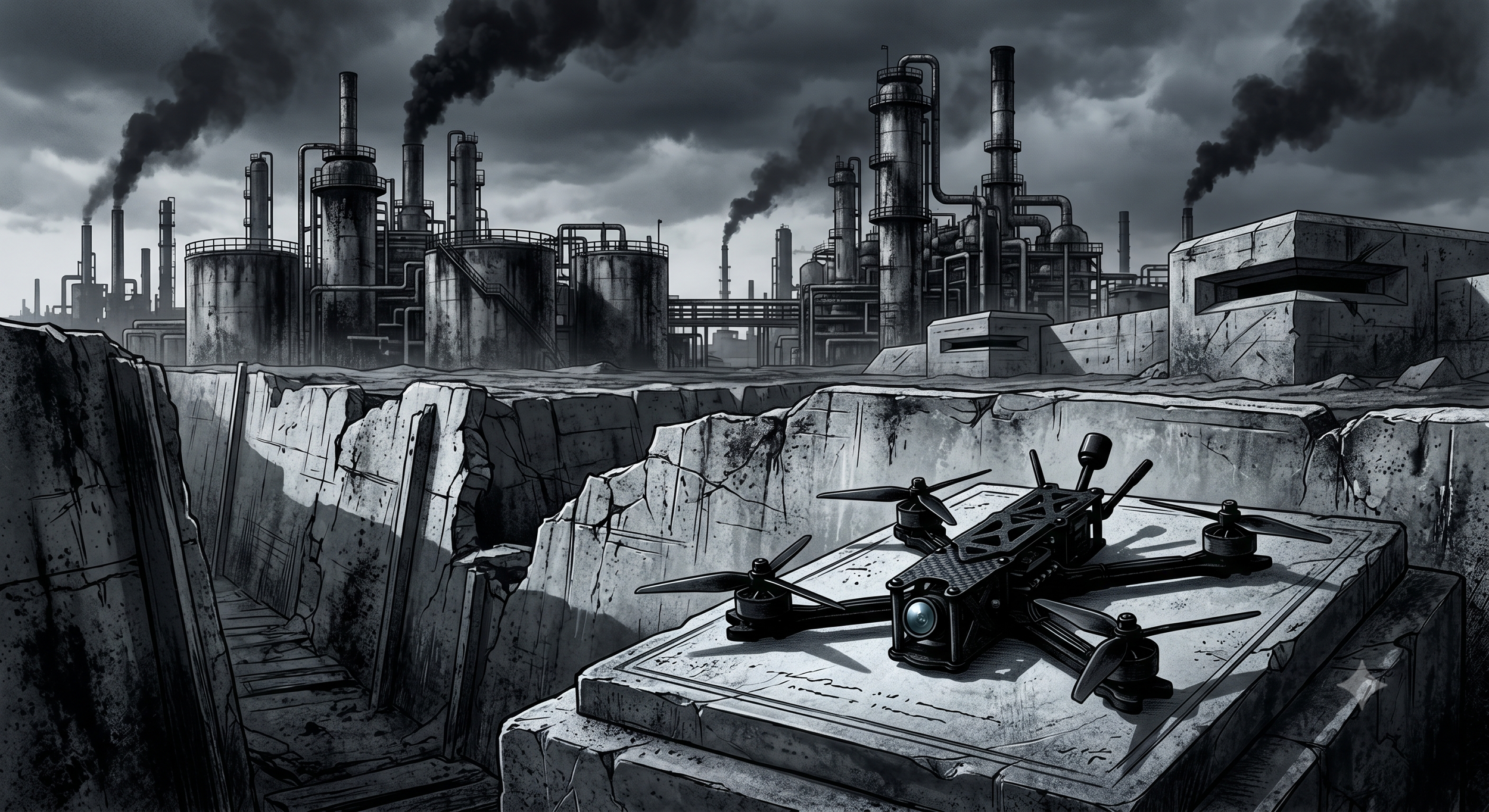
Military strategists like Major General Mick Ryan have documented the rise of the Tactical Lethality Grid. Historically, infantrymen fought within direct-fire rifle range. Today, first-person view (FPV) drones dominate the battlespace up to 15 or 20 kilometers deep, essentially acting as low-cost, precision-guided sniper weapons.
This absolute visibility makes massed armored maneuvers or sudden, sweeping troop breakthroughs impossible. Any vehicle or platoon that exposes itself above ground is instantly targeted and destroyed. Consequently, modern armies are forced into deep, subterranean trench systems that look identical to the mud of 1916, where massive casualties are traded for mere inches of territory.
This high-tech stagnation has completely upended traditional battlefield casualty metrics:
The Historical Baseline: Since World War II, Western military doctrine has operated on a statistical ratio where for every single soldier killed in action (KIA), approximately five to ten are wounded in action (WIA). This was achieved through robust medical evacuation chains and rapid frontline trauma care.
The Inverted Reality: In modern drone-dominated environments, that ratio has completely flipped. Recent disclosures highlight an unprecedented, catastrophic statistic: two deaths for every one soldier wounded.
Catastrophic Precision: Because 80% to 90% of frontline trauma is now caused by vertical, precision drone strikes, the injuries are overwhelmingly catastrophic. Paired with a fractured or non-existent medical evacuation chain on the adversarial side, wounded combatants simply do not survive the field.
The Dictator’s Economic Trap
The final, definitive mechanism prolonging modern conflict isn't found in the armor plating of a missile or the battery life of a drone—it is embedded within the domestic survival strategy of authoritarian leadership.
When a nation transitions its entire domestic architecture onto a war footing, it creates an irreversible economic momentum. Dictatorial regimes often cannot afford to end a war they are losing because a ceasefire poses an immediate, existential threat to their domestic security. The last thing an unstable regime can tolerate is hundreds of thousands of battle-hardened, heavily armed, and psychologically traumatized veterans returning to civilian towns with no employment and an economy hollowed out by international sanctions.
Therefore, keeping the war running indefinitely—even at a cost of thousands of lives per square mile—becomes the safest political option for the madmen at the helm. It keeps the population controlled, keeps dissent labeled as treason, and keeps the military apparatus pointed outward rather than inward toward the palace gates.
The Path Forward: Innovation Over Complacency
As the world watches these prolonged standoffs unfold, the lesson for Western democracies and territorial hubs alike is one of radical, institutional agility. Legacy peacetime bureaucracies that take decades to design, procure, and deploy defense assets are completely obsolete in an era where frontline requirements change overnight.
The future belongs to the societies that refuse to surrender to complacency, those that actively weed out systemic stagnation, and those that innovate at the speed of survival. Whether on a global geopolitical stage or right here on our own sovereign horizons, letting our infrastructure freeze in place while our neighbors adapt is the definitive recipe for long-term irrelevance.