
Trade-War Insurance: How Caribbean Sargassum Could Solve the Global Fertilizer Squeeze
By JOHN McCARTHY / St. Croix Sun News Reporter
As global trade networks fragment, the basic inputs that feed the world are increasingly caught in the crossfire of international conflict. Synthetic fertilizer—long the quiet bedrock of industrial agriculture—has become a casualty of geopolitics. Russia’s ongoing conflict in Ukraine continues to choke traditional Eurasian fertilizer exports, while rising tensions around maritime chokepoints like the Strait of Hormuz threaten vital global supply routes.
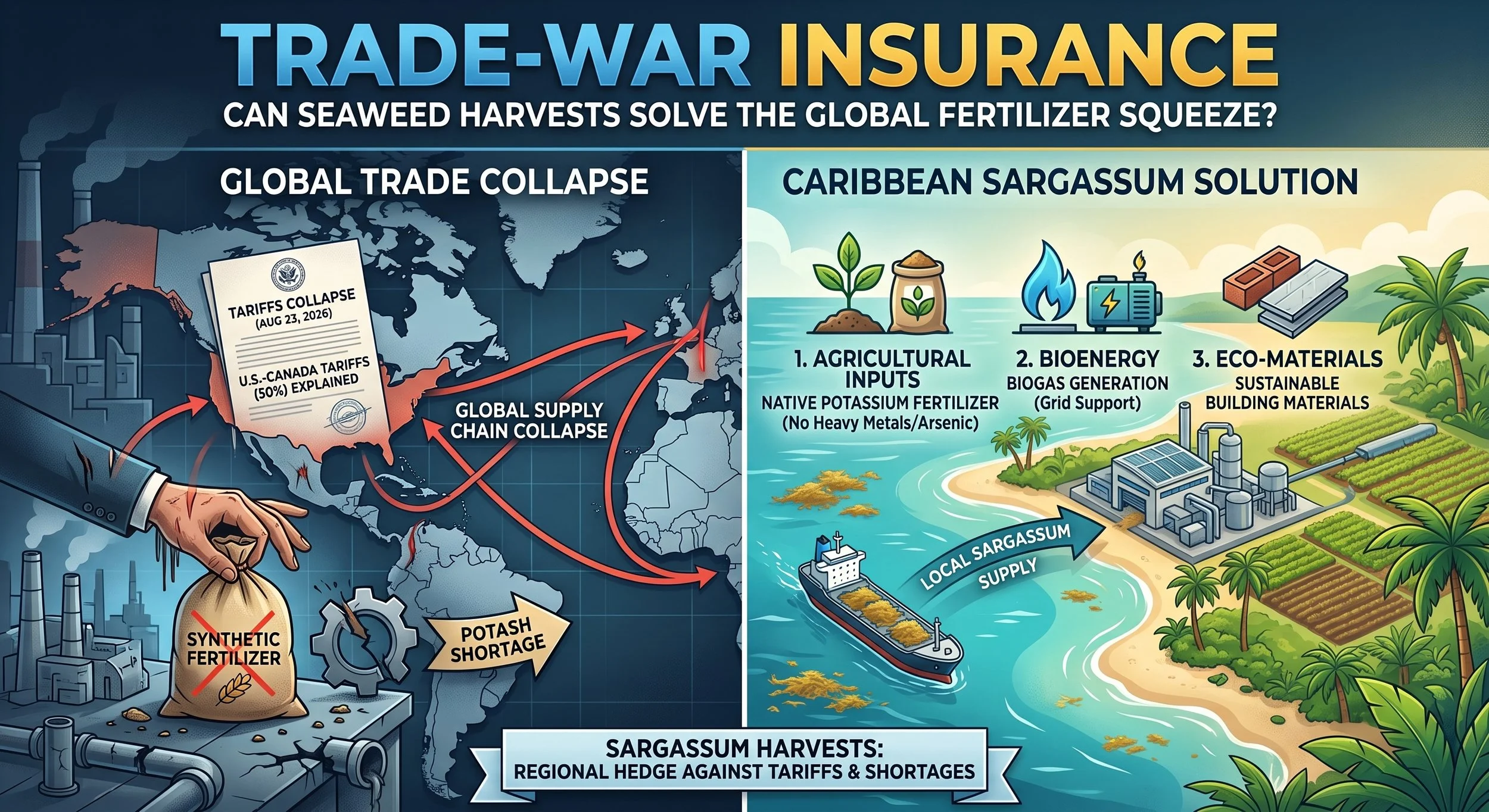
Now, the squeeze is hitting closer to home. Following the collapse of bilateral trade negotiations, the United States enacted 50 percent tariffs on $20 billion worth of Canadian goods. In response, Canadian Prime Minister Mark Carney announced that Ottawa will levy "dollar-for-dollar" retaliatory tariffs starting September 8.
Because Canada supplies roughly 85 percent of the potash used by American agriculture, and Ottawa’s retaliatory list explicitly targets U.S. agricultural machinery and inputs, North American growers are facing a severe dual-cost pressure. For import-dependent regions like the U.S. Virgin Islands and the broader Caribbean, these post-Labor Day tariff spikes translate directly into higher food prices and expensive agricultural imports.
Yet, while North America gets bogged down in retaliatory escalation, the Caribbean is sitting on an un-tariffed, infinite domestic resource that washes onto its beaches every single day: sargassum.
Comparing the Commercial Opportunities
Rather than treating pelagic sargassum strictly as a dead-weight expense for hotel workers and public works crews, regional innovators are recognizing its value as a natural supply-chain hedge.
Agricultural Biostimulants & Soil Inputs: Sargassum is naturally rich in potassium—the core nutrient provided by imported potash. Companies operate processing facilities in Puerto Rico and Mexico that convert harvested seaweed into liquid biostimulants, helping local crops absorb nutrients and build drought resistance without relying on expensive synthetic chemical imports.
Bioenergy & Grid Support (Biomass): Through anaerobic biodigesters, harvested sargassum can be converted into methane and bio-gas. Using the seaweed as energy biomass turns a coastal hazard into a local power source, reducing reliance on imported diesel fuel.
Industrial Materials & Bioplastics: Sargassum can be processed into eco-construction bricks, bio-panels, and carbon-negative plastics, permanently locking away carbon without touching the food supply.
The Processing Hurdle: The Arsenic Factor
Converting raw sargassum into a usable commodity is not as simple as scooping it off the beach and dumping it on local crops. Because pelagic sargassum acts like a natural sponge in open water, it absorbs trace heavy metals—most notably inorganic arsenic. Raw application risks contaminating soil and food crops.
Commercial viability requires localized processing infrastructure capable of rinsing out excess sea salt and extracting heavy metals safely. Furthermore, because raw sargassum is roughly 80 to 90 percent water, initial processing facilities must be situated near coastal landing sites to eliminate prohibitive hauling costs.
The Regional Bottom Line
Caribbean territories spend millions of dollars every year on reactive beach cleanups, hauling tons of organic material straight to landfills. By redirecting those cleanup funds toward regional processing facilities, local governments and private investors can build a self-sustaining industry. Transforming a seasonal ecological nuisance into domestic bio-inputs isn't just an environmental project—it is pure trade-war insurance.
